


Shopping Cart
Remove All Your shopping cart is currently empty


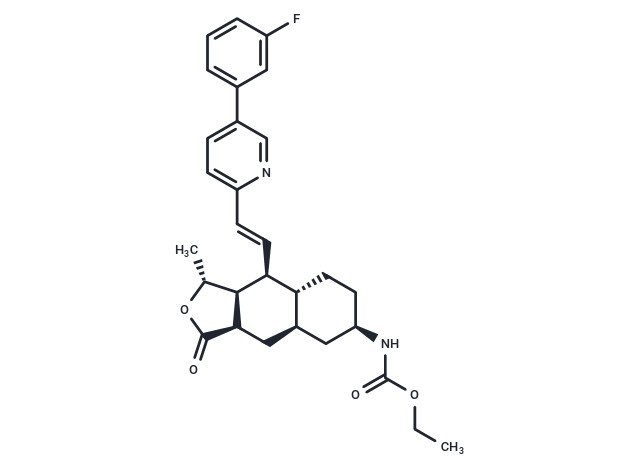
Synonyms: SCH 530348, MK-5348
| Pack Size | Price | USA Stock | Global Stock | Quantity |
|---|---|---|---|---|
| 1 mg | $68 | In Stock | In Stock | |
| 5 mg | $148 | In Stock | In Stock | |
| 10 mg | $213 | In Stock | In Stock | |
| 25 mg | $363 | In Stock | In Stock | |
| 50 mg | $497 | In Stock | In Stock | |
| 100 mg | $713 | In Stock | In Stock | |
| 200 mg | $986 | In Stock | In Stock | |
| 1 mL x 10 mM (in DMSO) | $163 | In Stock | In Stock |
| Description | Vorapaxar (MK-5348) is a selective, orally active, and competitive antagonist of the plasminogen activator receptor (PAR-1) with a Ki value of 8.1 nM. Vorapaxar primarily acts by targeting PAR-1 on the platelet surface to block thrombin-induced platelet activation. Vorapaxar is suitable for use in cardiovascular disease research. |
| Targets & IC50 | PAR1:8.1 nM (Ki) |
| In vitro | Methods: Fluorescent calcium indicator Fluo-3/AM was loaded into hPAR1/CHO-K1 cells. After 10-minute preincubation with Vorapaxar, stimuli were added: FXa (0.03 U/mL), thrombin (0.003 U/mL), or PAR1 agonist SFLLRN-NH₂ (3 nM). Fluorescence intensity changes were monitored in real-time using FLIPR. Results: The Ca²⁺ elevation induced by direct PAR1 activation with SFLLRN-NH₂ was inhibited by Vorapaxar, confirming its antagonistic effect on PAR1. [1] |
| In vivo | Methods: Eight-week-old ApoEko mice (whose platelets do not express PAR1, used to exclude platelet effects) were divided into two groups, both fed a Western diet. The experimental group received feed supplemented with Vorapaxar (10 mg/kg feed), while the control group did not, for a duration of 4 months. Results: The aortic sinus plaque area and overall aortic lipid deposition (Oil Red O staining) were significantly reduced in the Vorapaxar-treated group. [2] Methods: To investigate Vorapaxar's effects on renal function in diabetic nephropathy, male C57BL/6 mice aged 8-12 weeks were intraperitoneally injected with streptozotocin (STZ) (50 mg/kg, for 5 consecutive days) to induce type 1 diabetes. Four weeks after diabetes induction, oral administration of Vorapaxar (1.75 mg/kg) began, twice weekly for 20 weeks. Results: Diabetic mice in the control group exhibited significantly elevated urinary albumin levels. In contrast, diabetic mice treated with Vorapaxar showed no increase in urinary albumin and demonstrated significantly reduced glomerular damage. [3] |
| Synonyms | SCH 530348, MK-5348 |
| Molecular Weight | 492.58 |
| Formula | C29H33FN2O4 |
| Cas No. | 618385-01-6 |
| Smiles | CCOC(=O)N[C@@H]1CC[C@@H]2[C@H](C[C@@H]3[C@@H]([C@@H](C)OC3=O)[C@H]2\C=C\c2ccc(cn2)-c2cccc(F)c2)C1 |
| Relative Density. | 1.24 g/cm3 (Predicted) |
| Storage | Store at low temperature Powder: -20°C for 3 years | In solvent: -80°C for 1 year Shipping with blue ice/Shipping at ambient temperature. | |||||||||||||||||||||||||||||||||||
| Solubility Information | Ethanol: 92 mg/mL (186.77 mM), Sonication is recommended. DMSO: 257.5 mg/mL (522.76 mM), Sonication is recommended.  H2O: < 1 mg/mL (insoluble or slightly soluble) | |||||||||||||||||||||||||||||||||||
| In Vivo Formulation | 10% DMSO+40% PEG300+5% Tween 80+45% Saline: 5 mg/mL (10.15 mM), Sonication is recommended. Please add the solvents sequentially, clarifying the solution as much as possible before adding the next one. Dissolve by heating and/or sonication if necessary. Working solution is recommended to be prepared and used immediately. The formulation provided above is for reference purposes only. In vivo formulations may vary and should be modified based on specific experimental conditions. | |||||||||||||||||||||||||||||||||||
Solution Preparation Table | ||||||||||||||||||||||||||||||||||||
Ethanol/DMSO
Note : The dilution table applies only to solid products. For liquid products, please calculate the stock solution based on the stated concentration and/or density. | ||||||||||||||||||||||||||||||||||||
 For example, if the intended dosage is 10 mg/kg for animals weighing 20 g , with a dosing volume of 100 μL per animal, and a total of 10 animals are to be administered, using a formulation of
  10% DMSO+ 40% PEG300+ 5% Tween 80+ 45% Saline/PBS/ddH2O , the resulting working solution concentration would be 2 mg/mL.
Dissolve 2 mg of the compound in 100 μL DMSO to obtain a stock solution at a concentration of 20 mg/mL . If the required concentration exceeds the compound's known solubility, please contact us for technical support before proceeding.
1) Add 100 μL of the DMSO stock solution to 400 µL PEG300 and mix thoroughly until the solution becomes clear.
2) Add 50 µL Tween 80 and mix well until fully clarified.
3) Add 450 µL Saline,PBS or ddH2O and mix thoroughly until a homogeneous solution is obtained.
| Size | Quantity | Unit Price | Amount | Operation |
|---|
 Feedback
 Hello! How can I help you today?
Copyright © 2015-2026 TargetMol Chemicals Inc. All Rights Reserved.
