


Shopping Cart
Remove All Your shopping cart is currently empty


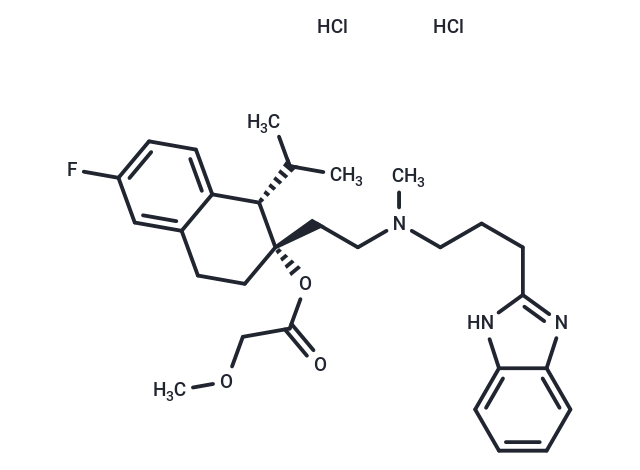
Synonyms: Ro 40-5967 (dihydrochloride)
| Pack Size | Price | USA Stock | Global Stock | Quantity |
|---|---|---|---|---|
| 1 mg | $64 | In Stock | In Stock | |
| 5 mg | $156 | In Stock | In Stock | |
| 10 mg | $256 | In Stock | - | |
| 25 mg | $539 | In Stock | - |
| Description | Mibefradil dihydrochloride (Ro 40-5967 (dihydrochloride)) is an blocker of calcium channel with moderate selectivity for T-type Ca2+ channels (T-type and L-type currents with IC50s of 2.7 μM and 18.6 μM, respectively). |
| Targets & IC50 | Ca2+ channel, T-type:2.7 μM , Ca2+ channel, L-type:18.6 μM |
| In vitro | Mibefradil dihydrochloride inhibits reversibly the T- and L-type currents with IC50 values of 2.7 and 18.6 μM, respectively.[1].Mibefradil inhibited Orai1, Orai2, and Orai3 currents dose-dependently. The IC50 for Orai1, Orai2, and Orai3 channels was 52.6, 14.1, and 3.8 μM respectively. Outside-out patch demonstrated that perfusion of 10-μM mibefradil to the extracellular surface completely blocked Orai3 currents and single channel activity evoked by 2-APB. Intracellular application of mibefradil did not alter Orai3 channel activity. Mibefradil at higher concentrations (>50 μM) inhibited Ca2+ release but had no effect on cytosolic STIM1 translocation evoked by thapsigargin. Inhibition on Orai channels by mibefradil was structure-related, as other T-type Ca2+ channel blockers with different structures, such as ethosuximide and ML218, had no or minimal effects on Orai channels. Moreover, mibefradil inhibited cell proliferation, induced apoptosis, and arrested cell cycle progression[3]. |
| In vivo | Compared with the saline-treated group, rats receiving Mibefradil or Ethosuximide show significant lower CaV3.2 expression in the spinal cord and DRG. |
| Synonyms | Ro 40-5967 (dihydrochloride) |
| Cell Research | Human Orai1-3 cDNAs in tetracycline-regulated pcDNA4/TO vectors were transfected into HEK293 T-REx cells with stromal interaction molecule 1 (STIM1) stable expression. The Orai currents were recorded by whole-cell and excised-membrane patch clamp. Ca2+?influx or release was measured by Fura-PE3/AM. Cell growth and death were monitored by WST-1, LDH assays and flow cytometry[3]. |
| Molecular Weight | 568.55 |
| Formula | C29H40Cl2FN3O3 |
| Cas No. | 116666-63-8 |
| Smiles | Cl.Cl.COCC(=O)O[C@]1(CCN(C)CCCc2nc3ccccc3[nH]2)CCc2cc(F)ccc2[C@@H]1C(C)C |
| Relative Density. | no data available |
| Storage | Keep away from moisture Powder: -20°C for 3 years | In solvent: -80°C for 1 year Shipping with blue ice/Shipping at ambient temperature. | |||||||||||||||||||||||||||||||||||
| Solubility Information | H2O: 122 mg/mL (214.58 mM), Sonication is recommended. | |||||||||||||||||||||||||||||||||||
Solution Preparation Table | ||||||||||||||||||||||||||||||||||||
H2O
Note : The dilution table applies only to solid products. For liquid products, please calculate the stock solution based on the stated concentration and/or density. | ||||||||||||||||||||||||||||||||||||
 For example, if the intended dosage is 10 mg/kg for animals weighing 20 g , with a dosing volume of 100 μL per animal, and a total of 10 animals are to be administered, using a formulation of
  10% DMSO+ 40% PEG300+ 5% Tween 80+ 45% Saline/PBS/ddH2O , the resulting working solution concentration would be 2 mg/mL.
Dissolve 2 mg of the compound in 100 μL DMSO to obtain a stock solution at a concentration of 20 mg/mL . If the required concentration exceeds the compound's known solubility, please contact us for technical support before proceeding.
1) Add 100 μL of the DMSO stock solution to 400 µL PEG300 and mix thoroughly until the solution becomes clear.
2) Add 50 µL Tween 80 and mix well until fully clarified.
3) Add 450 µL Saline,PBS or ddH2O and mix thoroughly until a homogeneous solution is obtained.
| Size | Quantity | Unit Price | Amount | Operation |
|---|
 Feedback
 Hello! How can I help you today?
Copyright © 2015-2026 TargetMol Chemicals Inc. All Rights Reserved.
