


Shopping Cart
Remove All Your shopping cart is currently empty


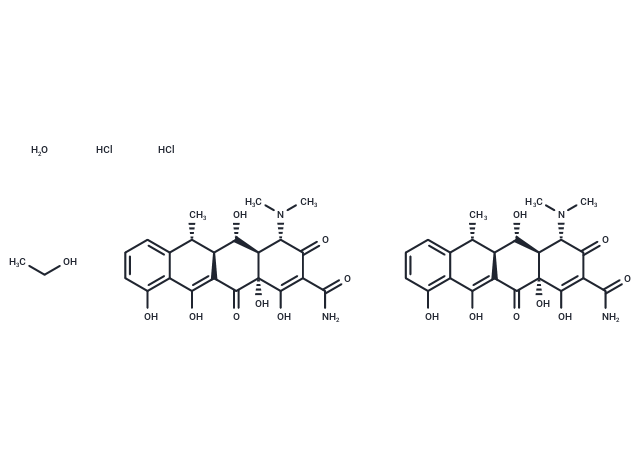
Synonyms: WC2031, Doxycycline hydrochloride hemiethanolate hemihydrate, Doxycycline hyclate
| Pack Size | Price | USA Stock | Global Stock | Quantity |
|---|---|---|---|---|
| 100 mg | $41 | In Stock | In Stock | |
| 1 g | $48 | In Stock | In Stock |
| Description | Doxycycline (hyclate) is an orally active tetracycline antibiotic with broad-spectrum inhibitory activity against matrix metalloproteinases (MMPs), possessing both antibacterial and antitumor properties, and is commonly used in inducible gene expression ON-OFF systems. |
| Targets & IC50 | A549 cells:1.06 μM, chlamydial isolates:0.497 μg/mL, NCI-H446 cells:1.70 μM, Pancreatic Cancer cells (72 h):99.64 μM, Pancreatic Cancer cells (48 h):987.5 μM, Pancreatic Cancer cells (96 h):50.02 μM |
| In vitro | METHODS: Twenty-two tumor cells were treated with Doxycycline for 48 h. Cell viability was measured by MTT. RESULTS: Lung cancer cells were more sensitive to Doxycycline than most other cell lines. NCI-H446 and A549 cells were sensitive to Doxycycline with IC50s of 1.70 μM and 1.06 μM, respectively. [1] METHODS: Human pancreatic cancer cells PANC-1 were treated with Doxycycline (10-40 μg/mL) for 8-24 h. The cell cycle was detected by Flow Cytometry. RESULTS: Doxycycline caused the cells to arrest in the G1-S phase of the cell cycle. [2] |
| In vivo | METHODS: To detect anti-tumor activity in vivo, Doxycycline (50 mg/kg) was administered intraperitoneally once daily for fifteen days to BALB/c mice harboring human mammary carcinoma tumor 4T1. RESULTS: Doxycycline delayed tumor growth and reduced the number of tumor-associated macrophages and blood vessels. [3] METHODS: To assay antimicrobial activity in vivo, Doxycycline (40 mg/kg) was administered intraperitoneally to BALB/c mice exposed to B. pseudomallei 1026b twice daily for two weeks. RESULTS: Doxycycline-treated mice survived 100% of the time, and no B. pseudomallei DNA was amplified from the lungs or spleens of the majority of the surviving mice. [4] |
| Synonyms | WC2031, Doxycycline hydrochloride hemiethanolate hemihydrate, Doxycycline hyclate |
| Disease Modeling Protocol | Lung airway-specific genetically engineered disease model
*Precautions: In all experiments, mice were killed within 24 hours after final inhalation for transgene expression analysis. |
| Kinase Assay | Gelatin (0.1% (w/v) is added to standard LaemmLi acrylamide polymerization mixture. Tissue extract is mixed 1:2 with sample buffer [250 mM Tris-Cl pH 6.8, 10% (w/v) SDS, 20% (v/v) glycerol, 0.005% (w/v) bromphenol blue]. Serum is diluted 1:10 with electrophoresis buffer (2.5 mM Tris, 20 mM glycine, 0.005% SDS) and mixed 1:2 with sample buffer. Twenty μLs are loaded after 10-min incubation at room temperature without boiling. After electrophoresis at 90 V, the gels are soaked in 2.5% (w/v) Triton X-100, incubated 2 to 3 days at 37°C in gelatin digestion buffer [50 mM Tris-Cl, pH 8.0, 8 mM CaCl2, 10 mM ZnSO2, 0.02% (w/v) NaN3], stained in 0.05% Coomassie blue R-250 in acetic acid/methanol/water (1:4.5:4.5 by volume), destained in 10% acetic acid and 5% methanol, and scanned for lysis band intensity. The lysis band intensity is proportional to gelatinase activity and is quantified densitometrically by using One-Dimensional Scan software. The result, a number between 0.07 and 3.75, is normalized to the protein content by dividing the densitometry result with the relative optical density from the BCA protein assay kit result. The result is used for the analysis as the arbitrary unit. For the total MMP activity results of lysis bands of pro-MMP-9, active MMP-9, pro-MMP-2, and active MMP-2 are added. A protein size marker is used to determine the correct size. |
| Cell Research | Doxycycline is diluted in culture medium at a concentration of 10 μg/mL. All in vitro treatments are performed in SMC cultures at 90% confluence, when ECM synthesis in SMC starts to be evident. Doxycycline (20 nM) is diluted in culture medium at a concentration of 10 μg/mL (20 nM), at which no toxicity or variation in primary cultured SMC proliferation has been reported, as well as in other cell lines and the incubation time is 48 h. SMC-C and SMC-Ch are seeded at equal cell density in 6-well plates and, when confluence reaches 90%, 1 mL culture medium is added to each well containing 3.7×10⁴?Bq L-[5-3H]-proline (9.62×10¹¹ Bq/mmol). After 48?h incubation, cells are lysed with 0.5 mL 0.5 mol/L NaOH for 1 h. The resulting solution is neutralized with an equal amount of 0.5 mol/L HCl, and 50 μL are used to measure total proteins with the Bradford method. One volume of 10% TCA is added to the remaining 250 μL and centrifuged at 13,000 g for 15?min at 4°C. The resulting precipitate is dissolved in 100 μL 0.2 mol/L NaOH, and then neutralized with 1 mol/L HCl. The solution is incubated with collagenase buffer (Tris-HCl, pH 7.6 20 mM, and CaCl2 250 mM final concentration) and 10 units of collagenase at 37°C overnight. Then, 150 μL 10% TCA are added and centrifuged at 13000 g for 15?min at 4°C. The resulting supernatant is added to 4 mL of scintillation fluid and the radioactivity is measured in a liquid scintillation counter LS 600 TA. |
| Molecular Weight | 512.90 |
| Formula | C22H24N2O8·HCl·1/2C2H6O·1/2H2O |
| Cas No. | 24390-14-5 |
| Smiles | O.Cl.Cl.CCO.C[C@@H]1[C@H]2[C@H](O)[C@H]3[C@H](N(C)C)C(=O)C(C(N)=O)=C(O)[C@@]3(O)C(=O)C2=C(O)c2c(O)cccc12.C[C@@H]1[C@H]2[C@H](O)[C@H]3[C@H](N(C)C)C(=O)C(C(N)=O)=C(O)[C@@]3(O)C(=O)C2=C(O)c2c(O)cccc12 |
| Relative Density. | no data available |
| Storage | Powder: -20°C for 3 years | In solvent: -80°C for 1 year Shipping with blue ice/Shipping at ambient temperature. | ||||||||||||||||||||||||||||||||||||||||
| Solubility Information | H2O: 13.89 mg/mL (27.08 mM), Sonication is recommended. DMSO: 250 mg/mL (487.42 mM), Sonication is recommended.  | ||||||||||||||||||||||||||||||||||||||||
Solution Preparation Table | |||||||||||||||||||||||||||||||||||||||||
H2O/DMSO
DMSO
Note : The dilution table applies only to solid products. For liquid products, please calculate the stock solution based on the stated concentration and/or density. | |||||||||||||||||||||||||||||||||||||||||
 For example, if the intended dosage is 10 mg/kg for animals weighing 20 g , with a dosing volume of 100 μL per animal, and a total of 10 animals are to be administered, using a formulation of
  10% DMSO+ 40% PEG300+ 5% Tween 80+ 45% Saline/PBS/ddH2O , the resulting working solution concentration would be 2 mg/mL.
Dissolve 2 mg of the compound in 100 μL DMSO to obtain a stock solution at a concentration of 20 mg/mL . If the required concentration exceeds the compound's known solubility, please contact us for technical support before proceeding.
1) Add 100 μL of the DMSO stock solution to 400 µL PEG300 and mix thoroughly until the solution becomes clear.
2) Add 50 µL Tween 80 and mix well until fully clarified.
3) Add 450 µL Saline,PBS or ddH2O and mix thoroughly until a homogeneous solution is obtained.
| Size | Quantity | Unit Price | Amount | Operation |
|---|
 Feedback
 Hello! How can I help you today?
Copyright © 2015-2026 TargetMol Chemicals Inc. All Rights Reserved.
