


Shopping Cart
Remove All Your shopping cart is currently empty

Synonyms:

| Pack Size | Price | USA Stock | Global Stock | Quantity |
|---|---|---|---|---|
| 2 mg | $30 | In Stock | In Stock | |
| 5 mg | $47 | In Stock | In Stock | |
| 10 mg | $76 | In Stock | In Stock | |
| 25 mg | $139 | In Stock | In Stock | |
| 50 mg | $208 | In Stock | In Stock | |
| 100 mg | $297 | - | In Stock | |
| 200 mg | $442 | - | In Stock | |
| 1 mL x 10 mM (in DMSO) | $52 | In Stock | In Stock |
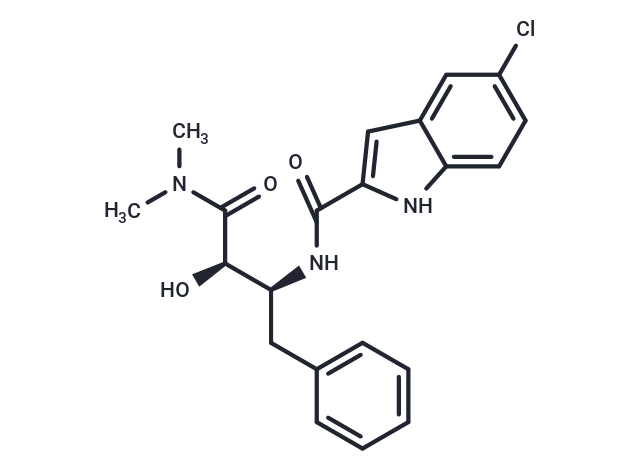
| Description | CP-91149 is a selective glycogen phosphorylase (GP) inhibitor with IC50 of 0.13 μM in the presence of glucose, 5- to 10-fold less potent in the absence of glucose. |
| Targets & IC50 | GP:0.13 μM |
| In vitro | CP-91149 displays 200-fold higher inhibitory activity against human liver glycogen phosphorylase a (HLGPa) than caffeine (IC50 = 26 μM). CP-91149 (10-100 μM) inhibits glucagon-stimulated glycogenolysis in isolated rat hepatocytes in a dose-dependent manner, and in primary human hepatocytes with IC50 of ~2.1 μM. [1] CP-91149 also potently inhibits the activities of human muscle phosphorylase a and b with IC50 of 0.2 μM and ~0.3 μM, respectively. CP-91149 treatment at 2.5 μM induces inactivation of phosphorylase and sequential activation of glycogen synthase in hepatocytes, and increases glycogen synthesis by 7-fold at 5 mM glucose and by 2-fold at 20 mM glucose. CP-91149 can partially counteract the effects of phosphorylase overexpression. [2] CP-91149 also potently inhibits brain GP with IC50 of 0.5 μM in A549 cells. CP-91149 treatment at 10-30 μM causes significant glycogen accumulation in A549 and HSF55 cells. CP-91149 treatment increases G1-phase cells with a significant reduction of the S-phase population in HSF55 cells, correlated with increased expression of p21 and p27. [3] CP-91149 also promotes the dephosphorylation and activation of GS (glycogen synthase) in non-engineered or GP-overexpressing cultured human muscle cells, but exclusively in glucose-deprived cells. [4] |
| In vivo | Oral administration of CP-91149 to diabetic ob/ob mice at 25-50 mg/kg causes rapid (3 hours) glucose lowering by 100-120 mg/dl without producing hypoglycemia, resulting from inhibition of glycogenolysis in vivo. CP-91149 treatment does not lower glucose levels in normoglycemic, nondiabetic mice. [1] In the non-fasted Goto-Kakizaki (GK) rats, administration of CP-91149 in combination with CS-917 suppresses hepatic glycogen reduction by CS-917 and decreases plasma glucose more than single administration of CS-917. [5] |
| Kinase Assay | Phosphorylase enzyme assay: Human liver glycogen phosphorylase a (HLGPa, 85 ng) activity is measured in the direction of glycogen synthesis by the release of phosphate from glucose-1-phosphate at 22°C in 100 μL of buffer containing 50 mM Hepes (pH 7.2), 100 mM KCl, 2.5 mM EGTA, 2.5 mM MgCl2, 0.5 mM glucose-1-phosphate, and 1 mg/mL glycogen. Phosphate is measured at 620 nm, 20 minutes after the addition of 150 μL of 1 M HCl containing 10 mg/mL ammonium molybdate and 0.38 mg/mL malachite green. Increasing concentrations of CP-91149 are added to the assay in 5 μL of 14% DMSO. |
| Cell Research | Cells are exposed to various concentrations of CP-91149 for 72hours. Viability is determined with manual cell counts following staining with trypan blue exclusion assay. Cells are fixed with 70% ethanol. DNA is stained with propidium iodide and the intensity of fluorescence is measured using a Becton-Dickinson flow cytometer at 488 nM for excitation and at 650 nM for emission. The cell cycle profile is analyzed using Modifit's Sync Wizard.(Only for Reference) |
| Molecular Weight | 399.87 |
| Formula | C21H22ClN3O3 |
| Cas No. | 186392-40-5 |
| Smiles | CN(C)C(=O)[C@H](O)[C@H](Cc1ccccc1)NC(=O)c1cc2cc(Cl)ccc2[nH]1 |
| Relative Density. | no data available |
| Storage | Powder: -20°C for 3 years | In solvent: -80°C for 1 year Shipping with blue ice/Shipping at ambient temperature. | |||||||||||||||||||||||||||||||||||
| Solubility Information | Ethanol: < 1 mg/mL (insoluble or slightly soluble) H2O: < 1 mg/mL (insoluble or slightly soluble) DMSO: 250 mg/mL (625.2 mM), Sonication is recommended.  | |||||||||||||||||||||||||||||||||||
| In Vivo Formulation | 10% DMSO+40% PEG300+5% Tween 80+45% Saline: 10 mg/mL (25.01 mM), Solution. 10% DMSO+90% Saline: < 10 mg/mL (25.01 mM), Lower concentrations may be soluble, but exact solubility limit is unknown. Please add the solvents sequentially, clarifying the solution as much as possible before adding the next one. Dissolve by heating and/or sonication if necessary. Working solution is recommended to be prepared and used immediately. The formulation provided above is for reference purposes only. In vivo formulations may vary and should be modified based on specific experimental conditions. | |||||||||||||||||||||||||||||||||||
Solution Preparation Table | ||||||||||||||||||||||||||||||||||||
DMSO
Note : The dilution table applies only to solid products. For liquid products, please calculate the stock solution based on the stated concentration and/or density. | ||||||||||||||||||||||||||||||||||||
 For example, if the intended dosage is 10 mg/kg for animals weighing 20 g , with a dosing volume of 100 μL per animal, and a total of 10 animals are to be administered, using a formulation of
  10% DMSO+ 40% PEG300+ 5% Tween 80+ 45% Saline/PBS/ddH2O , the resulting working solution concentration would be 2 mg/mL.
Dissolve 2 mg of the compound in 100 μL DMSO to obtain a stock solution at a concentration of 20 mg/mL . If the required concentration exceeds the compound's known solubility, please contact us for technical support before proceeding.
1) Add 100 μL of the DMSO stock solution to 400 µL PEG300 and mix thoroughly until the solution becomes clear.
2) Add 50 µL Tween 80 and mix well until fully clarified.
3) Add 450 µL Saline,PBS or ddH2O and mix thoroughly until a homogeneous solution is obtained.
| Size | Quantity | Unit Price | Amount | Operation |
|---|
 Feedback
 Hello! How can I help you today?
Copyright © 2015-2026 TargetMol Chemicals Inc. All Rights Reserved.
