


Shopping Cart
Remove All Your shopping cart is currently empty

Synonyms:
| Pack Size | Price | USA Stock | Global Stock | Quantity |
|---|---|---|---|---|
| 5 mg | $45 | In Stock | In Stock | |
| 10 mg | $61 | In Stock | In Stock | |
| 50 mg | $215 | - | In Stock | |
| 100 mg | $369 | - | In Stock |
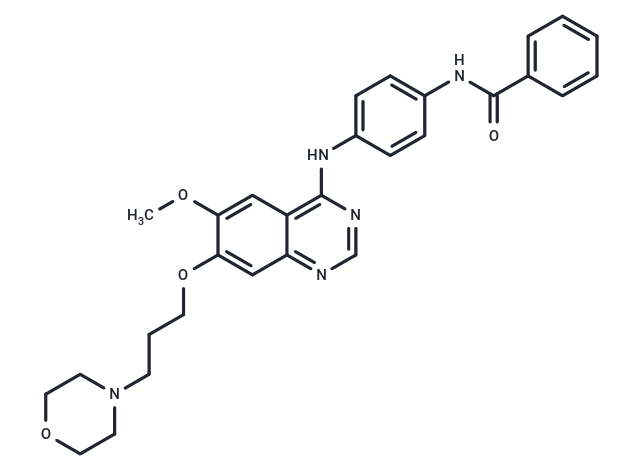
| Description | ZM 447439 is a selective and ATP-competitive inhibitor for Aurora A and Aurora B with IC50 of 110 nM and 130 nM, respectively. It is more than 8-fold selective for Aurora A/B than MEK1, Src, Lck and has little effect against CDK1/2/4, Plk1, Chk1, etc. |
| Targets & IC50 | Aurora B:130 nM, Aurora A:110 nM |
| In vitro | In vitro, ZM-447439 selectively inhibits recombinant human Aurora A and B with IC50 values of 110 and 130 nM, respectively, while other protein kinases of diverse structural types including the mitotic kinases CDK1 and PLK1 are inhibited with IC50 values >10 μM. [1] Aurora kinase inhibitor, ZM-447439 time- and dose-dependently inhibits the growth of all three cell lines with IC50 values of 3 μM (BON), 0.9 μM (QGP-1) and 3 μM (MIP-101) after 72 hours of continuous exposure. In addition, ZM-447439 potently induces cell apoptosis by promoting DNA fragmentation and caspase 3 and 7 activation, and arrests GEP-NET cells in the G0 /G1and G2/M phase of the cell cycle. [2] In mouse embryo, inhibition of Aurora kinase activity by ZM-447439 results in abnormalities during mitosis by regulating the phosphorylation of histone H3 serine 10 (H3S10Ph) from G2 to metaphase with different perturbations in each embryonic cycle. [3] A recent study shows that ZM-447439 exhibits growth inhibitory and proapoptotic effect on cervical cancer SiHa cells, and enhances the chemosensitivity to cisplatin. [4] |
| Kinase Assay | In vitro kinase assays : Recombinant Aurora A and B are expressed as NH2-terminal His6-tagged fusion proteins using a baculovirus expression system. Aurora A is purified by affinity chromatography using Ni-NTA agarose, and Aurora B is purified by ion exchange chromatography using CM Sepharose Fast Flow. 1 ng purified recombinant enzyme is added to a reaction cocktail containing 25 mM Tris-HCl, pH 7.5, 12.5 mM KCl, 2.5 mM NaF, 0.6 mM DTT, 6.25 mM MnCl2, 10 μM peptide substrate, 10 μM for Aurora A or 5 μM ATP for Aurora B, and 0.2 μCi γ-[33P]ATP (specific activity ≥2,500 Ci/mmol), and is then incubated at RT for 60 minutes. Reactions are stopped by addition of 20% phosphoric acid, and the products are captured on P30 nitrocellulose filters and assayed for incorporation of 33P with a BetaplateTM counter. No enzyme and no compound control values are used to determine the concentration of ZM447439, which gave 50% inhibition of enzyme activity. Further details are available on request from Nicholas Keen. |
| Cell Research | Cell number is evaluated by crystal violet staining. In brief, cells in 96-well plates are fixed with 1% glutaraldehyde. Then cells are stained with 0.1% crystal violet. The unbound dye is removed by washing with water. Bound crystal violet is solubilized with 0.2% Triton X-100. Light extinction which increases linearly with the cell number is analyzed at 570 nm using an ELISA reader.(Only for Reference) |
| Molecular Weight | 513.59 |
| Formula | C29H31N5O4 |
| Cas No. | 331771-20-1 |
| Smiles | COc1cc2c(Nc3ccc(NC(=O)c4ccccc4)cc3)ncnc2cc1OCCCN1CCOCC1 |
| Relative Density. | 1.282 g/cm3 |
| Storage | Powder: -20°C for 3 years | In solvent: -80°C for 1 year Shipping with blue ice/Shipping at ambient temperature. | |||||||||||||||||||||||||
| Solubility Information | DMSO: 16.7 mg/mL (32.52 mM), Sonication is recommended.  | |||||||||||||||||||||||||
| In Vivo Formulation | 10% DMSO+90% Saline: 1.67 mg/mL (3.25 mM), Suspension. 10% DMSO+40% PEG300+5% Tween 80+45% Saline: 1 mg/mL (1.95 mM), Sonication is recommended. Please add the solvents sequentially, clarifying the solution as much as possible before adding the next one. Dissolve by heating and/or sonication if necessary. Working solution is recommended to be prepared and used immediately. The formulation provided above is for reference purposes only. In vivo formulations may vary and should be modified based on specific experimental conditions. | |||||||||||||||||||||||||
Solution Preparation Table | ||||||||||||||||||||||||||
DMSO
Note : The dilution table applies only to solid products. For liquid products, please calculate the stock solution based on the stated concentration and/or density. | ||||||||||||||||||||||||||
 For example, if the intended dosage is 10 mg/kg for animals weighing 20 g , with a dosing volume of 100 μL per animal, and a total of 10 animals are to be administered, using a formulation of
  10% DMSO+ 40% PEG300+ 5% Tween 80+ 45% Saline/PBS/ddH2O , the resulting working solution concentration would be 2 mg/mL.
Dissolve 2 mg of the compound in 100 μL DMSO to obtain a stock solution at a concentration of 20 mg/mL . If the required concentration exceeds the compound's known solubility, please contact us for technical support before proceeding.
1) Add 100 μL of the DMSO stock solution to 400 µL PEG300 and mix thoroughly until the solution becomes clear.
2) Add 50 µL Tween 80 and mix well until fully clarified.
3) Add 450 µL Saline,PBS or ddH2O and mix thoroughly until a homogeneous solution is obtained.
| Size | Quantity | Unit Price | Amount | Operation |
|---|
 Feedback
 Hello! How can I help you today?
Copyright © 2015-2026 TargetMol Chemicals Inc. All Rights Reserved.
