


Shopping Cart
Remove All Your shopping cart is currently empty

Synonyms: OM-1563
| Pack Size | Price | USA Stock | Global Stock | Quantity |
|---|---|---|---|---|
| 500 mg | $35 | In Stock | In Stock | |
| 1 g | $47 | In Stock | In Stock | |
| 5 g | $77 | - | In Stock | |
| 1 mL x 10 mM (in DMSO) | $48 | In Stock | In Stock |
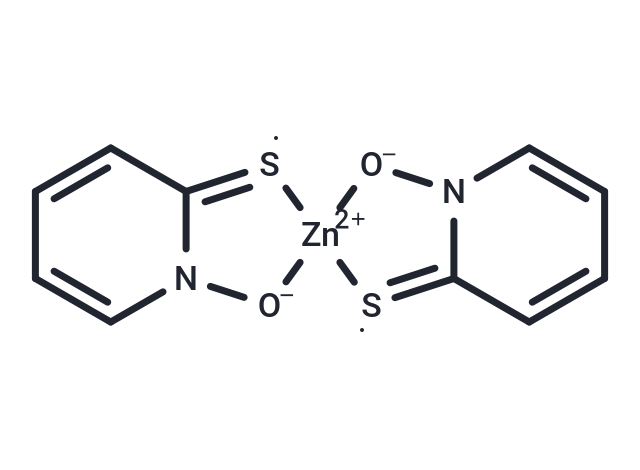
| Description | Zinc pyrithione (OM-1563), an antibacterial and antifungal agent can disrupt membrane transport by blocking the proton pump. |
| In vitro | In exposed mussel tissues, Zinc pyrithione accumulates rapidly, with the rate of accumulation being proportional to both exposure concentration and time. Despite a 7-day LC50 (lethal concentration for 50% of the population) of 8.27 μM in relatively higher concentrations of Zinc pyrithione, this indicates a potential threat to coastal ecosystems and marine life, necessitating further investigation into its sub-lethal biological effects. |
| In vivo | As a specific synthetic potentiator, Zinc pyrithione activates homotypic and heterotypic M channels by inducing a resting potential. It is considered a zinc complex. The Pyrithione ligand (formally a monoanion) chelates with Zn2+ through oxygen and iron-sulfur centers. In the crystalline state, Zinc pyrithione exists as a centrosymmetric dimer, with each zinc atom coordinated to two sulfur and three oxygen centers. However, in solution, the dimers dissociate through the cleavage of zinc-oxygen bonds. Although Zinc pyrithione is a dimer, its activity causing cytoplasmic membrane depolarization may originate from the monomer, with an effective concentration for half-maximum effect (K1/2) of approximately 0.3 mM. |
| Synonyms | OM-1563 |
| Molecular Weight | 317.71 |
| Formula | C10H8N2O2S2Zn |
| Cas No. | 13463-41-7 |
| Smiles | [O-]1N2C=CC=CC2=[S][Zn+2]13[O-]N4C=CC=CC4=[S]3 |
| Relative Density. | 1.782 g/cm3 at 25℃ |
| Storage | Powder: -20°C for 3 years | In solvent: -80°C for 1 year Shipping with blue ice/Shipping at ambient temperature. | |||||||||||||||||||||||||||||||||||
| Solubility Information | Ethanol: < 1 mg/mL (insoluble or slightly soluble) DMSO: 33 mg/mL (103.87 mM), Sonication and heating are recommended.  | |||||||||||||||||||||||||||||||||||
| In Vivo Formulation | 10% DMSO+90% Corn Oil: 2 mg/mL (6.3 mM), Sonication is recommended. Please add the solvents sequentially, clarifying the solution as much as possible before adding the next one. Dissolve by heating and/or sonication if necessary. Working solution is recommended to be prepared and used immediately. The formulation provided above is for reference purposes only. In vivo formulations may vary and should be modified based on specific experimental conditions. | |||||||||||||||||||||||||||||||||||
Solution Preparation Table | ||||||||||||||||||||||||||||||||||||
DMSO
Note : The dilution table applies only to solid products. For liquid products, please calculate the stock solution based on the stated concentration and/or density. | ||||||||||||||||||||||||||||||||||||
 For example, if the intended dosage is 10 mg/kg for animals weighing 20 g , with a dosing volume of 100 μL per animal, and a total of 10 animals are to be administered, using a formulation of
  10% DMSO+ 40% PEG300+ 5% Tween 80+ 45% Saline/PBS/ddH2O , the resulting working solution concentration would be 2 mg/mL.
Dissolve 2 mg of the compound in 100 μL DMSO to obtain a stock solution at a concentration of 20 mg/mL . If the required concentration exceeds the compound's known solubility, please contact us for technical support before proceeding.
1) Add 100 μL of the DMSO stock solution to 400 µL PEG300 and mix thoroughly until the solution becomes clear.
2) Add 50 µL Tween 80 and mix well until fully clarified.
3) Add 450 µL Saline,PBS or ddH2O and mix thoroughly until a homogeneous solution is obtained.
| Size | Quantity | Unit Price | Amount | Operation |
|---|
 Feedback
 Hello! How can I help you today?
Copyright © 2015-2026 TargetMol Chemicals Inc. All Rights Reserved.
