


Shopping Cart
Remove All Your shopping cart is currently empty


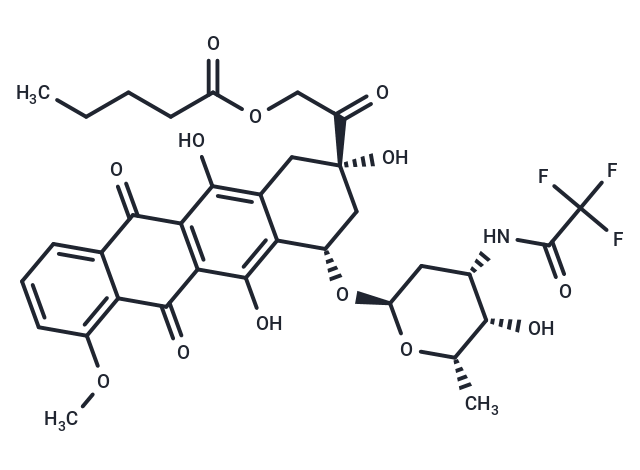
Synonyms: Valstar, AD-32
| Pack Size | Price | USA Stock | Global Stock | Quantity |
|---|---|---|---|---|
| 1 mg | $39 | In Stock | In Stock | |
| 5 mg | $89 | In Stock | In Stock | |
| 10 mg | $143 | In Stock | In Stock | |
| 25 mg | $253 | In Stock | In Stock | |
| 50 mg | $388 | In Stock | In Stock | |
| 100 mg | $538 | In Stock | In Stock | |
| 1 mL x 10 mM (in DMSO) | $143 | In Stock | In Stock |
| Description | Valrubicin (AD-32) (AD 32) inhibits TPA- and PDBu-induced PKC activation (IC50s: 0.85 and 1.25 μM) and has antitumor and anti-inflammatory activity. |
| Targets & IC50 | PKC (TPA-activated):0.85 μM, PKC (PDBu-induced):1.25 μM |
| In vitro | Valrubicin inhibits the binding of [3H]PDBu to PKC. Therefore, Valrubicin competes with the tumor promoter for the PKC binding site and prevents the latter from both interacting with the phospholipid and binding to PKC [1]. Valrubicin shows cytotoxic activity against squamous cell carcinoma (SCC) cell line colony formation, with IC50s and IC90s of 8.24 μM and 14.81 μM for UMSCC5 cells, 15.90 μM, 29.84 μM for UMSCC5/CDDP? cells, and 10.50 μM, 19.00 μM for UMSCC10b cells, respectively [2]. |
| In vivo | Valrubicin, administered at doses of 3, 6, or 9 mg, effectively reduces tumor growth through intratumoral injections in hamsters by the third week. When 6 mg of Valrubicin is used in conjunction with minimally cytotoxic irradiation (ranging from 150, 250, or 350 cGy), it induces significant tumor shrinkage in the hamster model [2]. Additionally, at a concentration of 0.1 μg/μL, Valrubicin markedly decreases the infiltration of neutrophils in TPA-challenged biopsies at 24 hours and mitigates chronic inflammation in mice. Furthermore, Valrubicin reduces the expression of inflammatory cytokines in the acute experimental setup [3]. |
| Synonyms | Valstar, AD-32 |
| Cell Research | UMSCC5 cells exposed to Valrubicin (2 μM for 3 h), a single dose of radiation (400 cGy), or the combined treatment are cultured for a further 12, 24, or 48 hours. At these times, the cells are collected by trypsinization (0.25%), washed in PBS, and fixed at 5 × 10^6 cells/mL with 95% ethanol. Cells are incubated with ribonuclease (50 μg; 70-90 Kunitz units/mg for 30 min), and the resulting pellet resuspended in and incubated with propidium iodide (0.05 mg/mL for 10 min). The DNA content of the samples is determined by flow cytometry according to standard technique [2]. |
| Animal Research | Hamsters with cheek pouch tumors of 100 mm2 are randomly assigned to one of five treatment groups. Momentarily anesthetized animals each receives once a week × 3 injections (27 g × 0.5-inch needle: 0.1 mL administered slowly to the base of the lesion) of Valrubicin (3, 6, or 9 mg) or drug vehicle (Cremophor: alcohol;1:1 by volume; NaCl diluent 12). A further group of animals receives anesthesia but no direct tumor treatment (control). Individual tumor sizes are measured with calipers at weekly intervals for 4 weeks, at which time the animals are sacrificed [2]. |
| Molecular Weight | 723.64 |
| Formula | C34H36F3NO13 |
| Cas No. | 56124-62-0 |
| Smiles | CCCCC(=O)OCC(=O)[C@@]1(O)C[C@H](O[C@H]2C[C@H](NC(=O)C(F)(F)F)[C@H](O)[C@H](C)O2)c2c(O)c3C(=O)c4c(OC)cccc4C(=O)c3c(O)c2C1 |
| Relative Density. | 1.3473 g/cm3 (Estimated) |
| Storage | Powder: -20°C for 3 years | In solvent: -80°C for 1 year Shipping with blue ice/Shipping at ambient temperature. | |||||||||||||||||||||||||||||||||||
| Solubility Information | DMSO: 122.5 mg/mL (169.28 mM), Sonication is recommended.  H2O: Insoluble | |||||||||||||||||||||||||||||||||||
| In Vivo Formulation | 10% DMSO+40% PEG300+5% Tween 80+45% Saline: 4 mg/mL (5.53 mM), Sonication is recommended. Please add the solvents sequentially, clarifying the solution as much as possible before adding the next one. Dissolve by heating and/or sonication if necessary. Working solution is recommended to be prepared and used immediately. The formulation provided above is for reference purposes only. In vivo formulations may vary and should be modified based on specific experimental conditions. | |||||||||||||||||||||||||||||||||||
Solution Preparation Table | ||||||||||||||||||||||||||||||||||||
DMSO
Note : The dilution table applies only to solid products. For liquid products, please calculate the stock solution based on the stated concentration and/or density. | ||||||||||||||||||||||||||||||||||||
 For example, if the intended dosage is 10 mg/kg for animals weighing 20 g , with a dosing volume of 100 μL per animal, and a total of 10 animals are to be administered, using a formulation of
  10% DMSO+ 40% PEG300+ 5% Tween 80+ 45% Saline/PBS/ddH2O , the resulting working solution concentration would be 2 mg/mL.
Dissolve 2 mg of the compound in 100 μL DMSO to obtain a stock solution at a concentration of 20 mg/mL . If the required concentration exceeds the compound's known solubility, please contact us for technical support before proceeding.
1) Add 100 μL of the DMSO stock solution to 400 µL PEG300 and mix thoroughly until the solution becomes clear.
2) Add 50 µL Tween 80 and mix well until fully clarified.
3) Add 450 µL Saline,PBS or ddH2O and mix thoroughly until a homogeneous solution is obtained.
| Size | Quantity | Unit Price | Amount | Operation |
|---|
 Feedback
 Hello! How can I help you today?
Copyright © 2015-2026 TargetMol Chemicals Inc. All Rights Reserved.
