


Shopping Cart
Remove All Your shopping cart is currently empty

Synonyms: SB 252218, MK 341
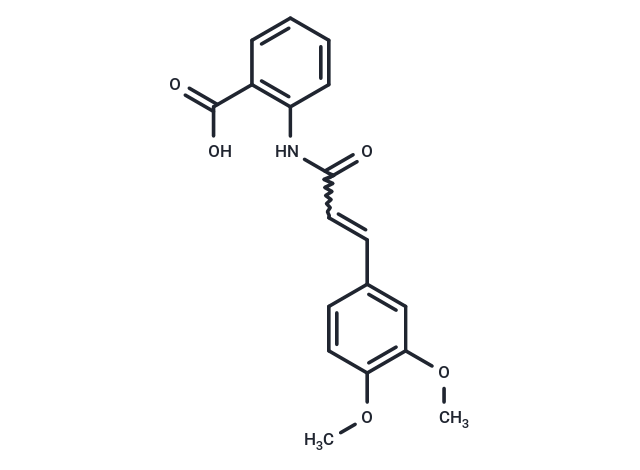
| Pack Size | Price | USA Stock | Global Stock | Quantity |
|---|---|---|---|---|
| 5 mg | $36 | In Stock | In Stock | |
| 10 mg | $50 | In Stock | In Stock | |
| 25 mg | $61 | In Stock | In Stock | |
| 50 mg | $85 | In Stock | In Stock | |
| 100 mg | $122 | In Stock | In Stock | |
| 200 mg | $185 | In Stock | In Stock | |
| 500 mg | $313 | - | In Stock | |
| 1 mL x 10 mM (in DMSO) | $50 | In Stock | In Stock |
| Description | Tranilast (SB 252218), an antiallergic drug, suppresses lipid mediator and cytokine release from inflammatory cells, therefore utilized in the treatment of allergic disorders. |
| Targets & IC50 | PGD2:0.1 mM (IC50) |
| In vitro | In diabetic rats' hearts, Tranilast reduces the phosphorylation of Smad2, effectively mitigating cardiac fibrosis. |
| In vivo | In hypertrophic and proliferative scar tissues, Tranilast ([3-300 mM]) inhibits collagen synthesis in fibroblasts by suppressing the Transforming Growth Factor (TGF)-β1, yet it does not inhibit the fibroblasts in normal skin. |
| Synonyms | SB 252218, MK 341 |
| Kinase Assay | His-tagged human Mps1Cat encoding amino acids 510-857 is generated. For kinase assays, 500 ng is added to buffer (25 mM Tris-HCl, pH 7.4, 100 mM NaCl, 50 μg/mL BSA, 0.1 mM EGTA, 0.1% β-mercaptoethanol, 10 mM MgCl2, and 0.5 μg/mL myelin basic protein), AZ3146, and 100 μM γ-[32P]ATP (2 μCi/assay). Reactions are incubated at 30°C for 20 min, spotted onto P81 paper, washed in 0.5% phosphoric acid, and immersed in acetone. Phosphate incorporation is determined by scintillation counting. For immunoprecipitation kinase assays, HeLa cells are treated with nocodazole for 14 h, mitotic cells isolated, washed in PBS, and lysed for 30 min in 50 mM Tris-HCl, pH 7.4, 100 mM NaCl, 0.5% NP-40, 5 mM EDTA, 5 mM EGTA, 40 mM β-glycerophosphate, 0.2 mM PMSF, 1 mM DTT, 1 mM sodium orthovanadate, 20 mM sodium fluoride, 1 μM okadaic acid, and complete EDTA-free protease inhibitor cocktail. Full-length Mps1 is immunoprecipitated. Purified complexes are washed with lysis buffer containing 100 mM NaCl and assayed as described for the recombinant protein. To quantify 32P incorporation, reactions are stopped with SDS sample buffer and separated by SDS-PAGE followed by phosphorimaging. The plate is analyzed using a phosphorimager using AIDA software. To assess the specificity of AZ3146, a single-point screen is carried using kinase profiling service. 50 kinases are selected and assayed with 1 μM AZ3146[1]. |
| Molecular Weight | 327.33 |
| Formula | C18H17NO5 |
| Cas No. | 53902-12-8 |
| Smiles | N(C(C=CC1=CC(OC)=C(OC)C=C1)=O)C2=C(C(O)=O)C=CC=C2 |
| Relative Density. | 1.299 g/cm3 |
| Storage | Keep away from direct sunlight,Store under nitrogen Powder: -20°C for 3 years | In solvent: -80°C for 1 year Shipping with blue ice/Shipping at ambient temperature. | |||||||||||||||||||||||||||||||||||
| Solubility Information | DMSO: 250 mg/mL (763.76 mM), Sonication is recommended.  | |||||||||||||||||||||||||||||||||||
| In Vivo Formulation | 10% DMSO+40% PEG300+5% Tween 80+45% Saline: 2 mg/mL (6.11 mM), Sonication is recommended. Please add the solvents sequentially, clarifying the solution as much as possible before adding the next one. Dissolve by heating and/or sonication if necessary. Working solution is recommended to be prepared and used immediately. The formulation provided above is for reference purposes only. In vivo formulations may vary and should be modified based on specific experimental conditions. | |||||||||||||||||||||||||||||||||||
Solution Preparation Table | ||||||||||||||||||||||||||||||||||||
DMSO
Note : The dilution table applies only to solid products. For liquid products, please calculate the stock solution based on the stated concentration and/or density. | ||||||||||||||||||||||||||||||||||||
 For example, if the intended dosage is 10 mg/kg for animals weighing 20 g , with a dosing volume of 100 μL per animal, and a total of 10 animals are to be administered, using a formulation of
  10% DMSO+ 40% PEG300+ 5% Tween 80+ 45% Saline/PBS/ddH2O , the resulting working solution concentration would be 2 mg/mL.
Dissolve 2 mg of the compound in 100 μL DMSO to obtain a stock solution at a concentration of 20 mg/mL . If the required concentration exceeds the compound's known solubility, please contact us for technical support before proceeding.
1) Add 100 μL of the DMSO stock solution to 400 µL PEG300 and mix thoroughly until the solution becomes clear.
2) Add 50 µL Tween 80 and mix well until fully clarified.
3) Add 450 µL Saline,PBS or ddH2O and mix thoroughly until a homogeneous solution is obtained.
| Size | Quantity | Unit Price | Amount | Operation |
|---|
 Feedback
 Hello! How can I help you today?
Copyright © 2015-2026 TargetMol Chemicals Inc. All Rights Reserved.
