


Shopping Cart
Remove All Your shopping cart is currently empty


Synonyms: STF 62247
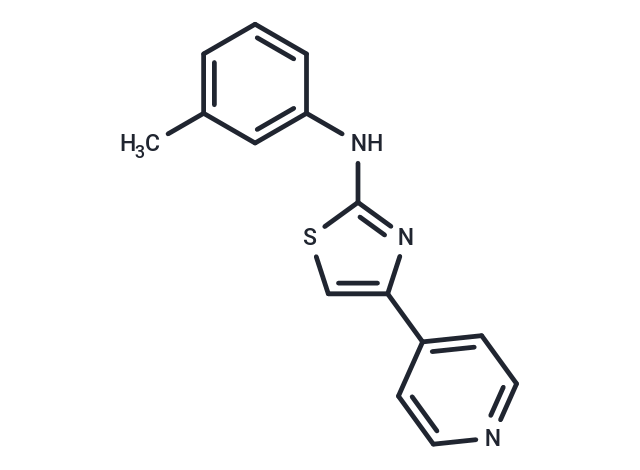

| Pack Size | Price | USA Stock | Global Stock | Quantity |
|---|---|---|---|---|
| 10 mg | $30 | In Stock | In Stock | |
| 25 mg | $59 | In Stock | In Stock | |
| 50 mg | $102 | In Stock | In Stock | |
| 100 mg | $178 | In Stock | In Stock | |
| 200 mg | $273 | In Stock | In Stock | |
| 1 mL x 10 mM (in DMSO) | $30 | In Stock | In Stock |
| Description | STF-62247 is TGN inhibitor with IC50 of 0.625 μM and 16 μM in RCC4 and RCC4/VHL cells, respectively. |
| Targets & IC50 | TGN (RCC4/VHL):16 μM, TGN (RCC4):0.625 μM |
| In vitro | In vitro, STF-62247 shows cytotoxicity and tumor growth inhibitory activity against wild-type VHL and VHL-deficient renal cell carcinoma (RCC) in a HIF-independent manner with IC50 of 16 μM and 0.625 μM, respectively. Moreover, STF-62247 also leads to cell death by increasing acidification and inducing autophagy in VHL-deficient cells. [1] STF-62247 specifically induces macroautophagy and enhances the fusion of autophagosome and lysosomes to form autolysosomes by interfering with Golgi-endoplasmic reticulum transport in cells that have lost VHL . [2] A recent study shows that induction of autophagy by STF-62247 increases sensitivity of RCC under hypoxic conditions to radiation in a VHL-dependent manner. [3] |
| In vivo | In vivo mouse model, STF-62247 at a dose of 8 mg/kg by intraperitoneal injection significantly reduces tumor growth of VHL-deficient SN12C tumor cells. [1] |
| Synonyms | STF 62247 |
| Kinase Assay | SIRT1 fluorescence polarization assay and HTS: In the SIRT1 FP assay, SIRT1 activity is monitored using a 20 amino acid peptide (Ac-Glu-Glu-Lys(biotin)-Gly-Gln-Ser-Thr-Ser-Ser-His-Ser-Lys(Ac)-Nle-Ser-Thr-Glu-Gly–Lys(MR121 or Tamra)-Glu-Glu-NH2 ) derived from the sequence of p53. The peptide is N-terminally linked to biotin and C-terminally modified with a fluorescent tag. The reaction for monitoring enzyme activity is a coupled enzyme assay where the first reaction is the deacetylation reaction catalyzed by SIRT1 and the second reaction is cleavage by trypsin at the newly exposed lysine residue. The reaction is stopped and streptavidin is added in order to accentuate the mass differences between substrate and product. The fluorescence polarization reaction conditions are as follows: 0.5 μM peptide substrate, 150 μM βNAD +, 0-10 nM SIRT1, 25 mM Tris-acetate pH 8, 137 mM Na-Ac, 2.7 mM K-Ac, 1 mM Mg-Ac, 0.05% Tween-20, 0.1% Pluronic F127, 10 mM CaCl 2 , 5 mM DTT, 0.025% BSA, and 0.15 mM nicotinamide. The reaction is incubated at 37°C and stopped by addition of nicotinamide, and trypsin is added to cleave the deacetylated substrate. This reaction is incubated at 37 ℃ in the presence of 1 μM streptavidin. Fluorescent polarization is determined at excitation (650 nm) and emission (680 nm) wavelengths. |
| Cell Research | For cell viability, 100,000 cells are plated in a 12-well plate. The following day, 1.25 μM STF-62247 is added in the presence or absence of 1 mM 3-MA for 24 hours at 37 °C. Cells are trypsinized and counted by trypan blue exclusion. For XTT assays, 5000 RCC4 with and without VHL cells or 2,500 SN12C with and without VHL shRNA cells are plated in 96-well plates. The following day, vehicle (DMSO), STF-62247 is added to media by serial dilution. Four days later, the media is aspirated and XTT solution containing 0.3 mg/ml of XTT in Phenol Red-free media, 20% FCS and 2.65 mg/ml N-methyl dibenzopyrazine methyl sulfate (PMS) is added to the cells and incubated at 37 °C for 1-2 hours. Metabolism of XTT is quantified by measuring the absorbance at 450 nm on a plate reader. (Only for Reference) |
| Molecular Weight | 267.35 |
| Formula | C15H13N3S |
| Cas No. | 315702-99-9 |
| Smiles | Cc1cccc(Nc2nc(cs2)-c2ccncc2)c1 |
| Relative Density. | 1.255g/cm3 |
| Storage | Powder: -20°C for 3 years | In solvent: -80°C for 1 year Shipping with blue ice/Shipping at ambient temperature. | ||||||||||||||||||||||||||||||||||||||||
| Solubility Information | DMSO: 55 mg/mL (205.72 mM), Sonication is recommended.  H2O: < 1 mg/mL (insoluble or slightly soluble) Ethanol: 3 mg/mL (11.22 mM), Sonication is recommended. | ||||||||||||||||||||||||||||||||||||||||
| In Vivo Formulation | 10% DMSO+40% PEG300+5% Tween 80+45% Saline: 2 mg/mL (7.48 mM), Sonication is recommended. Please add the solvents sequentially, clarifying the solution as much as possible before adding the next one. Dissolve by heating and/or sonication if necessary. Working solution is recommended to be prepared and used immediately. The formulation provided above is for reference purposes only. In vivo formulations may vary and should be modified based on specific experimental conditions. | ||||||||||||||||||||||||||||||||||||||||
Solution Preparation Table | |||||||||||||||||||||||||||||||||||||||||
Ethanol/DMSO
DMSO
Note : The dilution table applies only to solid products. For liquid products, please calculate the stock solution based on the stated concentration and/or density. | |||||||||||||||||||||||||||||||||||||||||
 For example, if the intended dosage is 10 mg/kg for animals weighing 20 g , with a dosing volume of 100 μL per animal, and a total of 10 animals are to be administered, using a formulation of
  10% DMSO+ 40% PEG300+ 5% Tween 80+ 45% Saline/PBS/ddH2O , the resulting working solution concentration would be 2 mg/mL.
Dissolve 2 mg of the compound in 100 μL DMSO to obtain a stock solution at a concentration of 20 mg/mL . If the required concentration exceeds the compound's known solubility, please contact us for technical support before proceeding.
1) Add 100 μL of the DMSO stock solution to 400 µL PEG300 and mix thoroughly until the solution becomes clear.
2) Add 50 µL Tween 80 and mix well until fully clarified.
3) Add 450 µL Saline,PBS or ddH2O and mix thoroughly until a homogeneous solution is obtained.
| Size | Quantity | Unit Price | Amount | Operation |
|---|
 Feedback
 Hello! How can I help you today?
Copyright © 2015-2026 TargetMol Chemicals Inc. All Rights Reserved.
