


Shopping Cart
Remove All Your shopping cart is currently empty


Synonyms: RDEA119, BAY 86-97661, BAY 869766

| Pack Size | Price | USA Stock | Global Stock | Quantity |
|---|---|---|---|---|
| 2 mg | $38 | In Stock | In Stock | |
| 5 mg | $60 | In Stock | In Stock | |
| 10 mg | $89 | In Stock | In Stock | |
| 25 mg | $158 | In Stock | In Stock | |
| 50 mg | $247 | In Stock | In Stock | |
| 100 mg | $363 | In Stock | In Stock | |
| 200 mg | $538 | In Stock | In Stock | |
| 1 mL x 10 mM (in DMSO) | $76 | In Stock | In Stock |
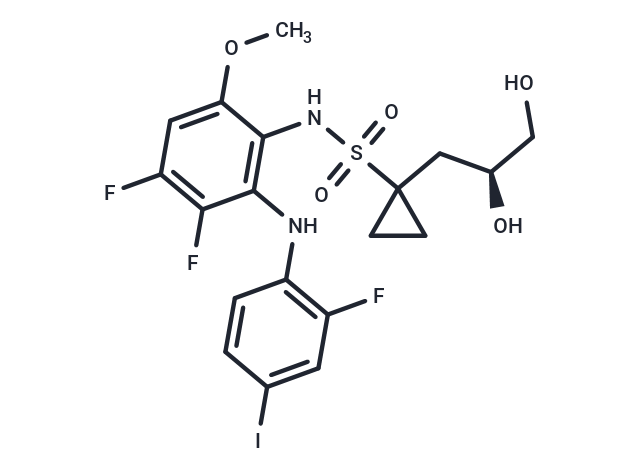
| Description | Refametinib (RDEA119) (RDEA119, Bay 86-9766) is an effective, ATP non-competitive and specific inhibitor of MEK1/2 (IC50: 19/47 nM). |
| Targets & IC50 | MEK2:47 nM, MEK1:19 nM |
| In vitro | RDEA119 is selectively bound directly to an allosteric pocket in the MEK1/2 enzymes, and highly efficacious at inhibiting cell proliferation in several tumor cell lines, including A375, SK-MEI-28, Colo205, HT-29 and BxPC3. RDEA119 inhibits anchorage-dependent growth of human cancer cell lines harboring the gain-of-function V600E BRAF mutant with GI50 values ranging from 67 to 89 nM. Under anchorage-independent conditions, GI50 values for all cell lines tested are similar (40-84 nM). RDEA119 shows a tissue selectivity that reduces its potential for central nervous system–related side effects. [1] RDEA119 potently inhibits the proliferation of the 4 cell lines that harbored BRAF mutation but has no or modest effects on the other 4 cells that harbored wild-type BRAF (IC50 of 0.034-0.217 μM vs. 1.413-34.120 μM). This inhibitory effect of RDEA119 in selected cell lines OCUT1 (BRAF V600E(+), PIK3CA H1047R(+)) and SW1376 (BRAF V600E(+)) is enhanced by combination with the mTOR inhibitor, temsirolimus. RDEA119 and temsirolimus also show synergistic effects on autophagic death of OCUT1 and KAT18 cells selectively tested. [2] |
| In vivo | Oral administration of RDEA119 at 50 mg/kg on a once daily x 14 schedule leads to a 68% tumor growth inhibition (TGI) in human melanoma A375 tumor model. Oral administration of RDEA119 at 25 mg/kg on a once a once daily x 14 schedule leads to a 123% TGI in human colon carcinoma Colo205 tumor model (TGI > 100% occurs when the tumor shrinks below its starting volume). A dose of 25 mg/kg once daily x 14 produces 56% and 67% TGI for HT-29 and A431 tumors, respectively. [1] |
| Synonyms | RDEA119, BAY 86-97661, BAY 869766 |
| Kinase Assay | MEK Kinase Assay: Kinase inactive murine ERK2 (mERK2) K52A/T183A is affinity purified from Escherichia coli expressed using the pET21a vector. MEK1 kinase activity is determined using mERK2 K52A T183A as the substrate. Recombinant MEK1 enzyme (5 nM) is first activated by 0.02 unit or 1.5 nM of RAF1 in the presence of 25 mM HEPES (pH 7.8), 1 mM MgCl2, 50 mM NaCl, 0.2 mM EDTA, and 50 μM ATP for 30 minutes at 25 °C. The reactions are initiated by adding 2 μM of mERK2K52A T183A and 2.5 μCi [γ-33P] ATP in a total volume of 20 μL. The MEK2 kinase activity is determined similarly except that activation by RAF1 is not needed and 11 nM of MEK2 enzyme (active) are used in the assays.Kinase profiling is performed by Invitrogen using their Select Screen Kinase Profiling Service. The Z'-LYTE biochemical assay is used. RDEA119 is assayed in quadruplicate at 10 μM against 205 kinases. |
| Cell Research | For anchorage-dependent growth inhibition experiments, cells are plated in white 384-well plates at 1,000/20 μL/well or white 96-well microplates at 4,000/100 μL/well. After 24-h incubation at 37 °C, 5% CO2, and 100% humidity, RDEA119 is incubated for 48 hours at 37 °C and assayed using CellTiter-Glo. For the 96-well anchorage-independent growth assay, wells of an "ultralow binding" plate (Corning) are filled with 60 μL of a 0.15% agarose solution in complete RPMI 1640. Then, 60 μL of complete RPMI 1640 containing 9,000 cells in 0.15% agarose are added per well. After 24 hour, 60 μL of a 3 × drug solution in agarose-free complete RPMI 1640 are added. After 7 d, 36 μL of 6 × 3-(4,5-dimethylthiazol-2-yl)-5-(3-carboxymethoxyphenyl)-2-(4-sulfophenyl)- 2H-tetrazolium, inner salt reagent are added per well. After 2 hours at 37 °C, absorbance at 490 nm is determined on the M5 plate reader. (Only for Reference) |
| Molecular Weight | 572.34 |
| Formula | C19H20F3IN2O5S |
| Cas No. | 923032-37-5 |
| Smiles | S(NC1=C(NC2=C(F)C=C(I)C=C2)C(F)=C(F)C=C1OC)(=O)(=O)C3(C[C@@H](CO)O)CC3 |
| Relative Density. | 1.82 g/cm3 (Predicted) |
| Storage | Powder: -20°C for 3 years | In solvent: -80°C for 1 year Shipping with blue ice/Shipping at ambient temperature. | |||||||||||||||||||||||||||||||||||
| Solubility Information | Ethanol: 93 mg/mL (162.49 mM), Sonication is recommended. DMSO: 150 mg/mL (262.08 mM), Sonication is recommended.  H2O: < 1 mg/mL (insoluble or slightly soluble) | |||||||||||||||||||||||||||||||||||
| In Vivo Formulation | 10% DMSO+90% Saline: < 10 mg/mL (17.47 mM), Lower concentrations may be soluble, but exact solubility limit is unknown. 10% DMSO+40% PEG300+5% Tween 80+45% Saline: 10 mg/mL (17.47 mM), Solution. Please add the solvents sequentially, clarifying the solution as much as possible before adding the next one. Dissolve by heating and/or sonication if necessary. Working solution is recommended to be prepared and used immediately. The formulation provided above is for reference purposes only. In vivo formulations may vary and should be modified based on specific experimental conditions. | |||||||||||||||||||||||||||||||||||
Solution Preparation Table | ||||||||||||||||||||||||||||||||||||
Ethanol/DMSO
Note : The dilution table applies only to solid products. For liquid products, please calculate the stock solution based on the stated concentration and/or density. | ||||||||||||||||||||||||||||||||||||
 For example, if the intended dosage is 10 mg/kg for animals weighing 20 g , with a dosing volume of 100 μL per animal, and a total of 10 animals are to be administered, using a formulation of
  10% DMSO+ 40% PEG300+ 5% Tween 80+ 45% Saline/PBS/ddH2O , the resulting working solution concentration would be 2 mg/mL.
Dissolve 2 mg of the compound in 100 μL DMSO to obtain a stock solution at a concentration of 20 mg/mL . If the required concentration exceeds the compound's known solubility, please contact us for technical support before proceeding.
1) Add 100 μL of the DMSO stock solution to 400 µL PEG300 and mix thoroughly until the solution becomes clear.
2) Add 50 µL Tween 80 and mix well until fully clarified.
3) Add 450 µL Saline,PBS or ddH2O and mix thoroughly until a homogeneous solution is obtained.
| Size | Quantity | Unit Price | Amount | Operation |
|---|
 Feedback
 Hello! How can I help you today?
Copyright © 2015-2026 TargetMol Chemicals Inc. All Rights Reserved.
