


Shopping Cart
Remove All Your shopping cart is currently empty

Synonyms: PD325901, PD0325901

| Pack Size | Price | USA Stock | Global Stock | Quantity |
|---|---|---|---|---|
| 5 mg | $47 | In Stock | In Stock | |
| 10 mg | $68 | In Stock | In Stock | |
| 25 mg | $129 | In Stock | In Stock | |
| 50 mg | $185 | In Stock | In Stock | |
| 100 mg | $287 | In Stock | In Stock | |
| 200 mg | $428 | In Stock | In Stock | |
| 500 mg | $697 | In Stock | In Stock | |
| 1 g | $945 | - | In Stock | |
| 1 mL x 10 mM (in DMSO) | $50 | In Stock | In Stock |
| Description | Mirdametinib (PD325901) is an MEK inhibitor (IC50=0.33 nM) with selective, non-ATP-competitive, and oral activity. Mirdametinib exhibits antitumor activity by inhibiting p-ERK1/2 expression and inducing apoptosis. |
| Targets & IC50 | MEK1:1 nM (Ki), MEK:0.33 nM (cell free), MEK2:1 nM (Ki) |
| In vitro | METHODS: Eleven human melanoma cell lines were treated with Mirdametinib (0.1-1000 nM) for 72 h, and cell counts were determined using the trypan blue exclusion test. RESULTS: Mirdametinib (IC50=20-50 nM) effectively inhibited the growth of human melanoma cell lines with BRAF mutations (M14/A375P/A375M/A375SM/ME10538/ME4686/JR8) or without BRAF mutations (ME4405/ME13923). ME8959 both have wild-type BRAF and are slightly more resistant to Mirdametinib-mediated growth inhibition (IC50≥100 nM). [1] METHODS: Papillary thyroid carcinoma (PTC) cell lines K2 and TPC-1 were treated with Mirdametinib (0.1-1000 nmol/L) for 1-96 h. Target protein expression levels were detected by Western Blot. RESULTS: Mirdametinib effectively inhibited the phosphorylation of ERK1/2 in various PTC cell lines. [2] |
| In vivo | METHODS: To assay antitumor activity in vivo, Mirdametinib (20-25 mg/kg, 80 mmol/L citric buffer (pH 7)) was administered by gavage to Athymic Ncr-nu/nu mice harboring PTC tumors K2 or TPC-1 five times per week for three weeks. RESULTS: Mirdametinib completely inhibited tumor growth in mice inoculated with PTC cells K2 harboring BRAF mutations and significantly reduced tumor growth in mice inoculated with PTC cells TPC-1 harboring RET/PTC1 rearrangements. [2] METHODS: To assay anti-tumor activity in vivo, Mirdametinib (1.6-25 mg/kg, 0.5% hydroxypropylmethylcellulose + 0.2% Tween 80 in water) was administered orally to mice bearing mouse colorectal cancer tumor CT26 once daily for fourteen days. RESULTS: Mirdametinib significantly inhibited pERK levels in tumors. [3] |
| Synonyms | PD325901, PD0325901 |
| Kinase Assay | Incorporation of 32P into myelin basic protein (MBP) is assayed in the presence of a glutathione S-transferase fusion protein containing p44MAP kinase (GST-MAPK) and a glutathione S-transferase protein containing p45MEK (GST-MEK). The assay solution contained 20 mM HEPES, pH 7.4, 10 mM MgCl2, 1 mM MnCl2, 1 mM EGTA, 50 mM [γ-32P]ATP, 10 mg GST-MEK, 0.5 mg GST-MAPK and 40 mg MBP in a final volume of 100 mL. Reactions are stopped after 20 minutes by addition of trichloroacetic acid and filtered through a GF/C filter mat. 32P retained on the filter mat is determined using a 1205 Betaplate [1]. |
| Cell Research | A cell death detection enzyme-linked immunosorbent assay was used per the manufacturer's instructions. Briefly, 4 × 10^4 cells were plated in 24-well plates in triplicate the day before treatment. PTC cells were treated with 0.1 μmol/L PD0325901 for 96 hours. Cells treated with 1 μmol/L staurosporine served as positive controls for apoptosis. At the end of treatment, cells were lysed using the lysis buffer provided in the kit for 30 minutes at room temperature and then centrifuged in 24-well plates. Lysates (20 μL of supernatant) were transferred to streptavidin-coated wells and incubated for 2 hours at room temperature with two antibodies (biotin-labeled anti-histone antibody and peroxidase-conjugated anti-DNA antibody). After the wells were washed three times, the samples were incubated with peroxidase substrate (ABTS) and the amount of colored product was determined spectrophotometrically at 405 nm. The background was measured at 490 nm [2]. |
| Animal Research | Athymic Ncr-nu/nu mice were obtained from the National Cancer Institute at ages 6 to 8 weeks and housed for at least 1 week after arrival. Mice (10–14 per group) were anesthetized s.c. with a cocktail (100 μL/10 g body weight of 10 mg/mL ketamine and 1 mg/mL xylazine). K2 and TPC-1 cells stably infected with a retrovirus expressing luciferase (5 × 10⁵ cells in 5 μL RPMI1640 medium) were inoculated into the thyroid gland, and the mice were monitored weekly for tumor growth by Xenogen (IVIS 200 imaging system) using Living Image 3.0 software. One week after inoculation, PD0325901 was dissolved in 80 mmol/L citric buffer (pH 7) by sonication and given to mice daily by oral gavage (20–25 mg/kg) for 3 weeks (5 consecutive days/week). Mice were sacrificed only due to tumor burden or loss of 20% of body weight. Tumor sizes were measured with calipers and tumor volume (V) was calculated by the formula (V = length × width × depth). Control mice were given 80 mmol/L citric buffer (pH 7) alone. All in vivo experiments were done at least twice [2]. |
| Molecular Weight | 482.19 |
| Formula | C16H14F3IN2O4 |
| Cas No. | 391210-10-9 |
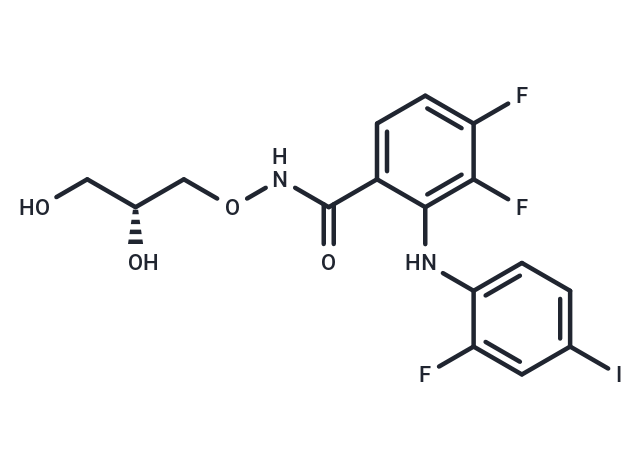
| Smiles | OC[C@@H](O)CONC(=O)C1=CC=C(F)C(F)=C1NC1=CC=C(I)C=C1F |
| Relative Density. | 1.818g/cm3 |
| Storage | Keep away from direct sunlight,Keep away from moisture Powder: -20°C for 3 years | In solvent: -80°C for 1 year Shipping with blue ice/Shipping at ambient temperature. | |||||||||||||||||||||||||||||||||||
| Solubility Information | H2O: Insoluble DMSO: 50 mg/mL (103.69 mM), Sonication is recommended.  | |||||||||||||||||||||||||||||||||||
| In Vivo Formulation | 10% DMSO+40% PEG300+5% Tween 80+45% Saline: 5 mg/mL (10.37 mM), Solution. Please add the solvents sequentially, clarifying the solution as much as possible before adding the next one. Dissolve by heating and/or sonication if necessary. Working solution is recommended to be prepared and used immediately. The formulation provided above is for reference purposes only. In vivo formulations may vary and should be modified based on specific experimental conditions. | |||||||||||||||||||||||||||||||||||
Solution Preparation Table | ||||||||||||||||||||||||||||||||||||
DMSO
Note : The dilution table applies only to solid products. For liquid products, please calculate the stock solution based on the stated concentration and/or density. | ||||||||||||||||||||||||||||||||||||
 For example, if the intended dosage is 10 mg/kg for animals weighing 20 g , with a dosing volume of 100 μL per animal, and a total of 10 animals are to be administered, using a formulation of
  10% DMSO+ 40% PEG300+ 5% Tween 80+ 45% Saline/PBS/ddH2O , the resulting working solution concentration would be 2 mg/mL.
Dissolve 2 mg of the compound in 100 μL DMSO to obtain a stock solution at a concentration of 20 mg/mL . If the required concentration exceeds the compound's known solubility, please contact us for technical support before proceeding.
1) Add 100 μL of the DMSO stock solution to 400 µL PEG300 and mix thoroughly until the solution becomes clear.
2) Add 50 µL Tween 80 and mix well until fully clarified.
3) Add 450 µL Saline,PBS or ddH2O and mix thoroughly until a homogeneous solution is obtained.
| Size | Quantity | Unit Price | Amount | Operation |
|---|
 Feedback
 Hello! How can I help you today?
Copyright © 2015-2026 TargetMol Chemicals Inc. All Rights Reserved.
