


Shopping Cart
Remove All Your shopping cart is currently empty


Synonyms: N-Phenethylbiguanide, Insoral, Debeone, BRN 1977317, Azucaps
| Pack Size | Price | USA Stock | Global Stock | Quantity |
|---|---|---|---|---|
| 2 mg | $30 | In Stock | In Stock | |
| 5 mg | $40 | In Stock | In Stock | |
| 10 mg | $65 | In Stock | In Stock | |
| 25 mg | $121 | In Stock | In Stock | |
| 50 mg | $179 | In Stock | In Stock | |
| 100 mg | $261 | In Stock | In Stock |
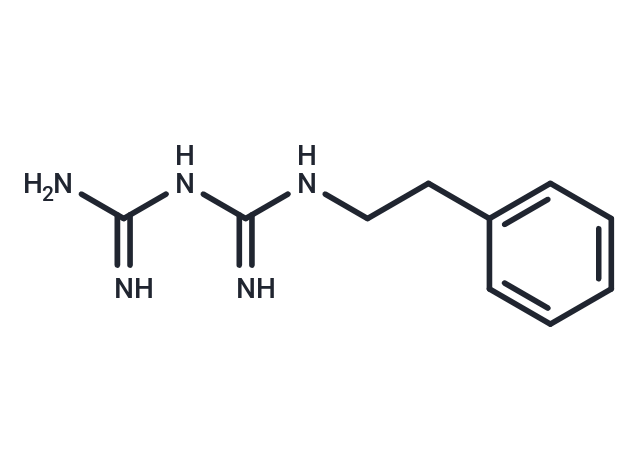
| Description | Phenformin (BRN 1977317) is a biguanide compound with anticancer and anti-glycemic activity, inhibits skin tumor growth and promotes keratinocyte differentiation and apoptosis. |
| In vitro | Phenformin acts by promoting phosphorylation and activation of AMPKalpha1 and AMPKalpha2 without altering the activity of the LKB1 gene [1]. In isolated hearts, Phenformin increased AMPK activity and phosphorylation levels, which correlated with increased AMPK activity and increased intracellular [AMP] [2].Phenformin was 50 times more potent than Metformin and was able to inhibit mitochondrial complex I. In LKB1-deficient non-small cell lung cancer cell lines, the Phenformin was able to induce apoptosis.Phenformin (2 mM) also induced AMPK signaling and increased levels of P-AMPK and P-Raptor.Phenformin induced higher levels of cellular stress, which in turn triggered the induction of P-Ser51 eIF2α and its downstream target CHOP, which are late stage molecular markers of apoptosis. In chronically treated KLluc mice, Phenformin induced survival and treatment response [3]. In H441 cells, Phenformin and AICAR increased AMPK activity in a dose-dependent manner, maximizing activation of the kinase at 5-10 mM and 2 mM concentrations. In H441 cell monolayers, Phenformin significantly reduced basal ion migration (measured as short-circuit current) by approximately 50%. Phenformin and AICAR significantly reduced amiloride-sensitive transmembrane Na ion transport compared to controls. Phenformin and AICAR inhibited amiloride-sensitive transmembrane Na ion transport in H441 cells by activating AMPK and inducing inhibition of sodium ion entry at the terminal and basolateral sides of ENaC cells via the Na+, K+ ATPase [4]. In rats treated with Phenformin, their blood insulin levels tend to decrease (radioimmunoassay) [5]. |
| Synonyms | N-Phenethylbiguanide, Insoral, Debeone, BRN 1977317, Azucaps |
| Molecular Weight | 205.26 |
| Formula | C10H15N5 |
| Cas No. | 114-86-3 |
| Smiles | NC(=N)NC(=N)NCCc1ccccc1 |
| Relative Density. | 1.31g/cm3 |
| Storage | Keep away from direct sunlight,Store at low temperature,Keep away from moisture,Store under nitrogen Powder: -20°C for 3 years | In solvent: -80°C for 1 year Shipping with blue ice/Shipping at ambient temperature. | |||||||||||||||||||||||||||||||||||
| Solubility Information | H2O: 250 mg/mL (1217.97 mM)  DMSO: Soluble | |||||||||||||||||||||||||||||||||||
Solution Preparation Table | ||||||||||||||||||||||||||||||||||||
H2O
Note : The dilution table applies only to solid products. For liquid products, please calculate the stock solution based on the stated concentration and/or density. | ||||||||||||||||||||||||||||||||||||
 For example, if the intended dosage is 10 mg/kg for animals weighing 20 g , with a dosing volume of 100 μL per animal, and a total of 10 animals are to be administered, using a formulation of
  10% DMSO+ 40% PEG300+ 5% Tween 80+ 45% Saline/PBS/ddH2O , the resulting working solution concentration would be 2 mg/mL.
Dissolve 2 mg of the compound in 100 μL DMSO to obtain a stock solution at a concentration of 20 mg/mL . If the required concentration exceeds the compound's known solubility, please contact us for technical support before proceeding.
1) Add 100 μL of the DMSO stock solution to 400 µL PEG300 and mix thoroughly until the solution becomes clear.
2) Add 50 µL Tween 80 and mix well until fully clarified.
3) Add 450 µL Saline,PBS or ddH2O and mix thoroughly until a homogeneous solution is obtained.
| Size | Quantity | Unit Price | Amount | Operation |
|---|
 Feedback
 Hello! How can I help you today?
Copyright © 2015-2026 TargetMol Chemicals Inc. All Rights Reserved.
