


Shopping Cart
Remove All Your shopping cart is currently empty

Synonyms:

| Pack Size | Price | USA Stock | Global Stock | Quantity |
|---|---|---|---|---|
| 1 mg | $65 | In Stock | In Stock | |
| 5 mg | $186 | In Stock | In Stock | |
| 10 mg | $322 | In Stock | In Stock | |
| 25 mg | $662 | In Stock | In Stock | |
| 50 mg | $912 | - | In Stock | |
| 100 mg | $1,230 | - | In Stock | |
| 200 mg | $1,600 | - | In Stock | |
| 1 mL x 10 mM (in DMSO) | $201 | In Stock | In Stock |

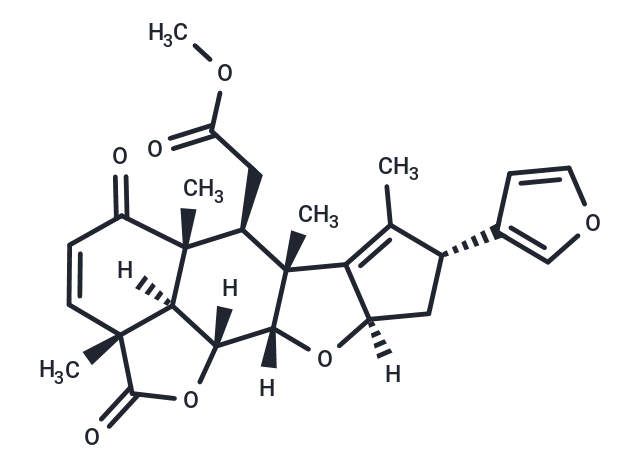
| Description | Nimbolide, a triterpenoid derived from neem leaves and flowers, is a natural product and a CDK4/CDK6/NF-κB inhibitor that inhibits multiple signaling pathways including Wnt and PI3K-Akt, possesses antitumor activity, and can induce tumor cell apoptosis. |
| Targets & IC50 | Parasites:8.13-9.4 μM, MCF-7 cells proliferation:5.04 ± 0.25 μM, N1E-115 cells viability:4-10 μM, MDA-MB-231 cells proliferation:1.97 ± 0.24 μM |
| In vitro | Methods:BV-2 mouse microglial cells were pretreated with Nimbolide (125, 250, 500 nM) for 30 minutes, then co-incubated with LPS (100 ng/mL) for 24 hours. Detection was performed using ELISA, Griess assay, and Western blot. Results: Nimbolide concentration-dependently reduced levels of TNFα, IL-6, IFNγ, NO/iNOS, and PGE2/COX-2, inhibited NF-κB and MAPK pathways, and activated the Nrf2 antioxidant mechanism.[1] Methods: Nine H. pylori strains including G27, 26695, and J99 were incubated with Nimbolide at 0.625–40 μg/mL for 24 hours. In vitro activity was evaluated through MIC/MBC determination and bactericidal kinetics assays. Results: Nimbolide exhibited MIC values of 1.25–2.5 μg/mL and MBC values of 2.5–10 μg/mL against tested strains, demonstrating time- and concentration-dependent bactericidal effects. It showed synergistic activity at low pH and was effective against multidrug-resistant strains.[2] Methods: Human bladder cancer EJ and 5637 cells were incubated with Nimbolide at 0, 0.5, 1, and 3 μmol/L for 12 hours. Detection was performed using MTT assay, cell counting, flow cytometry, wound healing assay, Transwell invasion assay, gelatin zymography, and EMSA. Results: Nimbolide concentration-dependently inhibited cell viability (IC₅₀ approximately 3 μmol/L), induced G2/M phase arrest, promoted JNK phosphorylation, inhibited p38MAPK and AKT phosphorylation, and reduced MMP-9 activity as well as NF-κB, AP-1, and Sp-1 transcription factor binding activity.[3] |
| In vivo | Methods: A Freund's complete adjuvant-induced arthritis model was established in male Wistar rats. Nimbolide was administered orally at a dose of 20 mg/kg/day with DMSO as the vehicle control, continuously until day 25. Results: Nimbolide significantly reduced joint scores, paw swelling, and organ indices, alleviated histopathological damage, and downregulated expression of inflammatory factors including TNF-α and IL-6 as well as iNOS and NF-κB proteins.[4] Methods: DSS-induced acute colitis and IL-10⁻/⁻ chronic colitis mouse models were employed. Nimbolide was administered by gavage at doses of 0.2 and 1 mg/kg/day with DMSO as the vehicle, continuously for 7 or 14 days. Results: Nimbolide significantly improved weight loss, colon shortening, disease activity index, and histological scores, and inhibited IκBα phosphorylation in colon tissue.[5] |
| Molecular Weight | 466.52 |
| Formula | C27H30O7 |
| Cas No. | 25990-37-8 |
| Smiles | C[C@]12[C@]3([C@]([C@@]4([C@](C)([C@@H]1CC(OC)=O)C=5[C@](O4)(C[C@H](C5C)C=6C=COC6)[H])[H])(OC(=O)[C@]3(C)C=CC2=O)[H])[H] |
| Relative Density. | 1.32 g/cm3 (Predicted) |
| Storage | Keep away from direct sunlight,Keep away from moisture,Store at low temperature Powder: -20°C for 3 years | In solvent: -80°C for 1 year Shipping with blue ice/Shipping at ambient temperature. | |||||||||||||||||||||||||||||||||||
| Solubility Information | DMSO: 60 mg/mL (128.61 mM), Sonication and heating are recommended.  | |||||||||||||||||||||||||||||||||||
| In Vivo Formulation | 10% DMSO+40% PEG300+5% Tween 80+45% Saline: 1 mg/mL (2.14 mM), Sonication is recommended. Please add the solvents sequentially, clarifying the solution as much as possible before adding the next one. Dissolve by heating and/or sonication if necessary. Working solution is recommended to be prepared and used immediately. The formulation provided above is for reference purposes only. In vivo formulations may vary and should be modified based on specific experimental conditions. | |||||||||||||||||||||||||||||||||||
Solution Preparation Table | ||||||||||||||||||||||||||||||||||||
DMSO
Note : The dilution table applies only to solid products. For liquid products, please calculate the stock solution based on the stated concentration and/or density. | ||||||||||||||||||||||||||||||||||||
 For example, if the intended dosage is 10 mg/kg for animals weighing 20 g , with a dosing volume of 100 μL per animal, and a total of 10 animals are to be administered, using a formulation of
  10% DMSO+ 40% PEG300+ 5% Tween 80+ 45% Saline/PBS/ddH2O , the resulting working solution concentration would be 2 mg/mL.
Dissolve 2 mg of the compound in 100 μL DMSO to obtain a stock solution at a concentration of 20 mg/mL . If the required concentration exceeds the compound's known solubility, please contact us for technical support before proceeding.
1) Add 100 μL of the DMSO stock solution to 400 µL PEG300 and mix thoroughly until the solution becomes clear.
2) Add 50 µL Tween 80 and mix well until fully clarified.
3) Add 450 µL Saline,PBS or ddH2O and mix thoroughly until a homogeneous solution is obtained.
| Size | Quantity | Unit Price | Amount | Operation |
|---|
 Feedback
 Hello! How can I help you today?
Copyright © 2015-2026 TargetMol Chemicals Inc. All Rights Reserved.
