


Shopping Cart
Remove All Your shopping cart is currently empty


Synonyms:

| Pack Size | Price | USA Stock | Global Stock | Quantity |
|---|---|---|---|---|
| 5 mg | $60 | In Stock | In Stock | |
| 10 mg | $86 | In Stock | In Stock | |
| 25 mg | $177 | In Stock | In Stock | |
| 50 mg | $321 | In Stock | In Stock | |
| 100 mg | $563 | In Stock | In Stock | |
| 1 mL x 10 mM (in DMSO) | $79 | In Stock | In Stock |
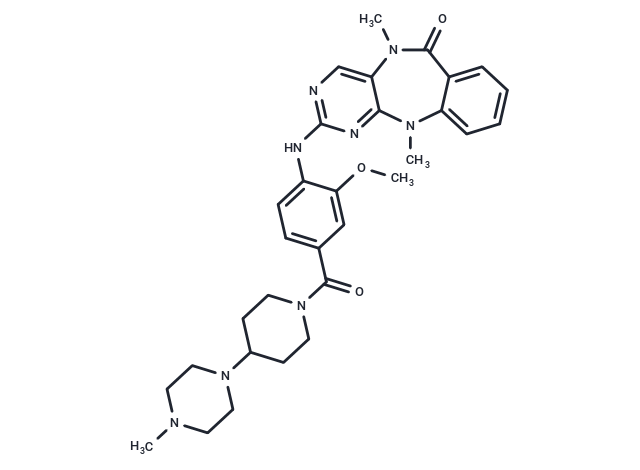
| Description | LRRK2-IN-1 is an effective and selective LRRK2 inhibitor. |
| Targets & IC50 | LRRK2 (G2019S):6 nM, LRRK2 (WT):13 nM, DCLK2:45 nM |
| In vitro | In HEK 293 cells stably expressing GFP-LRRK2[G2019S], LRRK2-IN-1 alters the cytoplasmic localization of LRRK2. In human-derived neuroblastoma SHSY5Y cells and mouse Swiss 3T3 cells, LRRK2-IN-1 induces a similar dose-dependent Ser910 and Ser935 dephosphorylation and loss of 14-3-3 binding to endogenous LRRK2. [1] In transgenic C. elegans expressing human R1441C- and G2019S-LRRK2, LRRK2-IN1 rescues the behavioral deficit characteristic of dopaminergic impairment. [2] In mouse fibroblasts, LRRK2-IN1 reduces cell motility. [3] In AsPC-1 and HCT116 cell lines, LRRK2-IN-1 shows anti-proliferative and pro-apoptotic properties, induces G1 and G2/M cell cycle arrest and inhibits DCLK1 mRNA and protein expression. [4] |
| In vivo | In wild type male C57BL/6 mice, LRRK2-IN-1 (100 mg/kg, i.p.) inhibits Ser910 and Ser935 dephosphorylation of LRRK2 in the kidney, while no effects in the brain. [1] |
| Kinase Assay | IC50 determination: Active GST-LRRK2 (1326-2527), GST-LRRK2 [G2019S] (1326-2527), GST-LRRK2 [A2016T] (1326-2527) and GST-LRRK2 [A2016T+G2019S] (1326-2527) enzyme is purified with glutathione sepharose from HEK293 cell lysate 36 h following transient transfection of the appropriate cDNA constructs. Peptide kinase assays, performed in duplicate, are set up in a total volume of 40 μL containing 0.5 μg LRRK2 kinase (which at approximately 10% purity gives a final concentration of 8 nM) in 50 mM Tris/HCl, pH 7.5, 0.1 mM EGTA, 10 mM MgCl2, 20 μM Nictide, 0.1 μM [γ-32P]ATP (~500 cpm/pmol) and the indicated concentrations of inhibitor dissolved in DMSO. After incubation for 15 min at 30 °C, reactions are terminated by spotting 35 μL of the reaction mix onto P81 phosphocellulose paper and immersion in 50 mM phosphoric acid. Samples are washed extensively and the incorporation of [γ-32P]ATP into Nictide is quantified by Cerenkov counting. IC50 values are calculated with GraphPad Prism using non-linear regression analysis. |
| Cell Research | Cells are seeded into a 96-well tissue culture plate in triplicate. The cells are cultured in the presence of LRRK2-IN-1 with DMSO as a vehicle at 0, 0.31, 0.63, 1, 2, and 5, 10, and 20 μM. 48 h post treatment, 10 μL of TACS MTT Reagent (RND Systems) is added to each well and the cells are incubated at 37°C until dark crystalline precipitate became visible in the cells. 100 μL of 266 mM NH4OH in DMSO is then added to the wells and placed on a plate shaker at low speed for 1 minute. After shaking, the plate is allowed to incubate for 10 minutes protected from light and the OD550 for each well is read using a microplate reader. The results are averaged and calculated as a percentage of the DMSO (vehicle) control +/- the standard error of the mean.(Only for Reference) |
| Molecular Weight | 570.69 |
| Formula | C31H38N8O3 |
| Cas No. | 1234480-84-2 |
| Smiles | COc1cc(ccc1Nc1ncc2N(C)C(=O)c3ccccc3N(C)c2n1)C(=O)N1CCC(CC1)N1CCN(C)CC1 |
| Relative Density. | 1.278 g/cm3 |
| Storage | Powder: -20°C for 3 years | In solvent: -80°C for 1 year Shipping with blue ice/Shipping at ambient temperature. | ||||||||||||||||||||||||||||||||||||||||
| Solubility Information | Ethanol: 57 mg/mL (99.88 mM), Sonication is recommended. DMSO: 245 mg/mL (429.3 mM), Sonication is recommended.  | ||||||||||||||||||||||||||||||||||||||||
| In Vivo Formulation | 10% DMSO+90% Saline: 10 mg/mL (17.52 mM), Solution. 10% DMSO+40% PEG300+5% Tween 80+45% Saline: 2 mg/mL (3.5 mM), Sonication is recommended. Please add the solvents sequentially, clarifying the solution as much as possible before adding the next one. Dissolve by heating and/or sonication if necessary. Working solution is recommended to be prepared and used immediately. The formulation provided above is for reference purposes only. In vivo formulations may vary and should be modified based on specific experimental conditions. | ||||||||||||||||||||||||||||||||||||||||
Solution Preparation Table | |||||||||||||||||||||||||||||||||||||||||
Ethanol/DMSO
DMSO
Note : The dilution table applies only to solid products. For liquid products, please calculate the stock solution based on the stated concentration and/or density. | |||||||||||||||||||||||||||||||||||||||||
 For example, if the intended dosage is 10 mg/kg for animals weighing 20 g , with a dosing volume of 100 μL per animal, and a total of 10 animals are to be administered, using a formulation of
  10% DMSO+ 40% PEG300+ 5% Tween 80+ 45% Saline/PBS/ddH2O , the resulting working solution concentration would be 2 mg/mL.
Dissolve 2 mg of the compound in 100 μL DMSO to obtain a stock solution at a concentration of 20 mg/mL . If the required concentration exceeds the compound's known solubility, please contact us for technical support before proceeding.
1) Add 100 μL of the DMSO stock solution to 400 µL PEG300 and mix thoroughly until the solution becomes clear.
2) Add 50 µL Tween 80 and mix well until fully clarified.
3) Add 450 µL Saline,PBS or ddH2O and mix thoroughly until a homogeneous solution is obtained.
| Size | Quantity | Unit Price | Amount | Operation |
|---|
 Feedback
 Hello! How can I help you today?
Copyright © 2015-2026 TargetMol Chemicals Inc. All Rights Reserved.
