


Shopping Cart
Remove All Your shopping cart is currently empty


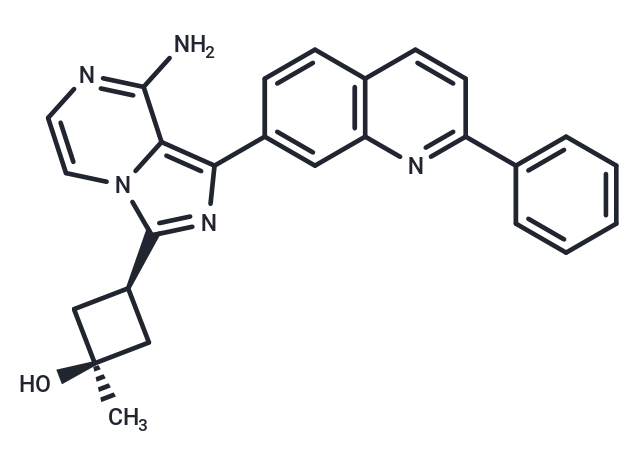
Synonyms: OSI-906

| Pack Size | Price | USA Stock | Global Stock | Quantity |
|---|---|---|---|---|
| 2 mg | $33 | In Stock | In Stock | |
| 5 mg | $52 | In Stock | In Stock | |
| 10 mg | $74 | In Stock | In Stock | |
| 25 mg | $118 | In Stock | In Stock | |
| 50 mg | $168 | In Stock | In Stock | |
| 100 mg | $233 | In Stock | In Stock | |
| 1 mL x 10 mM (in DMSO) | $58 | In Stock | In Stock |
| Description | Linsitinib (OSI-906) belongs to small molecule inhibitors and is a dual IGF-1/IR inhibitor (IC50 = 35 and 75 nM, respectively) with selectivity, cell permeability, and oral activity. This compound is used in antitumor research and can effectively inhibit cell proliferation and induce apoptosis. |
| Targets & IC50 | IGF-1R:35 nM, Insulin Receptor:75 nM, IRR:75 nM |
| In vitro | Methods: In SW48 colon cancer cells, pretreatment with Linsitinib (1.0 or 10.0 μmol/L) for 48 hours was followed by treatment with Regorafenib (5 μmol/L) for 96 hours. Results: MTT assay showed cell viability decreased to 42±7%, indicating that Linsitinib could inhibit Regorafenib resistance.[1] Methods: In PC9, HCC827, and H1975 human lung cancer cells, treatment with Linsitinib (10 μmol/L) for 5 days inhibited cell proliferation as detected by MTT assay. Results: Combination with Gefitinib synergistically inhibited cell viability in PC9 and HCC827 cells and increased apoptosis rates in HCC827 and H1975 cells. Western blot confirmed that the mechanism involved inhibition of IGF-1R and downstream AKT/ERK phosphorylation. [2] Methods: In H295R and HAC15 human adrenocortical carcinoma cells, treatment with Linsitinib for 3 or 6 days resulted in dose- and time-dependent inhibition of cell proliferation as measured by DNA content. Results: IC50 values were 1.5×10⁻⁷ M and 2.9×10⁻⁸ M, respectively. Additionally, DNA fragmentation assay confirmed its ability to induce apoptosis.[3] |
| In vivo | Methods: In an AOM/DSS-induced C57BL/6J mouse colon cancer model, Linsitinib was orally administered in combination with Regorafenib. Results: The combination therapy significantly inhibited body weight loss, reduced tumor number (minimum 1±1), and prolonged survival (40%). [1] |
| Synonyms | OSI-906 |
| Kinase Assay | Protein kinase biochemical assays: Protein kinase assays are either performed in-house by ELISA-based assay methods (IGF-1R,IR,EGFR and KDR) or at Upstate Inc.by a radiometric method with ATP at 100 μM concentration.In-house ELISA assays use poly(Glu:Tyr) as the substrate bound to the surface of 96-well assay plates and phosphorylation is detected using an antiphosphotyrosine antibody conjugated to horseradish peroxidase.The bound antibody is quantified using ABTS as the peroxidase substrate by measuring absorbance at 405 / 490 nm.All assays use purified recombinant kinase catalytic domains.Recombinant enzymes of human IGF-1R or EGFR are expressed as an NH2-terminal glutathione S-transferase fusion protein in insect cells and are purified in house.IC50 values are determined from the sigmoidal dose–response plot of percent inhibition versus log10 compound concentration.A minimum of three measurements,performed in duplicate,are carried out with in-house assays unless otherwise indicated.OSI-906 at a concentration of 1 μM is profiled versus a panel of kinases using the ProfilerProTM Kinase Selectivity Assay Kit. |
| Cell Research | For assays of cell proliferation, cells are seeded into 96-well plates in appropriate media containing FCS 10% and incubated for 3 days in the presence of OSI-906 at various concentrations. Inhibition of cell growth is determined by luminescent quantitation of intracellular ATP content using CellTiterGlo. Data is presented as a fraction of maximal proliferation, calculated by dividing the cellular density in the presence of varying concentrations of OSI-906 by the cellular density of control cells treated with vehicle (DMSO) only.(Only for Reference) |
| Molecular Weight | 421.49 |
| Formula | C26H23N5O |
| Cas No. | 867160-71-2 |
| Smiles | NC=1C=2N(C(=NC2C3=CC4=C(C=C3)C=CC(=N4)C5=CC=CC=C5)[C@H]6C[C@@](C)(O)C6)C=CN1 |
| Relative Density. | 1.39 g/cm3 |
| Storage | Store at low temperature Powder: -20°C for 3 years | In solvent: -80°C for 1 year Shipping with blue ice/Shipping at ambient temperature. | |||||||||||||||||||||||||||||||||||
| Solubility Information | Ethanol: < 1 mg/mL (insoluble or slightly soluble) H2O: < 1 mg/mL (insoluble or slightly soluble) DMSO: 96 mg/mL (227.76 mM), Sonication is recommended.  | |||||||||||||||||||||||||||||||||||
| In Vivo Formulation | 10% DMSO+40% PEG300+5% Tween 80+45% Saline: 3.3 mg/mL (7.83 mM), Sonication is recommended. Please add the solvents sequentially, clarifying the solution as much as possible before adding the next one. Dissolve by heating and/or sonication if necessary. Working solution is recommended to be prepared and used immediately. The formulation provided above is for reference purposes only. In vivo formulations may vary and should be modified based on specific experimental conditions. | |||||||||||||||||||||||||||||||||||
Solution Preparation Table | ||||||||||||||||||||||||||||||||||||
DMSO
Note : The dilution table applies only to solid products. For liquid products, please calculate the stock solution based on the stated concentration and/or density. | ||||||||||||||||||||||||||||||||||||
 For example, if the intended dosage is 10 mg/kg for animals weighing 20 g , with a dosing volume of 100 μL per animal, and a total of 10 animals are to be administered, using a formulation of
  10% DMSO+ 40% PEG300+ 5% Tween 80+ 45% Saline/PBS/ddH2O , the resulting working solution concentration would be 2 mg/mL.
Dissolve 2 mg of the compound in 100 μL DMSO to obtain a stock solution at a concentration of 20 mg/mL . If the required concentration exceeds the compound's known solubility, please contact us for technical support before proceeding.
1) Add 100 μL of the DMSO stock solution to 400 µL PEG300 and mix thoroughly until the solution becomes clear.
2) Add 50 µL Tween 80 and mix well until fully clarified.
3) Add 450 µL Saline,PBS or ddH2O and mix thoroughly until a homogeneous solution is obtained.
| Size | Quantity | Unit Price | Amount | Operation |
|---|
 Feedback
 Hello! How can I help you today?
Copyright © 2015-2026 TargetMol Chemicals Inc. All Rights Reserved.
