


Shopping Cart
Remove All Your shopping cart is currently empty


Synonyms: MDL 458
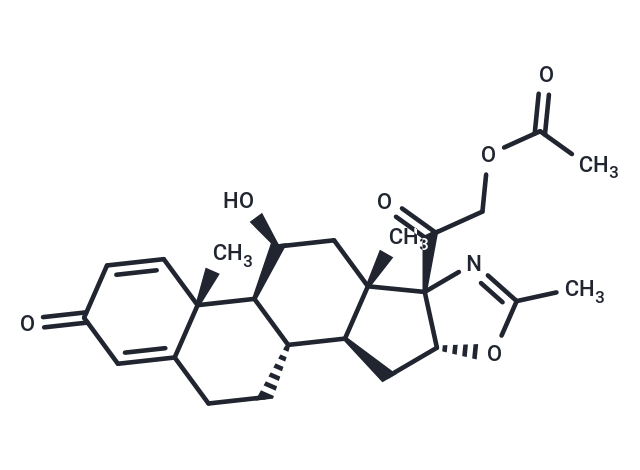

| Description | Deflazacort (MDL 458) is a glucocorticoid served as an immunosuppressant and anti-inflammatory. It can be used to treat autoimmune diseases due to inhibiting the immune system. It can also be acted in the therapy of some types of Ys. Deflazacort can help to prevent and to treat the rejection of transplanted organs. |
| In vivo | Deflazacort results in a significant and equal decrease of thymus weight, indicating a marked reduction in total immunogenic tissue in rats. [1] Deflazacort reduces thymus weight and Daily weight gain in rats. Deflazacort lowers liver IFG-I and GHR mRNA in rats. [2] Deflazacort (DFC) is a heterocyclic glucocorticoid with anti-inflammatory activity but with decreased side effects. Deflazacort and [3H]dexamethasone (DEX) similarly induce in vivo ornithine decarboxylase activity in hippocampus and liver, although body weight loss after chronic treatment is significantly less for DFC. [3] Deflazacort induces dose-dependent decreases in osteocalcin (OC) plasma production rate (PPR). Deflazacort and prednisolone increase both postabsorptive plasma glucose and plasma calcium levels in sheep, but there are no significant differences between their effects. [4] Deflazacort, especially combined with L-arginine, spares quadriceps muscle from injury-induced regeneration (myf5 expression) compared with placebo treatment, despite an increase in membrane permeability immediately after exercise. Deflazacort alone prevents the typical progressive loss of function (measured as voluntary distance run over 24 hours) that is observed 3 months later in placebo-treated mice. [5] Deflazacort causes a less significant alteration in the pattern of GH secretion and does not negatively affect the overall amount of GH secreted. [6] |
| Synonyms | MDL 458 |
| Molecular Weight | 441.53 |
| Formula | C25H31NO6 |
| Cas No. | 14484-47-0 |
| Smiles | CC1=N[C@@]2([C@H](O1)C[C@@H]1[C@@]2(C[C@@H]([C@H]2[C@H]1CCC1=CC(=O)C=C[C@]21C)O)C)C(=O)COC(=O)C |
| Relative Density. | 1.41 g/cm3 |
| Storage | Powder: -20°C for 3 years | In solvent: -80°C for 1 year Shipping with blue ice/Shipping at ambient temperature. | ||||||||||||||||||||||||||||||||||||||||
| Solubility Information | DMSO: 82 mg/mL (185.72 mM), Sonication is recommended. H2O: < 1 mg/mL (insoluble or slightly soluble) Ethanol: 10 mg/mL (22.65 mM), Sonication is recommended. | ||||||||||||||||||||||||||||||||||||||||
| In Vivo Formulation | 10% DMSO+40% PEG300+5% Tween 80+45% Saline: 3.3 mg/mL (7.47 mM), Sonication is recommended. Please add the solvents sequentially, clarifying the solution as much as possible before adding the next one. Dissolve by heating and/or sonication if necessary. Working solution is recommended to be prepared and used immediately. The formulation provided above is for reference purposes only. In vivo formulations may vary and should be modified based on specific experimental conditions. | ||||||||||||||||||||||||||||||||||||||||
Solution Preparation Table | |||||||||||||||||||||||||||||||||||||||||
Ethanol/DMSO
DMSO
Note : The dilution table applies only to solid products. For liquid products, please calculate the stock solution based on the stated concentration and/or density. | |||||||||||||||||||||||||||||||||||||||||
 For example, if the intended dosage is 10 mg/kg for animals weighing 20 g , with a dosing volume of 100 μL per animal, and a total of 10 animals are to be administered, using a formulation of
  10% DMSO+ 40% PEG300+ 5% Tween 80+ 45% Saline/PBS/ddH2O , the resulting working solution concentration would be 2 mg/mL.
Dissolve 2 mg of the compound in 100 μL DMSO to obtain a stock solution at a concentration of 20 mg/mL . If the required concentration exceeds the compound's known solubility, please contact us for technical support before proceeding.
1) Add 100 μL of the DMSO stock solution to 400 µL PEG300 and mix thoroughly until the solution becomes clear.
2) Add 50 µL Tween 80 and mix well until fully clarified.
3) Add 450 µL Saline,PBS or ddH2O and mix thoroughly until a homogeneous solution is obtained.
| Size | Quantity | Unit Price | Amount | Operation |
|---|
 Feedback
 Hello! How can I help you today?
Copyright © 2015-2026 TargetMol Chemicals Inc. All Rights Reserved.
