


Shopping Cart
Remove All Your shopping cart is currently empty

Synonyms: Sobelin HCl, Clinimycin HCl, Clindamycin HCl, Cleocin
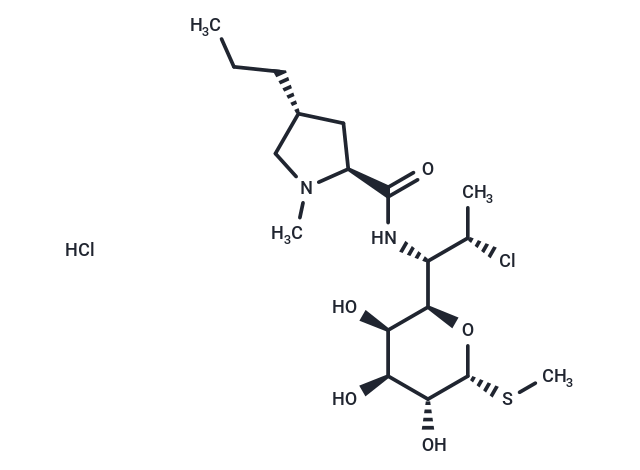
| Pack Size | Price | USA Stock | Global Stock | Quantity |
|---|---|---|---|---|
| 50 mg | $40 | In Stock | In Stock | |
| 100 mg | $48 | In Stock | In Stock | |
| 200 mg | $59 | In Stock | In Stock | |
| 1 g | $91 | - | In Stock | |
| 1 mL x 10 mM (in DMSO) | $50 | In Stock | In Stock |
| Description | Clindamycin hydrochloride (Clinimycin HCl) inhibits protein synthesis by acting on the 50S ribosomal. It is the hydrochloride salt form of clindamycin, a semi-synthetic, chlorinated broad-spectrum antibiotic produced by chemical modification of lincomycin. Clindamycin hydrochloride(Clinimycin HCl) is used as a solid in capsules. |
| In vitro | Clindamycin is a classical inhibitor of bacterial protein synthesis which binds to the 23S ribosomal RNA of the 50S ribosomal subunit. [1] |
| In vivo | Clindamycin hydrochloride is rapidly absorbed orally in dogs, exhibiting a mean absorption time (MAT) of 0.87 hours and a bioavailability of 72.55%. It shows a total clearance (CL) rate post intravenous (IV) and oral administration of 0.503 and 0.458 L/h/kg respectively, and reaches a steady-state volume of distribution (IV) of 2.48 L/kg, indicating extensive distribution throughout the body's fluids and tissues. Serum concentrations of clindamycin remain above 0.5 μg/mL for approximately 10 hours after both IV and oral administration. [1] Additionally, it significantly reduces oral malodor, dental plaque, dental calculus, and gingival bleeding in dogs over a period of 42 days. [2] At a dosage of 2.5 mg/lb following ultrasonic scaling, root planing, and polishing (USRP), clindamycin significantly impacts plaque and pocket depth related to periodontal disease, though not gingivitis. [3] Furthermore, it achieves a complete remission ratio of 71.4% (15/21) in dogs with canine superficial bacterial pyoderma within 14 to 28 days. [4] |
| Synonyms | Sobelin HCl, Clinimycin HCl, Clindamycin HCl, Cleocin |
| Kinase Assay | In vitro potency assays: After RO4929097 is used, the Aβ peptides are measured by ECL assays using a variety of anti-Aβ antibodies and an Origen 1.5 Analyzer. The 4 g8 murine mAb binds an epitope in the Aβ peptide (within amino acids 18–21) that is immediately distal to the α-secretase cleavage site. The G2–10 murine mAb binds the C terminus that is exposed after γ-secretase-mediated cleavage to generate amino acid 40 of the Aβ40 peptide. The FCA3542 rabbit antibody binds the C terminus that is exposed after γ-secretase-mediated cleavage to generate amino acid 42 of the Aβ42 peptide. The 4 g8 mAb is biotinylated with biotin-LC-sulfo-N-hydroxysuccinimide-ester. The G2–10 and FCA3542 antibodies are ruthenylated with TAG-N-hydroxysuccinimide ester. Aβ(x-40) is detected with biotinylated 4 g8 and ruthenylated G2–10. Aβ(x-42) is detected with biotinylated 4 g8 and ruthenylated FCA3542. |
| Molecular Weight | 461.44 |
| Formula | C18H33ClN2O5S·HCl |
| Cas No. | 21462-39-5 |
| Smiles | Cl.CCC[C@@H]1C[C@H](N(C)C1)C(=O)N[C@H]([C@H](C)Cl)[C@H]1O[C@H](SC)[C@H](O)[C@@H](O)[C@H]1O |
| Relative Density. | no data available |
| Storage | Powder: -20°C for 3 years | In solvent: -80°C for 1 year Shipping with blue ice/Shipping at ambient temperature. | |||||||||||||||||||||||||||||||||||
| Solubility Information | DMSO: 250 mg/mL (541.78 mM), Sonication is recommended.  | |||||||||||||||||||||||||||||||||||
| In Vivo Formulation | 10% DMSO+40% PEG300+5% Tween 80+45% Saline: 2 mg/mL (4.33 mM), Sonication is recommended. 10% DMSO+90% Saline: 10 mg/mL (21.67 mM), Solution. Please add the solvents sequentially, clarifying the solution as much as possible before adding the next one. Dissolve by heating and/or sonication if necessary. Working solution is recommended to be prepared and used immediately. The formulation provided above is for reference purposes only. In vivo formulations may vary and should be modified based on specific experimental conditions. | |||||||||||||||||||||||||||||||||||
Solution Preparation Table | ||||||||||||||||||||||||||||||||||||
DMSO
Note : The dilution table applies only to solid products. For liquid products, please calculate the stock solution based on the stated concentration and/or density. | ||||||||||||||||||||||||||||||||||||
 For example, if the intended dosage is 10 mg/kg for animals weighing 20 g , with a dosing volume of 100 μL per animal, and a total of 10 animals are to be administered, using a formulation of
  10% DMSO+ 40% PEG300+ 5% Tween 80+ 45% Saline/PBS/ddH2O , the resulting working solution concentration would be 2 mg/mL.
Dissolve 2 mg of the compound in 100 μL DMSO to obtain a stock solution at a concentration of 20 mg/mL . If the required concentration exceeds the compound's known solubility, please contact us for technical support before proceeding.
1) Add 100 μL of the DMSO stock solution to 400 µL PEG300 and mix thoroughly until the solution becomes clear.
2) Add 50 µL Tween 80 and mix well until fully clarified.
3) Add 450 µL Saline,PBS or ddH2O and mix thoroughly until a homogeneous solution is obtained.
| Size | Quantity | Unit Price | Amount | Operation |
|---|
 Feedback
 Hello! How can I help you today?
Copyright © 2015-2026 TargetMol Chemicals Inc. All Rights Reserved.
