


Shopping Cart
Remove All Your shopping cart is currently empty


Synonyms: SB-207499, Ariflo
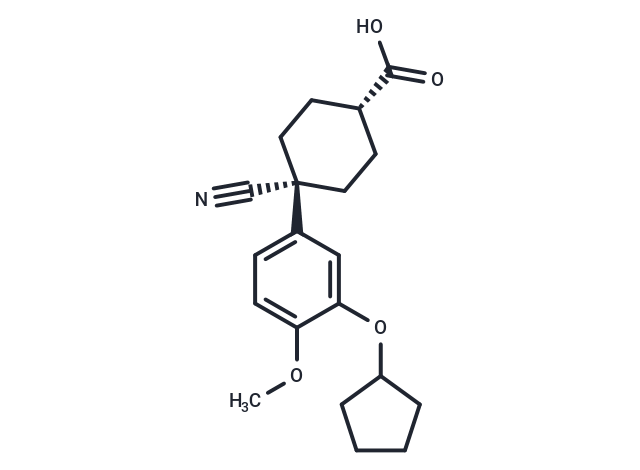

| Pack Size | Price | USA Stock | Global Stock | Quantity |
|---|---|---|---|---|
| 5 mg | $48 | In Stock | In Stock | |
| 10 mg | $89 | In Stock | In Stock | |
| 25 mg | $161 | In Stock | In Stock | |
| 50 mg | $286 | In Stock | In Stock | |
| 100 mg | $419 | In Stock | In Stock | |
| 1 mL x 10 mM (in DMSO) | $53 | In Stock | In Stock |
| Description | Cilomilast (SB-207499) is a potent PDE4 inhibitor with an IC50 of approximately 110 nM, demonstrating anti-inflammatory activity and minimal central nervous system effects. Phase 3. |
| Targets & IC50 | LPDE4:100 nM, PDE4 (human):120 nM |
| In vitro | Cilomilast produces a concentration-dependent increase in cAMP content in U937 cells. Cilomilast produces a concentration-dependent increase in cAMP content in U937 cells. [2] In isolated human monocytes, Cilomilast and (R)-rolipram are equipotent at suppressing LPS-induced TNF-α formation with -log (IC50) of 7.0 and 7.2, respectively. Both Cilomilast and (R)-rolipram produces a modest prevention of fMLP-induced degranulation of human neutrophils. Cilomilast and (R)-rolipram are equipotent at suppressing neutrophil activation with -log (IC50) of 7.1 and 6.4, respectively. [2] Cilomilast significantly decreases the expression of TNF-α in the cornea and IL-1α, IL-1β, and TNF-α in the conjunctivaas compared to vehicle control. Cilomilast treatment markedly decreases the presence of CD11b+ antigen-presenting cells in the central and peripheral cornea, and leads to decreased conjunctival expression of cytokines IL-6, IL-23, and IL-17. Moreover, Cilomilast decreases the expression of IL-17 and IL-23 in the draining lymph nodes. [3] Cilomilast reduces TLR4 expression, IL-8 release and neutrophil chemotactic activity as well as it increased IP-10 release and lymphocyte chemotactic activity. [4] |
| In vivo | Cilomilast inhibits human TNFα production with oral ED50 of 4.9 mg/kg. In contrast to their equipotent activity against TNFα production, Cilomilast (ED50 = 2.3 mg/kg, p.o.) is 10-fold less potent than R-rolipram (ED50 = 0.23 mg/kg, p.o.) in reversing reserpine-induced hypothermia, a model of antidepressant activity. [1] In time course studies, Cilomilast (30 mg/kg, p.o.) suppresses TNFα production for at least 10 hour. The ability of Cilomilast to modulate interleukin-4 productionin vivo is assessed in a chronic oxazolone-induced contact sensitivity model in Balb/c mice. Topical administration of Cilomilast (1000 μg) inhibits intralesional concentrations of interleukin-4. [1] Orally administered cilomilast dose-dependently inhibits production of interleukin-4, TNF-α, and cysteinyl leukotrienes, as well as leukocyte infiltration in bronchoalveolar lavage fluid from the airways of ovalbumin-sensitized Brown Norway rats [5]. |
| Synonyms | SB-207499, Ariflo |
| Cell Research | U937 cells (1-2 × 10 6) are incubated at 37 °C in a shaking water bath with Cilomilast for 1 min before the addition of 0.1 μM PGE2 (total volume of 200 μL). The incubation proceeds for an additional 4 min and is stopped by the addition of 0.1 mL of HClO4 (17.5%), neutralized with 0.15 ml of K2 |
| Molecular Weight | 343.42 |
| Formula | C20H25NO4 |
| Cas No. | 153259-65-5 |
| Smiles | COc1ccc(cc1OC1CCCC1)[C@]1(CC[C@@H](CC1)C(O)=O)C#N |
| Relative Density. | 1.21 g/cm3 (Predicted) |
| Storage | Powder: -20°C for 3 years | In solvent: -80°C for 1 year Shipping with blue ice/Shipping at ambient temperature. | ||||||||||||||||||||||||||||||||||||||||
| Solubility Information | Ethanol: 31 mg/mL (90.27 mM), Sonication is recommended. DMSO: 150 mg/mL (436.78 mM), Sonication is recommended.  H2O: < 1 mg/mL (insoluble or slightly soluble) | ||||||||||||||||||||||||||||||||||||||||
| In Vivo Formulation | 10% DMSO+40% PEG300+5% Tween 80+45% Saline: 10 mg/mL (29.12 mM), Solution. 10% DMSO+90% Saline: < 10 mg/mL (29.12 mM), Lower concentrations may be soluble, but exact solubility limit is unknown. Please add the solvents sequentially, clarifying the solution as much as possible before adding the next one. Dissolve by heating and/or sonication if necessary. Working solution is recommended to be prepared and used immediately. The formulation provided above is for reference purposes only. In vivo formulations may vary and should be modified based on specific experimental conditions. | ||||||||||||||||||||||||||||||||||||||||
Solution Preparation Table | |||||||||||||||||||||||||||||||||||||||||
Ethanol/DMSO
DMSO
Note : The dilution table applies only to solid products. For liquid products, please calculate the stock solution based on the stated concentration and/or density. | |||||||||||||||||||||||||||||||||||||||||
 For example, if the intended dosage is 10 mg/kg for animals weighing 20 g , with a dosing volume of 100 μL per animal, and a total of 10 animals are to be administered, using a formulation of
  10% DMSO+ 40% PEG300+ 5% Tween 80+ 45% Saline/PBS/ddH2O , the resulting working solution concentration would be 2 mg/mL.
Dissolve 2 mg of the compound in 100 μL DMSO to obtain a stock solution at a concentration of 20 mg/mL . If the required concentration exceeds the compound's known solubility, please contact us for technical support before proceeding.
1) Add 100 μL of the DMSO stock solution to 400 µL PEG300 and mix thoroughly until the solution becomes clear.
2) Add 50 µL Tween 80 and mix well until fully clarified.
3) Add 450 µL Saline,PBS or ddH2O and mix thoroughly until a homogeneous solution is obtained.
| Size | Quantity | Unit Price | Amount | Operation |
|---|
 Feedback
 Hello! How can I help you today?
Copyright © 2015-2026 TargetMol Chemicals Inc. All Rights Reserved.
