


Shopping Cart
Remove All Your shopping cart is currently empty

Synonyms: CB5083, CB 5083
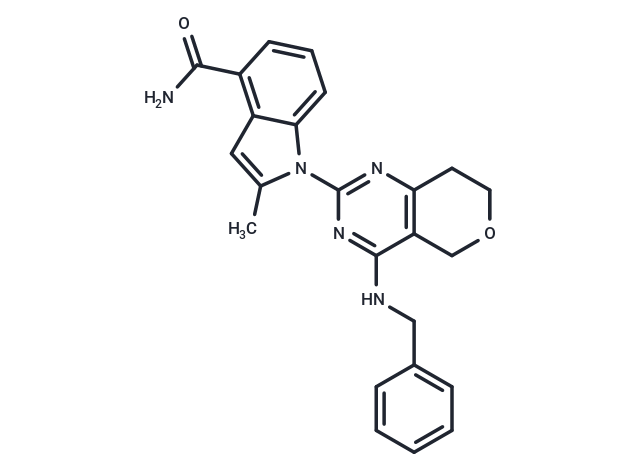

| Pack Size | Price | USA Stock | Global Stock | Quantity |
|---|---|---|---|---|
| 1 mg | $38 | In Stock | In Stock | |
| 2 mg | $54 | In Stock | In Stock | |
| 5 mg | $89 | In Stock | In Stock | |
| 10 mg | $139 | In Stock | In Stock | |
| 25 mg | $313 | In Stock | In Stock | |
| 50 mg | $493 | In Stock | In Stock | |
| 100 mg | $723 | In Stock | In Stock | |
| 500 mg | $1,520 | - | In Stock | |
| 1 mL x 10 mM (in DMSO) | $98 | In Stock | In Stock |
| Description | CB-5083 is an effective, selective, orally available p97 AAA ATPase inhibitor with an IC50 of 11 nM. CB-5083 exhibits broad-spectrum antitumor activity. CB-5083 can be used in studies of protein homeostasis disruption, endoplasmic reticulum stress, and tumor drug resistance. |
| Targets & IC50 | p97 AAA ATPase:11 nM |
| In vitro | Methods: Patient-derived myoblasts (p.R155H) were treated with CB-5083 (75, 100, 150 nM) for 5 days. Western blot analysis was performed to detect MFN2, p62, LC3, TFEB, and VCP protein levels. Results: CB-5083 induced significant upregulation of MFN2 levels, along with marked increases in autophagy markers p62 and the LC3-II/I ratio. No significant changes were observed in TFEB or total VCP levels. [1] Methods: Eleven osteosarcoma cell lines (U2OS, HOS, SJSA-1, etc.) and human osteoblasts (hFOB1.19) were treated with CB-5083 at concentrations ranging from 0 to 8 μM for 72 hours. Cell viability was assessed using the MTT assay, and the half-maximal inhibitory concentration (IC₅₀) was calculated. Results: CB-5083 exhibited a dose-dependent inhibitory effect on osteosarcoma cells with an IC₅₀ range of 0.3286–1.032 μM.[2] |
| In vivo | Methods: Homozygous VCPR 155H/R155H mice (2 months old) received oral gavage of CB-5083 at 15 mg/kg/day once daily for 5 months. Results: CB-5083 was well tolerated with normal body weight. Serum AST and CK showed a decreasing trend, with no hepatotoxicity observed. Rotarod performance did not significantly deteriorate. [1] Methods: Nude mice were subcutaneously implanted with SJSA-1 cells. Upon reaching a tumor volume of 100 mm³, oral gavage administration of CB-5083 (100 mg/kg/day) was initiated once daily for 30 days. Results: Tumor volume in the CB-5083-treated group was significantly smaller than the control group starting from day 15. At the endpoint, the mean tumor weight was significantly higher in the control group (823 mg) than in the CB-5083 group (416 mg).[2] |
| Synonyms | CB5083, CB 5083 |
| Kinase Assay | ATPase assay: Compounds are diluted in DMSO with a 3-fold 10-point serial dilution starting at 10 μM. The assay is done in a 384-well plate with each row as a single dilution series with duplicate of each compound concentration point. In 5 μL total volume, 20 nM p97 hexameric enzyme and 20 μM ATP are added to start the reaction. The plate is sealed and incubated at 37 °C for 15 min after mixing thoroughly in an orbital shaker. Compound dilution, ATP and enzymes addition are conducted with automated liquid handling using the Freedom Evo. ADP Glo reagents 1 and 2 are added according to the manufacturer's protocol. The luminescence is measured by Envision plate reader as the end point of the reaction. The IC50 of each compound is derived by fitting the luminescence values to a four-parameter sigmoidal curve. |
| Cell Research | A549 and other tumor cell lines are cultured according to ATCC guidelines. Cells are cultured in black or white, clear-bottomed, tissue culture-treated 384-well plates. Cells are treated with 10-point dose titration of the compound in well duplicates. After a 72 h treatment, CellTiter-Glo is added to the white plates to measure cell viability. Luminescence values are fit to a four-parameter sigmoidal curve to determine IC50 concentrations.(Only for Reference) |
| Molecular Weight | 413.47 |
| Formula | C24H23N5O2 |
| Cas No. | 1542705-92-9 |
| Smiles | Cc1cc2c(cccc2n1-c1nc2CCOCc2c(NCc2ccccc2)n1)C(N)=O |
| Relative Density. | 1.37 g/cm3 (Predicted) |
| Storage | Store at low temperature Powder: -20°C for 3 years | In solvent: -80°C for 1 year Shipping with blue ice/Shipping at ambient temperature. | ||||||||||||||||||||||||||||||||||||||||
| Solubility Information | Ethanol: 11 mg/mL (26.6 mM), Sonication is recommended. H2O: < 1 mg/mL (insoluble or slightly soluble) DMSO: 247.5 mg/mL (598.59 mM), Sonication is recommended.  | ||||||||||||||||||||||||||||||||||||||||
| In Vivo Formulation | 10% DMSO+40% PEG300+5% Tween 80+45% Saline: 6 mg/mL (14.51 mM), Solution. Please add the solvents sequentially, clarifying the solution as much as possible before adding the next one. Dissolve by heating and/or sonication if necessary. Working solution is recommended to be prepared and used immediately. The formulation provided above is for reference purposes only. In vivo formulations may vary and should be modified based on specific experimental conditions. | ||||||||||||||||||||||||||||||||||||||||
Solution Preparation Table | |||||||||||||||||||||||||||||||||||||||||
Ethanol/DMSO
DMSO
Note : The dilution table applies only to solid products. For liquid products, please calculate the stock solution based on the stated concentration and/or density. | |||||||||||||||||||||||||||||||||||||||||
 For example, if the intended dosage is 10 mg/kg for animals weighing 20 g , with a dosing volume of 100 μL per animal, and a total of 10 animals are to be administered, using a formulation of
  10% DMSO+ 40% PEG300+ 5% Tween 80+ 45% Saline/PBS/ddH2O , the resulting working solution concentration would be 2 mg/mL.
Dissolve 2 mg of the compound in 100 μL DMSO to obtain a stock solution at a concentration of 20 mg/mL . If the required concentration exceeds the compound's known solubility, please contact us for technical support before proceeding.
1) Add 100 μL of the DMSO stock solution to 400 µL PEG300 and mix thoroughly until the solution becomes clear.
2) Add 50 µL Tween 80 and mix well until fully clarified.
3) Add 450 µL Saline,PBS or ddH2O and mix thoroughly until a homogeneous solution is obtained.
| Size | Quantity | Unit Price | Amount | Operation |
|---|
 Feedback
 Hello! How can I help you today?
Copyright © 2015-2026 TargetMol Chemicals Inc. All Rights Reserved.
