


Shopping Cart
Remove All Your shopping cart is currently empty


Synonyms: BAY 68-4986
| Pack Size | Price | USA Stock | Global Stock | Quantity |
|---|---|---|---|---|
| 5 mg | $29 | In Stock | In Stock | |
| 10 mg | $37 | In Stock | In Stock | |
| 50 mg | $109 | In Stock | In Stock | |
| 1 mL x 10 mM (in DMSO) | $29 | In Stock | In Stock |
| Description | Capadenoson (BAY 68-4986) is a selective adenosine-A1 receptor agonist. |
| In vitro | To elucidate the pharmacological effects of Capadenson, GTP shift assays compare its action to the A1-agonist CCPA and A1-antagonist DPCPX on rat cortical brain membranes. CCPA has a Ki value of 4.2 nM, which increases to 64 nM with 1 mM GTP, demonstrating a GTP shift of 15. Conversely, DPCPX displays a GTP shift of 1, indicating nearly unchanged Ki values with and without GTP. Capadenson presents a Ki value of 24 nM, escalating to 116 nM when exposed to 1 mM GTP, equating to a GTP shift of 5. This data highlights the distinct interactions of these compounds with GTP and their varied pharmacological profiles. |
| In vivo | In vivo experiments involving Wistar rats and SHR showed that pre-treatment with Capadenoson (0.15 mg/kg) for 5 days led to a consistent plasma concentration of the drug, averaging 7.63 μg/L on days 4 and 5. This level remained stable even after a 2-hour physical restraint stress test performed on day 5, administered 3 hours post Capadenoson intake, indicating steady absorption and efficacy throughout the pre-test period. |
| Synonyms | BAY 68-4986 |
| Kinase Assay | Membranes from the human cortex are prepared. [35S]GTPγS binding is measured. Briefly, 5 μg of membrane protein is incubated in a total volume of 160 μL for 2 hr at 25°C in a shaking water bath. [35S]GTPγS binding in control incubations and in the presence of Capadenoson showed a linear time course up to this incubation time. Binding buffer contained 50 mM Tris/HCl, pH 7.4, 2 mM triethanolamine, 1 mM EDTA, 5 mM MgCl2, 10 μM GDP, 1 mM dithiothreitol, 100 mM NaCl, 0.2 units/mL adenosine deaminase, 0.2 nM [35S]GTPγS, and 0.5% bovine serum albumin. Non-specific binding is determined in the presence of 10 μM GTPγS. Incubations are terminated through filtration of the samples over multiscreen FB glass fiber filters followed by two washes with binding buffer. The filters are dried, coated with scintillator and counted for radioactivity. Binding curves of [35S]GTPγS are analyzed by nonlinear regression using GraphPad Prism. |
| Animal Research | A total of 14 Wistar rats and 18 SHR (bodyweight 200-50 g, all-female) underwent experiments to evaluate the exocytotic, stimulation-induced NE release during electrical field stimulation. Rats are killed by an injection of pentobarbital i.p. (0.5 mL/100 mg body weight), and hearts are rapidly excised, and placed in ice-cold Krebs-Henseleit solution (KHL). They are quickly mounted on a Langendorff apparatus for retrograde perfusion with KHL. Perfusion rate is kept constant at 10 mL/min, the temperature is adjusted to 37°C, and the pH to 7.4 through bubbling with 5% CO2/95% O2. Via an inflow line desipramine at a concentration of 10?7 M is added to the perfusion buffer. After an equilibration period of 20 minutes, electrical field stimulation is commenced via two metal paddles adjacent to both sides of the beating heart for 1 minute (5V, 6 Hz). We collected the efflux in plastic tubes the minute before, during, and 3 minutes after the stimulation. These are rapidly frozen in liquid nitrogen and stored at ?20°C till analysis. The NE release is calculated as the cumulative release induced by electrical stimulation. After the first stimulation (S1), the study drug Capadenoson at concentrations of 30 μg/L (6×10^?8 M) or 300 μg/L(6×10^?7 M), or CCPA (10^?6 M), respectively, are added via separate perfusion lines for 30 minutes. After this time a second stimulation (S2) is executed to determine the effect of the drugs on NE release compared to the first stimulation. The effect of each pharmacological intervention is analyzed by calculating the ratio of NE release induced by the second and first stimulation (S2/S1 ratio). |
| Molecular Weight | 520.03 |
| Formula | C25H18ClN5O2S2 |
| Cas No. | 544417-40-5 |
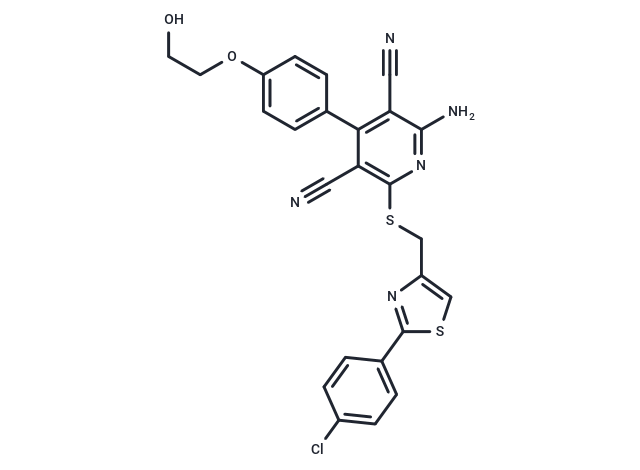
| Smiles | Nc1nc(SCc2csc(n2)-c2ccc(Cl)cc2)c(C#N)c(-c2ccc(OCCO)cc2)c1C#N |
| Relative Density. | 1.51 |
| Storage | Powder: -20°C for 3 years | In solvent: -80°C for 1 year Shipping with blue ice/Shipping at ambient temperature. | |||||||||||||||||||||||||||||||||||
| Solubility Information | DMSO: 70 mg/mL (134.61 mM), Sonication is recommended.  H2O: Insoluble | |||||||||||||||||||||||||||||||||||
| In Vivo Formulation | 10% DMSO+90% Corn Oil: 3.3 mg/mL (6.35 mM), Sonication is recommended. Please add the solvents sequentially, clarifying the solution as much as possible before adding the next one. Dissolve by heating and/or sonication if necessary. Working solution is recommended to be prepared and used immediately. The formulation provided above is for reference purposes only. In vivo formulations may vary and should be modified based on specific experimental conditions. | |||||||||||||||||||||||||||||||||||
Solution Preparation Table | ||||||||||||||||||||||||||||||||||||
DMSO
Note : The dilution table applies only to solid products. For liquid products, please calculate the stock solution based on the stated concentration and/or density. | ||||||||||||||||||||||||||||||||||||
 For example, if the intended dosage is 10 mg/kg for animals weighing 20 g , with a dosing volume of 100 μL per animal, and a total of 10 animals are to be administered, using a formulation of
  10% DMSO+ 40% PEG300+ 5% Tween 80+ 45% Saline/PBS/ddH2O , the resulting working solution concentration would be 2 mg/mL.
Dissolve 2 mg of the compound in 100 μL DMSO to obtain a stock solution at a concentration of 20 mg/mL . If the required concentration exceeds the compound's known solubility, please contact us for technical support before proceeding.
1) Add 100 μL of the DMSO stock solution to 400 µL PEG300 and mix thoroughly until the solution becomes clear.
2) Add 50 µL Tween 80 and mix well until fully clarified.
3) Add 450 µL Saline,PBS or ddH2O and mix thoroughly until a homogeneous solution is obtained.
| Size | Quantity | Unit Price | Amount | Operation |
|---|
 Feedback
 Hello! How can I help you today?
Copyright © 2015-2026 TargetMol Chemicals Inc. All Rights Reserved.
