


Shopping Cart
Remove All Your shopping cart is currently empty


Synonyms: RG 6046, GDC-0810, GDC0810, GDC 0810, ARN-810

| Pack Size | Price | USA Stock | Global Stock | Quantity |
|---|---|---|---|---|
| 1 mg | $37 | In Stock | In Stock | |
| 5 mg | $85 | In Stock | In Stock | |
| 10 mg | $132 | In Stock | In Stock | |
| 25 mg | $239 | In Stock | In Stock | |
| 50 mg | $363 | In Stock | In Stock | |
| 100 mg | $546 | In Stock | In Stock | |
| 1 mL x 10 mM (in DMSO) | $93 | In Stock | In Stock |
| Description | Brilanestrant (GDC-0810) is a selective estrogen receptor degrader (IC50: 0.7 nM). |
| Targets & IC50 | ERα:0.7 nM |
| In vitro | Brilanestrant is a ERα binder (IC50: 6.1 nM), a full transcriptional antagonist with no agonism (3× ERE, IC50: 2 nM), and displays good potency and efficacy in ER-α degradation (EC50: 0.7 nM) and MCF-7 breast cancer cell viability (IC50; 2.5 nM) assays [1]. Brilanestrant induces a distinct ERα conformation versus tamoxifen and other ER therapeutics, and does not exhibit tamoxifen-like ER agonism in MCF7 cells [2]. |
| In vivo | The pharmacokinetic profile of Brilanestrant shows it is a clearance molecule across species, with good bioavailability (40%-60%). Brilanestrant (3 mg/kg, p.o.) shows substantial tumor-growth inhibition in a tamoxifen-sensitive MCF-7 xenograft model, while at the highest dose of 100 mg/kg/day, all animals show tumor regression of more than 50% without weight loss [1]. Brilanestrant exhibits low clearance (11 mL/min/kg) and 61% oral bioavailability. Brilanestrant (1-100 mg/kg/day, p.o.) displays dose-dependent efficacy in the MCF7 xenograft model [2]. |
| Synonyms | RG 6046, GDC-0810, GDC0810, GDC 0810, ARN-810 |
| Cell Research | MCF-7 cells are adjusted to a concentration of 40000 cells per mL in RPMI containing 10% FBS and 20 mM HEPES. Then 16 μL of the cell suspension (640 cells) is added to each well of a 384-well plate, and the cells are incubated overnight to allow the cells to adhere. The following day a 10-point, serial 1:5 dilution of each compound is added to the cells in 16 μL at a final concentration ranging from 10 to 0.000005 μM. After 5 days' compound exposure, 16 μL of CellTiter-GLo is added to the cells, and the relative luminescence units of each well are determined. CellTiter-GLo added to 32 μL of medium without cells is used to obtain a background value. The percent viability of each sample is determined as follows: RLU sample-RLU background/RLU untreated cells-RLU background ×100=%viability. |
| Animal Research | Time release pellets containing 0.72 mg 17-β estradiol are subcutaneously implanted into nu/nu mice. MCF-7 cells are grown in RPMI containing 10% FBS at 5% CO2 37°C. Trypsinized cells are pelleted and resuspended in 50% RPMI(serum free)and 50% Matrigel at 1×10⁷ cells/mL. MCF-7 cells are subcutaneously injected (100 μL/animal) on the right flank 2-3 days post pellet implantation. Tumor volume (length × width2/2) is monitored biweekly. When tumors reach an average volume of appr 200 mm3 animals are randomized and treatment is started. Animals are treated with vehicle or compound daily for 4 weeks. Tumor volume and body weight are monitored biweekly throughout the study. |
| Molecular Weight | 446.9 |
| Formula | C26H20ClFN2O2 |
| Cas No. | 1365888-06-7 |
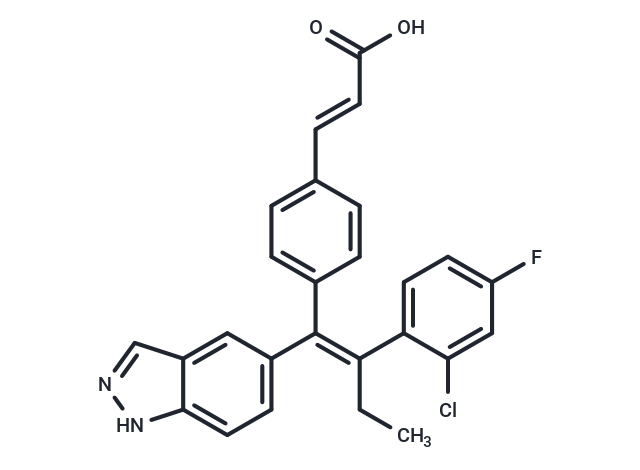
| Smiles | CC\C(=C(\c1ccc(\C=C\C(O)=O)cc1)c1ccc2[nH]ncc2c1)c1ccc(F)cc1Cl |
| Relative Density. | 1.342 g/cm3 (Predicted) |
| Storage | Powder: -20°C for 3 years | In solvent: -80°C for 1 year Shipping with blue ice/Shipping at ambient temperature. | |||||||||||||||||||||||||||||||||||
| Solubility Information | DMSO: 150 mg/mL (335.65 mM), Sonication is recommended.  H2O: Insoluble | |||||||||||||||||||||||||||||||||||
| In Vivo Formulation | 10% DMSO+40% PEG300+5% Tween 80+45% Saline: 10 mg/mL (22.38 mM), Suspension. 10% DMSO+90% Saline: < 10 mg/mL (22.38 mM), Lower concentrations may be soluble, but exact solubility limit is unknown. Please add the solvents sequentially, clarifying the solution as much as possible before adding the next one. Dissolve by heating and/or sonication if necessary. Working solution is recommended to be prepared and used immediately. The formulation provided above is for reference purposes only. In vivo formulations may vary and should be modified based on specific experimental conditions. | |||||||||||||||||||||||||||||||||||
Solution Preparation Table | ||||||||||||||||||||||||||||||||||||
DMSO
Note : The dilution table applies only to solid products. For liquid products, please calculate the stock solution based on the stated concentration and/or density. | ||||||||||||||||||||||||||||||||||||
 For example, if the intended dosage is 10 mg/kg for animals weighing 20 g , with a dosing volume of 100 μL per animal, and a total of 10 animals are to be administered, using a formulation of
  10% DMSO+ 40% PEG300+ 5% Tween 80+ 45% Saline/PBS/ddH2O , the resulting working solution concentration would be 2 mg/mL.
Dissolve 2 mg of the compound in 100 μL DMSO to obtain a stock solution at a concentration of 20 mg/mL . If the required concentration exceeds the compound's known solubility, please contact us for technical support before proceeding.
1) Add 100 μL of the DMSO stock solution to 400 µL PEG300 and mix thoroughly until the solution becomes clear.
2) Add 50 µL Tween 80 and mix well until fully clarified.
3) Add 450 µL Saline,PBS or ddH2O and mix thoroughly until a homogeneous solution is obtained.
| Size | Quantity | Unit Price | Amount | Operation |
|---|
 Feedback
 Hello! How can I help you today?
Copyright © 2015-2026 TargetMol Chemicals Inc. All Rights Reserved.
