


Shopping Cart
Remove All Your shopping cart is currently empty


Synonyms: BIX 01294
| Pack Size | Price | USA Stock | Global Stock | Quantity |
|---|---|---|---|---|
| 2 mg | $48 | In Stock | In Stock | |
| 5 mg | $65 | In Stock | In Stock | |
| 10 mg | $109 | In Stock | In Stock | |
| 25 mg | $202 | In Stock | In Stock | |
| 50 mg | $288 | In Stock | In Stock | |
| 100 mg | $496 | In Stock | In Stock | |
| 200 mg | $675 | In Stock | In Stock | |
| 1 mL x 10 mM (in DMSO) | $98 | In Stock | In Stock |
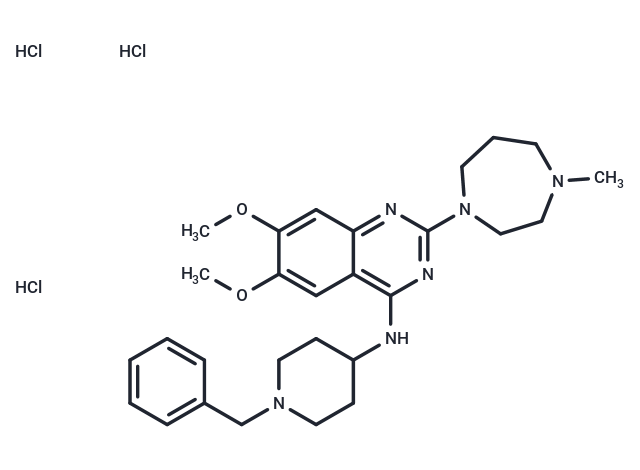
| Description | BIX-01294 trihydrochloride is an inhibitor of G9a histone methyltransferase.In a cell-free assay, the IC50=2.7 μM for G9a histone methyltransferase. |
| Targets & IC50 | G9a:2.7 μM |
| In vivo | In wild-type embryonic stem (ES) cells, mouse embryonic fibroblasts, and HeLa cells, BIX-01294 (4.1 μM) reduces the levels of H3K9me2. BIX-01294 can specifically inhibit G9a (IC50=1.7 μM) and GLP (IC50=38 μM). |
| Synonyms | BIX 01294 |
| Kinase Assay | ATR for use in the in vitro enzyme assay is obtained from HeLa nuclear extract by immunoprecipitation with rabbit polyclonal antiserum raised to amino acids 400-480 of ATR contained in the following buffer: 25 mM HEPES (pH 7.4), 2 mM MgCl2, 250 mM NaCl, 0.5 mM EDTA, 0.1 mM Na3VO4, 10% v/v glycerol, and 0.01% v/v Tween 20. ATR-antibody complexes are isolated from nuclear extract by incubating with protein A-Sepharose beads for 1 h and then through centrifugation to recover the beads. In the well of a 96-well plate, 10 μL ATR-containing Sepharose beads are incubated with 1 μg of substrate glutathione?S-transferase-p53N66 (NH2-terminal 66 amino acids of p53 fused to glutathione?S-transferase are expressed in?E. coli) in ATR assay buffer (50 mM HEPES (pH 7.4), 150 mM NaCl, 6 mM MgCl2, 4 mM MnCl2, 0.1 mM Na3VO4, 0.1 mM DTT, and 10% (v/v) glycerol) at 37°C in the presence or absence of inhibitor. After 10 min with gentle shaking, ATP is added to a final concentration of 3 μM and the reaction continued at 37°C for an additional 1 h. The reaction is stopped by addition of 100 μL of PBS, and the reaction is transferred to a white opaque glutathione coated 96-well plate and incubated overnight at 4°C. This plate is then washed with PBS/0.05% (v/v) Tween 20, blotted dry, and analyzed by a standard ELISA technique with a phosphoserine 15 p53 antibody. The detection of phosphorylated glutathione?S-transferase-p53N66 substrate is performed in combination with a goat anti-mouse horseradish peroxidase-conjugated secondary antibody. Enhanced chemiluminescence solution is used to produce a signal, and chemiluminescent detection is carried out via a TopCount plate reader. The resulting calculated % enzyme activity is then used to determine the IC50?values for the compounds (IC50?taken as the concentration at which 50% of the enzyme activity is inhibited). |
| Molecular Weight | 600.02 |
| Formula | C28H38N6O2·3HCl |
| Cas No. | 1392399-03-9 |
| Smiles | Cl.Cl.Cl.COc1cc2nc(nc(NC3CCN(Cc4ccccc4)CC3)c2cc1OC)N1CCCN(C)CC1 |
| Relative Density. | no data available |
| Storage | Powder: -20°C for 3 years | In solvent: -80°C for 1 year Shipping with blue ice/Shipping at ambient temperature. | |||||||||||||||||||||||||||||||||||
| Solubility Information | H2O: 60 mg/mL (100 mM), Sonication is recommended. DMSO: 260 mg/mL (433.32 mM), Sonication is recommended.  | |||||||||||||||||||||||||||||||||||
Solution Preparation Table | ||||||||||||||||||||||||||||||||||||
H2O/DMSO
Note : The dilution table applies only to solid products. For liquid products, please calculate the stock solution based on the stated concentration and/or density. | ||||||||||||||||||||||||||||||||||||
 For example, if the intended dosage is 10 mg/kg for animals weighing 20 g , with a dosing volume of 100 μL per animal, and a total of 10 animals are to be administered, using a formulation of
  10% DMSO+ 40% PEG300+ 5% Tween 80+ 45% Saline/PBS/ddH2O , the resulting working solution concentration would be 2 mg/mL.
Dissolve 2 mg of the compound in 100 μL DMSO to obtain a stock solution at a concentration of 20 mg/mL . If the required concentration exceeds the compound's known solubility, please contact us for technical support before proceeding.
1) Add 100 μL of the DMSO stock solution to 400 µL PEG300 and mix thoroughly until the solution becomes clear.
2) Add 50 µL Tween 80 and mix well until fully clarified.
3) Add 450 µL Saline,PBS or ddH2O and mix thoroughly until a homogeneous solution is obtained.
| Size | Quantity | Unit Price | Amount | Operation |
|---|
 Feedback
 Hello! How can I help you today?
Copyright © 2015-2026 TargetMol Chemicals Inc. All Rights Reserved.
