


Shopping Cart
Remove All Your shopping cart is currently empty


Synonyms: Venagil, Vasoc, Benzaronum, Benzarona
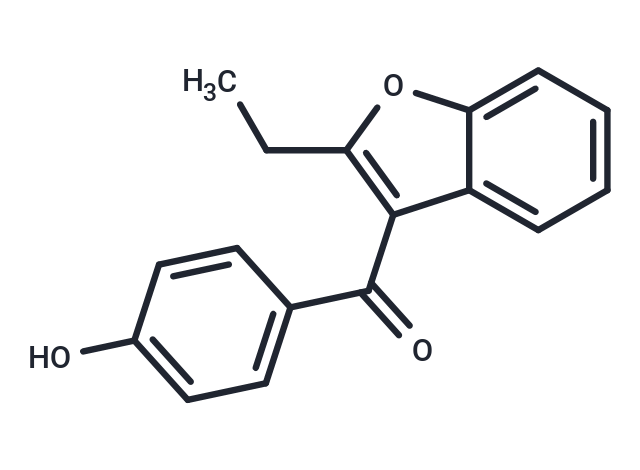
| Pack Size | Price | USA Stock | Global Stock | Quantity |
|---|---|---|---|---|
| 1 g | $30 | In Stock | In Stock | |
| 1 mL x 10 mM (in DMSO) | $29 | In Stock | In Stock |
| Description | Benzarone (Benzarona) is a potent inhibitor of human uric acid transporter 1 (URAT1, IC50 = 2.8 μM in oocyte). Benzarone lowers the level of uric acid serum. |
| Targets & IC50 | URAT1:2.8 μM(oocyte) |
| In vitro | Studies on the action of benzarone on the metabolism of cultured arterial smooth muscle cells and arterial tissue had the following results: 1. On incubation of calf arterial tissue in the presence of 0.03--0.1 mmol/l benzarone (8--26 micrograms/ml medium) the metabolic transformation of [14C]-glucose to [14C]-lactate and 14CO2 and the incorporation of 14C radioactivity into the total lipids is not significantly altered as compared with control values. In cultured human arterial smooth muscle cells 0.03 mmol/l benzarone stimulates the incorporation of [14C]-acetate and [3H]-palmitate into the cellular lipids while the receptor mediated uptake of homologous low-density lipoproteins (LDL) by the cells and their release are not influenced. 2. In concentrations greater than 0.2 mmol/l benzarone the glucose utilisation of arterial tissue is enhanced, while the labelling of lipids, in particular the labelling of the triglyceride fraction, is depressed. Under the same conditions the protein biosynthesis and the incorporation of [14C]-acetate and [3H]-palmitate into the total lipids of cultured arterial smooth muscle cells are decreased[2]. |
| In vivo | Rats of BD X strain and SHR/NIH Montreal Ingelheim strain (genetic hypertension) received a diet containing 3.9% cholesterol or 3.7% cholesterol plus 0.6% benzarone, respectively, and libitum for 5 or 9 months. The following chemical and ultrastructural results were obtained. 1. The cholesterol-benzarone diet causes a body weight reduction of 10%, a relative increase of serum HDL and a corresponding decrease of serum LDL and VLDL, as compared with the effects of the cholesterol diet. No differences of total serum cholesterol and serum triglycerides between the two groups were observed. 2. The aorta of cholesterol fed animals shows a slight but statistically not significant increase of total cholesterol content. 3. No differences in the composition of connective tissue components (collagen, elastin, uronic acid content) between the cholesterol fed animals and a control group on normal diet could be detected. 4. Electron micrographs of several vessel wall areas from cholesterol fed hypertensive animals revealed fibrosis, necrosis of media muscle cells and an increase of matrix vesicles. Severe damages were found in coronary arteries and in the caudal arteries. 5. Cholesterol feeding of hypertensive rats increases the cholesterol content of liver 10fold and the triglycerides content 3fold as compared with liver lipids of control rats. Benzarone application to cholesterol fed rats effects a statistically significant decrease of liver cholesterol and triglycerides[3]. |
| Synonyms | Venagil, Vasoc, Benzaronum, Benzarona |
| Molecular Weight | 266.29 |
| Formula | C17H14O3 |
| Cas No. | 1477-19-6 |
| Smiles | CCc1oc2ccccc2c1C(=O)c1ccc(O)cc1 |
| Relative Density. | 1.1601 g/cm3 (Estimated) |
| Storage | Powder: -20°C for 3 years | In solvent: -80°C for 1 year Shipping with blue ice/Shipping at ambient temperature. | |||||||||||||||||||||||||||||||||||
| Solubility Information | DMSO: 55 mg/mL (206.54 mM), Sonication is recommended.  | |||||||||||||||||||||||||||||||||||
| In Vivo Formulation | 10% DMSO+40% PEG300+5% Tween 80+45% Saline: 2 mg/mL (7.51 mM), Sonication is recommended. Please add the solvents sequentially, clarifying the solution as much as possible before adding the next one. Dissolve by heating and/or sonication if necessary. Working solution is recommended to be prepared and used immediately. The formulation provided above is for reference purposes only. In vivo formulations may vary and should be modified based on specific experimental conditions. | |||||||||||||||||||||||||||||||||||
Solution Preparation Table | ||||||||||||||||||||||||||||||||||||
DMSO
Note : The dilution table applies only to solid products. For liquid products, please calculate the stock solution based on the stated concentration and/or density. | ||||||||||||||||||||||||||||||||||||
 For example, if the intended dosage is 10 mg/kg for animals weighing 20 g , with a dosing volume of 100 μL per animal, and a total of 10 animals are to be administered, using a formulation of
  10% DMSO+ 40% PEG300+ 5% Tween 80+ 45% Saline/PBS/ddH2O , the resulting working solution concentration would be 2 mg/mL.
Dissolve 2 mg of the compound in 100 μL DMSO to obtain a stock solution at a concentration of 20 mg/mL . If the required concentration exceeds the compound's known solubility, please contact us for technical support before proceeding.
1) Add 100 μL of the DMSO stock solution to 400 µL PEG300 and mix thoroughly until the solution becomes clear.
2) Add 50 µL Tween 80 and mix well until fully clarified.
3) Add 450 µL Saline,PBS or ddH2O and mix thoroughly until a homogeneous solution is obtained.
| Size | Quantity | Unit Price | Amount | Operation |
|---|
 Feedback
 Hello! How can I help you today?
Copyright © 2015-2026 TargetMol Chemicals Inc. All Rights Reserved.
