


Shopping Cart
Remove All Your shopping cart is currently empty


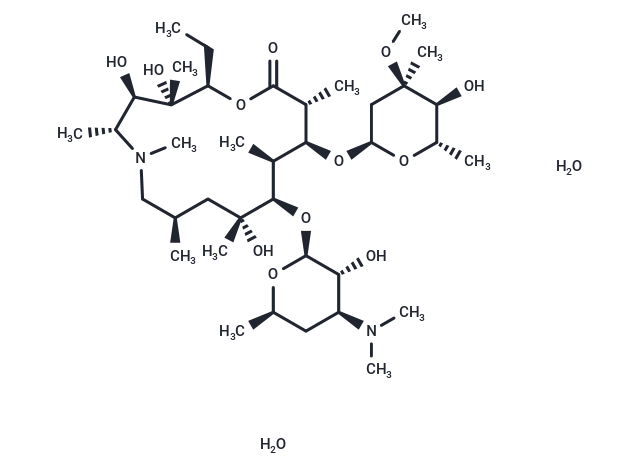
Synonyms: CP-62993 dihydrate, Azithromycin dihydrate
| Pack Size | Price | USA Stock | Global Stock | Quantity |
|---|---|---|---|---|
| 25 mg | $36 | In Stock | In Stock | |
| 50 mg | $52 | In Stock | In Stock | |
| 100 mg | $79 | In Stock | In Stock | |
| 200 mg | $125 | In Stock | In Stock | |
| 500 mg | $217 | In Stock | In Stock | |
| 1 mL x 10 mM (in DMSO) | $39 | In Stock | In Stock |
| Description | Azithromycin hydrate (CP-62993 dihydrate) is a semi-synthetic macrolide antibiotic structurally related to ERYTHROMYCIN. It has been used in the treatment of Mycobacterium avium intracellulare infections, toxoplasmosis, and cryptosporidiosis. |
| In vivo | Azithromycin (50 mg/kg) does not alter bronchoalveolar lavage inflammatory parameters or LDH levels in a mouse asthma exacerbation model. It also does not induce general inflammation or LDH release, but enhances interferon-stimulated gene expression and MDA5, a pattern recognition receptor, effectively lowering viral load without affecting RIG-I in exacerbating mice[2]. |
| Synonyms | CP-62993 dihydrate, Azithromycin dihydrate |
| Cell Research | THP-1 cells (106 cells in 1 mL RPMI medium, without antibiotics, growth factors or serum) are seeded in each well of 24-well plates and allowed to settle for 1 hour. Next, 50 μL of the test compound is added followed by 50 μL of LPS (final concentration of 10 μg/mL). After 24h (37°C and 5% CO2) the supernatants and cell pellets are collected (1200 rpm, 5 min). THP-1 cell viability is tested using 3-(4,5-dimethylthiazol-2-yl)-2,5-diphenyltetrazolium bromide (MTT). MTT is dissolved at 2 mg/mL in PBS and aliquots are stored at -20°C. The MTT assay is performed according to the suppliers instructions. Absorbance of MTT converted into formazan is measured at a wavelength of 570 nm with background subtraction at 630 nm. |
| Molecular Weight | 785.03 |
| Formula | C38H72N2O12·2H2O |
| Cas No. | 117772-70-0 |
| Smiles | N1([C@@H]([C@H]([C@@]([C@H](OC(=O)[C@@H]([C@H]([C@@H]([C@H]([C@@](C[C@H](C1)C)(O)C)O[C@H]1[C@@H]([C@H](C[C@H](O1)C)N(C)C)O)C)O[C@H]1C[C@]([C@H]([C@@H](O1)C)O)(OC)C)C)CC)(O)C)O)C)C.O.O |
| Relative Density. | 1.18g/cm3 |
| Storage | Powder: -20°C for 3 years | In solvent: -80°C for 1 year Shipping with blue ice/Shipping at ambient temperature. | |||||||||||||||||||||||||||||||||||||||||||||
| Solubility Information | H2O: 10 mg/mL (12.74 mM), Sonication is recommended. DMSO: 50 mg/mL (63.69 mM), Sonication is recommended.  Ethanol: 93 mg/mL (118.47 mM), Sonication is recommended. | |||||||||||||||||||||||||||||||||||||||||||||
Solution Preparation Table | ||||||||||||||||||||||||||||||||||||||||||||||
H2O/DMSO/Ethanol
DMSO/Ethanol
Ethanol
Note : The dilution table applies only to solid products. For liquid products, please calculate the stock solution based on the stated concentration and/or density. | ||||||||||||||||||||||||||||||||||||||||||||||
 For example, if the intended dosage is 10 mg/kg for animals weighing 20 g , with a dosing volume of 100 μL per animal, and a total of 10 animals are to be administered, using a formulation of
  10% DMSO+ 40% PEG300+ 5% Tween 80+ 45% Saline/PBS/ddH2O , the resulting working solution concentration would be 2 mg/mL.
Dissolve 2 mg of the compound in 100 μL DMSO to obtain a stock solution at a concentration of 20 mg/mL . If the required concentration exceeds the compound's known solubility, please contact us for technical support before proceeding.
1) Add 100 μL of the DMSO stock solution to 400 µL PEG300 and mix thoroughly until the solution becomes clear.
2) Add 50 µL Tween 80 and mix well until fully clarified.
3) Add 450 µL Saline,PBS or ddH2O and mix thoroughly until a homogeneous solution is obtained.
| Size | Quantity | Unit Price | Amount | Operation |
|---|
 Feedback
 Hello! How can I help you today?
Copyright © 2015-2026 TargetMol Chemicals Inc. All Rights Reserved.
