Shopping Cart
Remove All
  • TargetMol
    Your shopping cart is currently empty

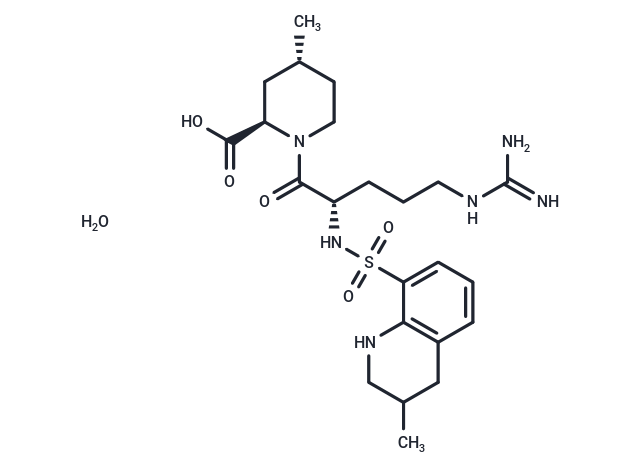
Argatroban Monohydrate

Catalog No. T22246 Copy Product Info
Purity: 99.92%
🥰Excellent
Argatroban Monohydrate is a selective thrombin inhibitor and a non-heparin anticoagulant that effectively prevents thrombosis. It is commonly used in thrombolysis model studies.

Argatroban Monohydrate

Copy Product Info
🥰Excellent
Catalog No. T22246

Argatroban Monohydrate is a selective thrombin inhibitor and a non-heparin anticoagulant that effectively prevents thrombosis. It is commonly used in thrombolysis model studies.

Argatroban Monohydrate
Cas No. 141396-28-3
Pack SizePriceUSA StockGlobal StockQuantity
5 mg$33In StockIn Stock
10 mg$45In StockIn Stock
25 mg$68In StockIn Stock
50 mg$101In StockIn Stock
100 mg$162In StockIn Stock
200 mg$233-In Stock
1 mL x 10 mM (in DMSO)$43In StockIn Stock
For In stock only · Estimated delivery: USA Stock (1-2 days) Global Stock (5-7 days)
Add to Cart
Add to Quotation
For research use only—not for human use. No sales to individuals. Use as intended only.
Questions
TargetMol
View More

Batch Information

Select Batch
Purity:99.92%
Appearance:Solid
Color:White
Contact us for more batch information

Resource Download

Product Introduction

Bioactivity
Description
Argatroban Monohydrate is a selective thrombin inhibitor and a non-heparin anticoagulant that effectively prevents thrombosis. It is commonly used in thrombolysis model studies.
Targets&IC50
Thrombin:5-39 nM(Ki)
Disease Modeling Protocol
Thrombolysis Model
  • Modeling Mechanism:

    Argatroban Monohydrate, as a direct thrombin inhibitor, inhibits thrombin-mediated fibrinogenesis, platelet aggregation, and coagulation factor activation by reversibly binding to the thrombin active site. It can also penetrate the thrombus to inhibit thrombin-binding thrombin activity, preventing thrombus reformation. When synergistically used with t-PA, it reduces intermittent reocclusion during t-PA thrombolysis, accelerates thrombus dissolution, and does not interfere with the fibrinolytic system.

  • Related Products:

    Argatroban Monohydrate (T22246)

  • Modeling Method:

    Experimental Subject:

    Hamsters: Golden hamsters, male, body weight 120–130 g

    Dosage and Administration Route:

    ① Thrombosis induction:
    - Anaesthesia: Sodium pentobarbital (100 mg/kg) administered intraperitoneally for induction, tracheotomy performed for ventilation maintenance. Right subclavian artery cannulated (PE10 catheter) to the common carotid artery opening; right femoral vein cannulated for drug administration;
    - Thrombosis induction: Sodium fluorescein (50 mg/kg) injected into the right subclavian artery. Five minutes later, a small vein (diameter 50–70 μm) was selected and locally irradiated with filtered light (diameter 100 μm, intensity 20 mW/mm², wavelength 400–500 nm) until thrombosis caused 99% luminal stenosis(approximately 7 minutes);
    ② Thrombolytic intervention:
    - Fifteen minutes after thrombus formation, initiate continuous infusion of t-PA (72×10⁴ IU/kg/h) into the right subclavian artery, concurrently with continuous infusion of Argatroban (0.05–0.3 mg/kg/h) via the femoral vein for 4 hours;
    - Control treatment:
    - Blank control: Normal saline infusion via femoral vein;
    - UFH control: UFH (12.5 anti-Xa U/kg/h) administered via femoral vein infusion, with all other aspects identical to the intervention group.

    Dosing Frequency and Duration Model:

    Single dose

  • Validation:

    1. Thrombolysis indicators: - Vascular stenosis rate: One hour after thrombolysis, the vascular stenosis rate in the argatroban (0.1 mg/kg/h) group decreased to 59.6±4.0% (93.2±2.5% in the control group, p<0.01), and further decreased after 4 hours, showing a dose-dependent effect; - Thrombus area percentage: One hour after thrombolysis, the thrombus area percentage in the argatroban (0.3 mg/kg/h) group was only 37.9±16.9% (79.4±9.5% in the UFH group, p<0.01); 2. Coagulation function indicators: - Activated partial thromboplastin time (aPTT): The aPTT in the argatroban (0.3 mg/kg/h) group was prolonged to 34.6±2.1 s (28.8±0.4 s in the control group, p<0.01), without excessive prolongation (<180 s); Bleeding time (BT): The BT was not significantly prolonged in the argatroban (0.1-0.2 mg/kg/h) group (216-228 s vs. 204±6 s in the control group), while the BT was prolonged to 265±9 s in the 0.3 mg/kg/h group (p<0.01), but no serious bleeding complications occurred; 3. Re-occlusion: The incidence of intermittent re-occlusion within 1 hour of thrombolysis in the argatroban group was significantly lower than that in the t-PA alone group and the UFH group.

*Precautions:

*References:Yamada K,et,al. Effects of argatroban and heparin on thrombus formation and tissue plasminogen activator-induced thrombolysis in a microvascular thrombosis model. Thromb Res. 2003 Jan 1;109(1):55-64.

Chemical Properties
Molecular Weight526.65
FormulaC23H38N6O6S
Cas No.141396-28-3
SmilesO.C[C@@H]1CCN([C@H](C1)C(O)=O)C(=O)[C@H](CCCNC(N)=N)NS(=O)(=O)c1cccc2CC(C)CNc12
Relative Density.1.47 g/cm3
Storage & Solubility Information
Storagekeep away from moisture | Powder: -20°C for 3 years | In solvent: -80°C for 1 year | Shipping with blue ice/Shipping at ambient temperature.
Solubility Information
DMSO: 99 mg/mL (187.98 mM), Sonication is recommended.
In Vivo Formulation
10% DMSO+40% PEG300+5% Tween 80+45% Saline: 3.3 mg/mL (6.27 mM), Sonication is recommended.
Please add the solvents sequentially, clarifying the solution as much as possible before adding the next one. Dissolve by heating and/or sonication if necessary. Working solution is recommended to be prepared and used immediately. The formulation provided above is for reference purposes only. In vivo formulations may vary and should be modified based on specific experimental conditions.
Solution Preparation Table
DMSO
1mg5mg10mg50mg
1 mM1.8988 mL9.4940 mL18.9879 mL94.9397 mL
5 mM0.3798 mL1.8988 mL3.7976 mL18.9879 mL
10 mM0.1899 mL0.9494 mL1.8988 mL9.4940 mL
20 mM0.0949 mL0.4747 mL0.9494 mL4.7470 mL
50 mM0.0380 mL0.1899 mL0.3798 mL1.8988 mL
100 mM0.0190 mL0.0949 mL0.1899 mL0.9494 mL
Note : The dilution table applies only to solid products. For liquid products, please calculate the stock solution based on the stated concentration and/or density.

Calculator

  • Molarity Calculator
  • Dilution Calculator
  • Reconstitution Calculator
  • Molecular Weight Calculator

In Vivo Formulation Calculator (Clear solution)

Please enter your animal experiment information in the following box and click Calculate to obtain the stock solution preparation method and in vivo formula preparation method:
TargetMol | Animal experiments For example, if the intended dosage is 10 mg/kg for animals weighing 20 g , with a dosing volume of 100 μL per animal, TargetMol | Animal experiments and a total of 10 animals are to be administered, using a formulation of TargetMol | reagent 10% DMSO+ 40% PEG300+ 5% Tween 80+ 45% Saline/PBS/ddH2O , the resulting working solution concentration would be 2 mg/mL.

Stock Solution Preparation:

Dissolve 2 mg of the compound in 100 μL DMSOTargetMol | reagent to obtain a stock solution at a concentration of 20 mg/mL . If the required concentration exceeds the compound's known solubility, please contact us for technical support before proceeding.

Preparation of the In Vivo Formulation:

1) Add 100 μL of the DMSOTargetMol | reagent stock solution to 400 μL PEG300TargetMol | reagent and mix thoroughly until the solution becomes clear.

2) Add 50 μL Tween 80 and mix well until fully clarified.

3) Add 450 μL Saline,PBS or ddH2OTargetMol | reagent and mix thoroughly until a homogeneous solution is obtained.

This example is provided solely to demonstrate the use of the In Vivo Formulation Calculator and does not constitute a recommended formulation for any specific compound. Please select an appropriate dissolution and formulation strategy based on your experimental model and route of administration.
All co-solvents required for this protocol, includingDMSO, PEG300/PEG400, Tween 80, SBE-β-CD, and Corn oil, are available for purchase on the TargetMol website.
1 Enter information below:
mg/kg
g
μL
2 Enter the in vivo formulation:
% DMSO
%
% Tween 80
% Saline/PBS/ddH2O

Dose Conversion

You can also refer to dose conversion for different animals. More Dose Conversion

Tech Support

Please see Inhibitor Handling Instructions for more frequently ask questions. Topics include: how to prepare stock solutions, how to store products, and cautions on cell-based assays & animal experiments, etc

Keywords

Related Tags: buy Argatroban Monohydrate | purchase Argatroban Monohydrate | Argatroban Monohydrate cost | order Argatroban Monohydrate | Argatroban Monohydrate chemical structure | Argatroban Monohydrate formula | Argatroban Monohydrate molecular weight