


Shopping Cart
Remove All Your shopping cart is currently empty

Synonyms:
| Pack Size | Price | USA Stock | Global Stock | Quantity |
|---|---|---|---|---|
| 100 mg | $40 | - | In Stock | |
| 500 mg | $92 | In Stock | In Stock | |
| 1 g | $133 | - | In Stock | |
| 1 mL x 10 mM (in DMSO) | $29 | - | In Stock |
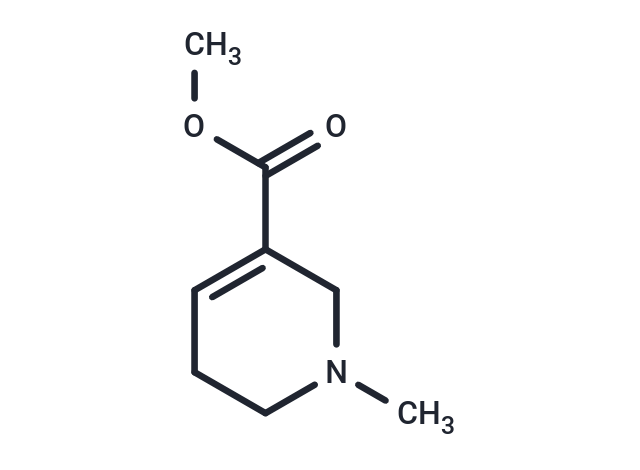
| Description | Arecoline is a natural alkaloid derived from areca nut in the palm family and is a potent nicotine and partial agonist of muscarinic acetylcholine receptors. Arecoline has anti-anxiety and anti-parasitic activity, can induce oxidative stress and can be used to study Alzheimer's disease and Alzheimer's disease. |
| In vitro | Arecoline induces reactive oxygen species generation and cell cycle arrest at the G1/G0 phase in HaCaT cells without affecting p21/Cip1 expression. It also upregulates stress-responsive genes such as hemeoxygenase-1, ferritin light chain, glucose-6-phosphate dehydrogenase, glutamate-cysteine ligase catalytic subunit, and glutathione reductase. At higher concentrations, arecoline causes epithelial cell death due to oxidative trauma without triggering apoptosis[1]. |
| Molecular Weight | 155.19 |
| Formula | C8H13NO2 |
| Cas No. | 63-75-2 |
| Smiles | C(OC)(=O)C=1CN(C)CCC1 |
| Storage | Keep away from direct sunlight,Keep away from moisture,Store under nitrogen Pure form: -20°C for 3 years | In solvent: -80°C for 1 year Shipping with blue ice/Shipping at ambient temperature. | |||||||||||||||||||||||||||||||||||
| Solubility Information | DMSO: 250 mg/mL (1610.93 mM), Sonication is recommended.  H2O: 200 mg/mL (1288.74 mM), Sonication and heating are recommended. | |||||||||||||||||||||||||||||||||||
| In Vivo Formulation | 10% DMSO+90% Saline: 10 mg/mL (64.44 mM), Solution. 10% DMSO+40% PEG300+5% Tween 80+45% Saline: 2 mg/mL (12.89 mM), Sonication is recommended. Please add the solvents sequentially, clarifying the solution as much as possible before adding the next one. Dissolve by heating and/or sonication if necessary. Working solution is recommended to be prepared and used immediately. The formulation provided above is for reference purposes only. In vivo formulations may vary and should be modified based on specific experimental conditions. | |||||||||||||||||||||||||||||||||||
Solution Preparation Table | ||||||||||||||||||||||||||||||||||||
H2O/DMSO
Note : The dilution table applies only to solid products. For liquid products, please calculate the stock solution based on the stated concentration and/or density. | ||||||||||||||||||||||||||||||||||||
 For example, if the intended dosage is 10 mg/kg for animals weighing 20 g , with a dosing volume of 100 μL per animal, and a total of 10 animals are to be administered, using a formulation of
  10% DMSO+ 40% PEG300+ 5% Tween 80+ 45% Saline/PBS/ddH2O , the resulting working solution concentration would be 2 mg/mL.
Dissolve 2 mg of the compound in 100 μL DMSO to obtain a stock solution at a concentration of 20 mg/mL . If the required concentration exceeds the compound's known solubility, please contact us for technical support before proceeding.
1) Add 100 μL of the DMSO stock solution to 400 µL PEG300 and mix thoroughly until the solution becomes clear.
2) Add 50 µL Tween 80 and mix well until fully clarified.
3) Add 450 µL Saline,PBS or ddH2O and mix thoroughly until a homogeneous solution is obtained.
| Size | Quantity | Unit Price | Amount | Operation |
|---|
 Feedback
 Hello! How can I help you today?
Copyright © 2015-2026 TargetMol Chemicals Inc. All Rights Reserved.
