


Shopping Cart
Remove All Your shopping cart is currently empty


Synonyms: Apoptosis Activator VII

| Pack Size | Price | USA Stock | Global Stock | Quantity |
|---|---|---|---|---|
| 2 mg | $30 | In Stock | In Stock | |
| 5 mg | $43 | In Stock | In Stock | |
| 10 mg | $76 | In Stock | In Stock | |
| 25 mg | $139 | In Stock | In Stock | |
| 50 mg | $247 | In Stock | In Stock | |
| 100 mg | $368 | In Stock | In Stock | |
| 200 mg | $543 | In Stock | In Stock | |
| 1 mL x 10 mM (in DMSO) | $60 | In Stock | In Stock |
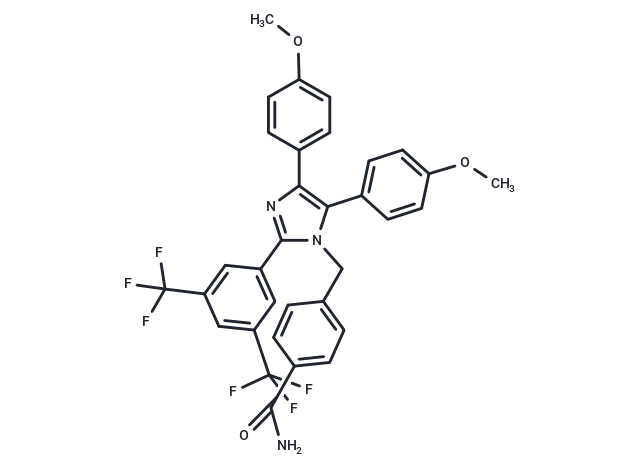
| Description | Apoptozole (Apoptosis Activator VII) inhibits the ATPase domain of Hsc70 and Hsp70, inducing apoptosis. |
| Targets & IC50 | HSC70:0.21 μM(Kd), HSP70:0.14 μM(Kd) |
| In vitro | Apoptozole induces caspase dependent apoptosis by blocking interaction of HSP70 with APAF-1, without affecting interactions of HSP70 with ASK1, JNK, BAX, and AIF[2]. However, apoptozole may form aggregates under aqueous conditions that could interact with HSP70 proteins in a non-specific manner, potentially leading to false positives and inconsistent data[3]. |
| In vivo | Apoptozole greatly retards tumor growth in mice xenografted with cancer cells without affecting mouse viability. The elimination half-life time (T1/2) of Az in blood is found to be significantly longer than that of Dox (8.04 versus 1.60 hr) and the time needed to reach a maximum concentration (Tmax) of Az is shorter than that of Dox (1.00 versus 4.00 hr)[2]. |
| Synonyms | Apoptosis Activator VII |
| Kinase Assay | Inhibition of HER2/erbB2 tyrosine kinase activity: BT-474 cells are seeded on 24-well plates and cultured overnight. Mubritinib is then added at various concentrations. After incubation for 2 hours, the cells are harvested directly into sodium dodecyl sulfate (SDS)-sample buffer (200 μL). Aliquots containing equal amounts of total cell extract are run on 7.5% to 15% gradient SDS–polyacrylamide gel electrophoresis (PAGE). Following electrophoresis, proteins are transferred onto a polyvinylidene fluoride (PVDF) membrane, for western blot analysis using a relevant primary antibody. Detection of protein is accomplished by an enhanced chemiluminescent (ECL) detection method. The extent of tyrosine phosphorylation of HER2/erbB2 is measured by the LAS-1000 plus lumino-image analyser. The concentration of Mubritinib that inhibits HER2/erbB2 phosphorylation by 50% (IC50) is calculated from a dose–response curve generated by least-squares linear regression of the response using SAS software. |
| Cell Research | Several cancer cell lines (A549, lung adenocarcinoma epithelial cells; HeLa, cervical cancer cells; MDA-MB-231, breast cancer cells; HepG2, liver cancer cells) are treated with various concentrations (0-15 μM) of Az or compound 7 as a negative control for 18 hr. Cell viabilities are then determined using an MTT assay.(Only for Reference) |
| Molecular Weight | 625.56 |
| Formula | C33H25F6N3O3 |
| Cas No. | 1054543-47-3 |
| Smiles | COc1ccc(cc1)-c1nc(-c2cc(cc(c2)C(F)(F)F)C(F)(F)F)n(Cc2ccc(cc2)C(N)=O)c1-c1ccc(OC)cc1 |
| Relative Density. | 1.33 g/cm3 (Predicted) |
| Storage | Powder: -20°C for 3 years | In solvent: -80°C for 1 year Shipping with blue ice/Shipping at ambient temperature. | ||||||||||||||||||||||||||||||||||||||||
| Solubility Information | H2O: < 1 mg/mL (insoluble or slightly soluble) Ethanol: 24 mg/mL (38.37 mM), Sonication is recommended. DMSO: 93 mg/mL (148.67 mM), Sonication is recommended. | ||||||||||||||||||||||||||||||||||||||||
| In Vivo Formulation | 10% DMSO+40% PEG300+5% Tween 80+45% Saline: 3.3 mg/mL (5.28 mM), Sonication is recommended. Please add the solvents sequentially, clarifying the solution as much as possible before adding the next one. Dissolve by heating and/or sonication if necessary. Working solution is recommended to be prepared and used immediately. The formulation provided above is for reference purposes only. In vivo formulations may vary and should be modified based on specific experimental conditions. | ||||||||||||||||||||||||||||||||||||||||
Solution Preparation Table | |||||||||||||||||||||||||||||||||||||||||
Ethanol/DMSO
DMSO
Note : The dilution table applies only to solid products. For liquid products, please calculate the stock solution based on the stated concentration and/or density. | |||||||||||||||||||||||||||||||||||||||||
 For example, if the intended dosage is 10 mg/kg for animals weighing 20 g , with a dosing volume of 100 μL per animal, and a total of 10 animals are to be administered, using a formulation of
  10% DMSO+ 40% PEG300+ 5% Tween 80+ 45% Saline/PBS/ddH2O , the resulting working solution concentration would be 2 mg/mL.
Dissolve 2 mg of the compound in 100 μL DMSO to obtain a stock solution at a concentration of 20 mg/mL . If the required concentration exceeds the compound's known solubility, please contact us for technical support before proceeding.
1) Add 100 μL of the DMSO stock solution to 400 µL PEG300 and mix thoroughly until the solution becomes clear.
2) Add 50 µL Tween 80 and mix well until fully clarified.
3) Add 450 µL Saline,PBS or ddH2O and mix thoroughly until a homogeneous solution is obtained.
| Size | Quantity | Unit Price | Amount | Operation |
|---|
 Feedback
 Hello! How can I help you today?
Copyright © 2015-2026 TargetMol Chemicals Inc. All Rights Reserved.
