


Shopping Cart
Remove All Your shopping cart is currently empty

Synonyms:

| Pack Size | Price | USA Stock | Global Stock | Quantity |
|---|---|---|---|---|
| 1 mg | $105 | - | In Stock | |
| 5 mg | $255 | - | In Stock | |
| 10 mg | $376 | - | In Stock | |
| 25 mg | $626 | - | In Stock | |
| 50 mg | $889 | - | In Stock | |
| 1 mL x 10 mM (in DMSO) | $263 | - | In Stock |
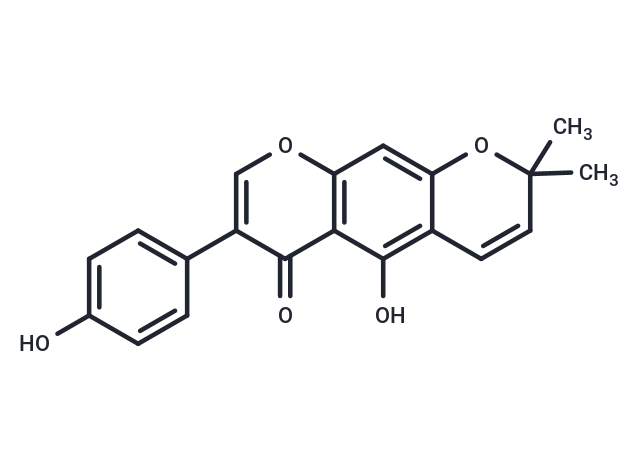
| Description | Alpinumisoflavone is a natural isopentenyl isoflavone extracted from Laburnum alpinum. Alpinumisoflavone exerts anti-inflammatory and antioxidant effects by inhibiting the NF-κB, MAPK, and NLRP3 inflammasome pathways. Alpinumisoflavone also exhibits antitumor activity. |
| In vitro | Methods: RAW264.7 cells were pretreated with different concentrations of Alpinumisoflavone (1, 5, 10 μg/mL) for 1 hour, then stimulated with LPS (100 ng/mL) for 24 hours; Culture supernatants were collected, and NO levels were measured using the Griess method; TNF-α, IL-6, IL-1β, and IL-17 levels were measured using ELISA; and ICAM-1 protein expression was assessed by Western blot. Results: Alpinumisoflavone dose-dependently inhibited LPS-induced production of NO, TNF-α, IL-6, IL-1β, and ICAM-1, with inhibition rates reaching 60%–80% at 10 μg/mL (p < 0.001). [1] Methods: RAW264.7 cells were pretreated with Alpinumisoflavone (1, 5, 10 μg/mL) for 1 hour, then stimulated with LPS (100 ng/mL) for 24 hours; Intracellular ROS levels were measured using the DCFH-DA fluorescence assay, and protein expression of CAT, HO-1, GPx, SOD, TLR4, iNOS, and COX-2 was assessed by Western blot. Results: Alpinumisoflavone dose-dependently upregulated the expression of the antioxidant enzymes CAT, HO-1, GPx, and SOD (p < 0.01); significantly inhibited LPS-induced intracellular ROS production, with ROS levels reduced by approximately 50% at 10 μg/mL (p < 0.001). [1] Methods: The CCK-8 assay was used to assess the effects of different concentrations of Alpinumisoflavone (0–20 μM) on the viability of HepG2, SMMC 7721, Huh7, and Bel7402 hepatocellular carcinoma cells, as well as normal LO2 hepatocytes, with treatment durations of 24 and 48 hours. Results: Alpinumisoflavone exhibited selective cytotoxicity toward hepatocellular carcinoma cells and very low cytotoxicity toward normal LO2 cells (IC₅₀ at 48 hours = 151.32 μM). [2] |
| In vivo | Methods: Six-week-old male ICR mice were administered 5 mg/kg of LPS via intratracheal instillation. One hour prior to stimulation, Alpinumisoflavone (1, 5, or 10 mg/kg) was administered via intraperitoneal injection. The mice were sacrificed 6 hours after LPS stimulation. Results: Alpinumisoflavone pretreatment significantly alleviated LPS-induced interstitial edema, alveolar wall thickening, hemorrhage, and massive inflammatory cell infiltration in mouse lung tissue. [1] Methods: Huh7 cells (1 × 10⁶ cells/mouse) were subcutaneously inoculated into the backs of nude mice. When tumor volume reached approximately 100 mm³, the mice were randomly divided into 3 groups (n = 6/group): control group (gavaged with saline), low-dose Alpinumisoflavone group (20 mg/kg/day by gavage), and high-dose Alpinumisoflavone group (40 mg/kg/day by gavage). Tumor volume and mouse body weight were measured every 3 days. After 30 consecutive days of treatment, the mice were euthanized, and the tumors were excised and weighed. Results: Alpinumisoflavone exhibited dose-dependent inhibition of tumor growth; in the high-dose group, tumor volume and weight were reduced by approximately 60% and 55%, respectively, compared to the control group (p<0.01). There were no significant differences in body weight among the groups, and no obvious pathological changes were observed in major organs such as the heart, liver, spleen, lungs, and kidneys, indicating that Alpinumisoflavone has good in vivo safety.[2] |
| Molecular Weight | 336.34 |
| Formula | C20H16O5 |
| Cas No. | 34086-50-5 |
| Smiles | O=C1C(=COC=2C=C3OC(C=CC3=C(O)C12)(C)C)C=4C=CC(O)=CC4 |
| Relative Density. | 1.368g/cm3 |
| Storage | Powder: -20°C for 3 years | In solvent: -80°C for 1 year Shipping with blue ice/Shipping at ambient temperature. | |||||||||||||||||||||||||||||||||||
| Solubility Information | DMSO: 80 mg/mL (237.85 mM), Sonication is recommended. | |||||||||||||||||||||||||||||||||||
Solution Preparation Table | ||||||||||||||||||||||||||||||||||||
DMSO
Note : The dilution table applies only to solid products. For liquid products, please calculate the stock solution based on the stated concentration and/or density. | ||||||||||||||||||||||||||||||||||||
 For example, if the intended dosage is 10 mg/kg for animals weighing 20 g , with a dosing volume of 100 μL per animal, and a total of 10 animals are to be administered, using a formulation of
  10% DMSO+ 40% PEG300+ 5% Tween 80+ 45% Saline/PBS/ddH2O , the resulting working solution concentration would be 2 mg/mL.
Dissolve 2 mg of the compound in 100 μL DMSO to obtain a stock solution at a concentration of 20 mg/mL . If the required concentration exceeds the compound's known solubility, please contact us for technical support before proceeding.
1) Add 100 μL of the DMSO stock solution to 400 µL PEG300 and mix thoroughly until the solution becomes clear.
2) Add 50 µL Tween 80 and mix well until fully clarified.
3) Add 450 µL Saline,PBS or ddH2O and mix thoroughly until a homogeneous solution is obtained.
| Size | Quantity | Unit Price | Amount | Operation |
|---|
 Feedback
 Hello! How can I help you today?
Copyright © 2015-2026 TargetMol Chemicals Inc. All Rights Reserved.
