


Shopping Cart
Remove All Your shopping cart is currently empty


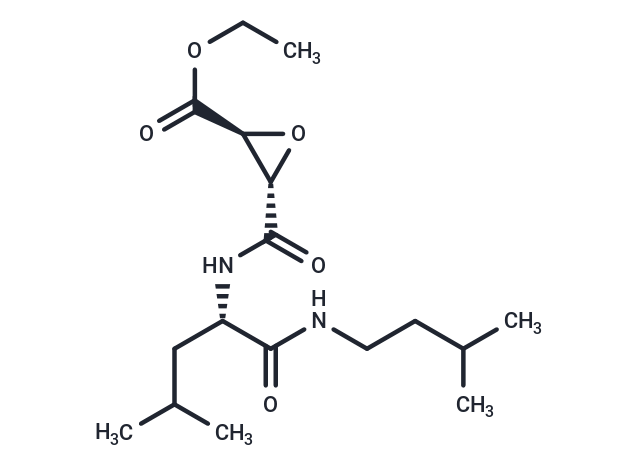
Synonyms: Loxistatin, E64d, E64c ethyl ester

| Pack Size | Price | USA Stock | Global Stock | Quantity |
|---|---|---|---|---|
| 1 mg | $36 | In Stock | In Stock | |
| 5 mg | $80 | In Stock | In Stock | |
| 10 mg | $122 | In Stock | In Stock | |
| 25 mg | $198 | In Stock | In Stock | |
| 50 mg | $328 | In Stock | In Stock | |
| 100 mg | $529 | In Stock | In Stock | |
| 1 mL x 10 mM (in DMSO) | $64 | In Stock | In Stock |
| Description | Aloxistatin (E64d) is an inhibitor of cysteine protease with blood platelet aggregation inhibiting activity. Aloxistatin is an irreversible, membrane-permeable inhibitor of lysosomal and cytosolic cysteine proteases with the ability to inhibit calpain activity in intact platelets. |
| In vitro | Aloxistatin can enter the intact platelet and inhibit proteolysis by inhibiting calpain. [2] Aloxistatin blunts Parathyroid hormone (PTH)-induced cell proliferation and inhibits differentiation osteoblasts in vitro. [3] |
| In vivo | Aloxistatin (100 mg/kg, p.o.) strongly inhibits the cathepsin B&L activities in the skeletal muscle, heart and liver of hamsters. [1] In spinal cord injury (SCI) rats, Aloxistatin provides neuroprotection in SCI lesion and penumbra. [4] Aloxistatin reduces brain amyloid-β and improves memory deficits in Alzheimer's disease animal models by inhibiting cathepsin B activity. [5] |
| Synonyms | Loxistatin, E64d, E64c ethyl ester |
| Kinase Assay | The CTLs and NK cells (0.8×10⁶/mL) are treated with the inhibitors L1 (10-20 μM) or Aloxistatin (20-30 μM) for 24 hr at 37°C in 24-well plates. Cells are then used in 51Cr-release assays or are lysed to examine perforin in Western blots. The inhibitor is also added at the same concentration during the 4 hr reactions in some 51Cr-release assays, as indicated. Cell lysates are prepared using NP-40 lysis buffer (25 mM HEPES, 250 mM NaCl, 2.5 mM ethylenediaminetetraacetic acid, 0.1% volume/volume Nonidet P-40) and total protein concentration is determined using the Bradford assay. Equal amounts of protein are loaded and resolved on 8% SDS-PAGE gels. Human or mouse perforin is detected using the appropriate antibodies as indicated. Anti-actin antibody is used as a loading control[2]. |
| Cell Research | Aloxistatin (E64d) is dissolved in DMSO and stored, and then diluted with appropriate medium (final DMSO 0.1 %) before use[3]. Cell proliferation and apoptosis are assessed by staining for a proliferation marker, Ki67, or an apoptotic marker, cleaved caspase 3, following the protocol described above for the polarity markers. MCF10 variants are grown in 3D rBM overlay cultures for 4 days and are treated with 0.1 % DMSO, 5 μM CA074Me or 5 μM Aloxistatin. The percentage of structures that are positive for Ki67 or cleaved caspase 3 is determined by counting a total of 100 structures on two separate coverslips with a Zeiss Axiophot epifluorescent microscope. Structures are considered Ki67 positive if they contained at least one cell staining for Ki67. Structures are considered to be caspase 3 positive if they contained at least one cell that is positive for cleaved caspase 3 and the positive cell(s) is not localized in the center of a developing lumen[3]. |
| Molecular Weight | 342.43 |
| Formula | C17H30N2O5 |
| Cas No. | 88321-09-9 |
| Smiles | CCOC(=O)[C@H]1O[C@@H]1C(=O)N[C@@H](CC(C)C)C(=O)NCCC(C)C |
| Relative Density. | 1.0657 g/cm3 (Estimated) |
| Storage | Powder: -20°C for 3 years | In solvent: -80°C for 1 year Shipping with blue ice/Shipping at ambient temperature. | |||||||||||||||||||||||||
| Solubility Information | DMSO: 10.73 mg/mL (31.33 mM), Sonication is recommended.  | |||||||||||||||||||||||||
Solution Preparation Table | ||||||||||||||||||||||||||
DMSO
Note : The dilution table applies only to solid products. For liquid products, please calculate the stock solution based on the stated concentration and/or density. | ||||||||||||||||||||||||||
 For example, if the intended dosage is 10 mg/kg for animals weighing 20 g , with a dosing volume of 100 μL per animal, and a total of 10 animals are to be administered, using a formulation of
  10% DMSO+ 40% PEG300+ 5% Tween 80+ 45% Saline/PBS/ddH2O , the resulting working solution concentration would be 2 mg/mL.
Dissolve 2 mg of the compound in 100 μL DMSO to obtain a stock solution at a concentration of 20 mg/mL . If the required concentration exceeds the compound's known solubility, please contact us for technical support before proceeding.
1) Add 100 μL of the DMSO stock solution to 400 µL PEG300 and mix thoroughly until the solution becomes clear.
2) Add 50 µL Tween 80 and mix well until fully clarified.
3) Add 450 µL Saline,PBS or ddH2O and mix thoroughly until a homogeneous solution is obtained.
| Size | Quantity | Unit Price | Amount | Operation |
|---|
 Feedback
 Hello! How can I help you today?
Copyright © 2015-2026 TargetMol Chemicals Inc. All Rights Reserved.
