Shopping Cart
Remove All
  • TargetMol
    Your shopping cart is currently empty

Alloxan monohydrate

Catalog No. T7814 Copy Product Info
Purity: 99.42%
😃Good
Alloxan Monohydrate is a diabetogenic agent that acts as a proteasome inhibitor and induces diabetes in experimental animals by damaging the insulin-secreting β-cells in the pancreas. It is commonly used to establish diabetes models.

Alloxan monohydrate

Copy Product Info
😃Good
Catalog No. T7814

Alloxan Monohydrate is a diabetogenic agent that acts as a proteasome inhibitor and induces diabetes in experimental animals by damaging the insulin-secreting β-cells in the pancreas. It is commonly used to establish diabetes models.

Alloxan monohydrate
Cas No. 2244-11-3
Pack SizePriceUSA StockGlobal StockQuantity
1 g$29In StockIn Stock
For In stock only · Estimated delivery: USA Stock (1-2 days) Global Stock (5-7 days)
Add to Cart
Add to Quotation
For research use only—not for human use. No sales to individuals. Use as intended only.
Questions
TargetMol
View More

Batch Information

Select Batch
Purity:99.42%
Appearance:Solid
Color:White to Yellow
Contact us for more batch information

Resource Download

Product Introduction

Bioactivity
Description
Alloxan Monohydrate is a diabetogenic agent that acts as a proteasome inhibitor and induces diabetes in experimental animals by damaging the insulin-secreting β-cells in the pancreas. It is commonly used to establish diabetes models.
In vitro
Alloxan caused the accumulation of ubiquitinated proteins in NRK cells through the inhibition of the proteolytic activities of the proteasome.?Alloxan directly acts on the chymotrypsin- and trypsin-like peptidase activities[1]
Disease Modeling Protocol
Diabetes model
  • Modeling Mechanism:

    Alloxan monohydrate damages pancreatic islet β cells through oxidative stress, leading to β cell necrosis or loss of function, significantly reducing insulin secretion, and thus causing persistent hyperglycemia, which is consistent with the core pathological features of type 1 diabetes or type 2 diabetes with pancreatic islet failure. High-dose administration may cause fatal hypoglycemia in the early stages due to the release of a large amount of insulin.

  • Related Products:

    Alloxan monohydrate (T7814)

  • Modeling Method:

    Experimental Subject:

    Rats, Wistar albino, Males and females equally, 180-240g, 12-14 weeks old

    Dosage and Administration Route:

    150 mg/kg alloxan, dissolved in fresh distilled water, intraperitoneal injection (i.p.)
    Post-administration management: 6 hours post-dose, administer 10 mL of 20% (w/v) glucose solution orally; subsequently provide 5% (w/v) glucose solution continuously for 24 hours to prevent hypoglycaemic mortality

    Dosing Frequency and Duration Model:

    Single dose

  • Validation:

    1. Blood glucose indicators: After modeling, rats with fasting blood glucose >250 mg/dL (approximately 13.9 mmol/L) were selected to confirm the successful establishment of the diabetic model; the oral glucose tolerance test (OGTT) showed that blood glucose significantly increased 0.5-1 hours after glucose loading and failed to effectively decrease after 2 hours; 2. Pathological indicators: HE staining of pancreatic tissue showed severe damage and reduced number of pancreatic β cells, and disordered pancreatic islet structure (significantly different from normal rat pancreatic tissue); 3. Functional indicators: decreased insulin secretion capacity and weakened insulin response to exogenous glucose stimulation.

*Precautions:

*References:Agwaya MS,et,al. Hypoglycemic Activity of Aqueous Root Bark Extract Zanthoxylum chalybeum in Alloxan-Induced Diabetic Rats. J Diabetes Res. 2016;2016:8727590.

Chemical Properties
Molecular Weight160.09
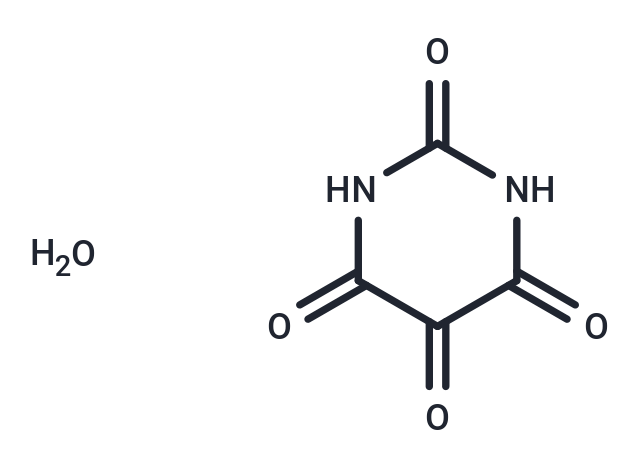
FormulaC4H4N2O5
Cas No.2244-11-3
SmilesO.O=C1NC(=O)C(=O)C(=O)N1
Relative Density.1.681g/cm3
Storage & Solubility Information
Storagekeep away from moisture,keep away from direct sunlight | Powder: -20°C for 3 years | In solvent: -80°C for 1 year | Shipping with blue ice/Shipping at ambient temperature.
Solubility Information
DMSO: 60 mg/mL (374.79 mM), Sonication is recommended.

In Vivo Formulation
10% DMSO+40% PEG300+5% Tween 80+45% Saline: 2 mg/mL (12.49 mM), Sonication is recommended.
Please add the solvents sequentially, clarifying the solution as much as possible before adding the next one. Dissolve by heating and/or sonication if necessary. Working solution is recommended to be prepared and used immediately. The formulation provided above is for reference purposes only. In vivo formulations may vary and should be modified based on specific experimental conditions.
Solution Preparation Table
DMSO
1mg5mg10mg50mg
1 mM6.2465 mL31.2324 mL62.4649 mL312.3243 mL
5 mM1.2493 mL6.2465 mL12.4930 mL62.4649 mL
10 mM0.6246 mL3.1232 mL6.2465 mL31.2324 mL
20 mM0.3123 mL1.5616 mL3.1232 mL15.6162 mL
50 mM0.1249 mL0.6246 mL1.2493 mL6.2465 mL
100 mM0.0625 mL0.3123 mL0.6246 mL3.1232 mL
Note : The dilution table applies only to solid products. For liquid products, please calculate the stock solution based on the stated concentration and/or density.

Calculator

  • Molarity Calculator
  • Dilution Calculator
  • Reconstitution Calculator
  • Molecular Weight Calculator

In Vivo Formulation Calculator (Clear solution)

Please enter your animal experiment information in the following box and click Calculate to obtain the stock solution preparation method and in vivo formula preparation method:
TargetMol | Animal experiments For example, if the intended dosage is 10 mg/kg for animals weighing 20 g , with a dosing volume of 100 μL per animal, TargetMol | Animal experiments and a total of 10 animals are to be administered, using a formulation of TargetMol | reagent 10% DMSO+ 40% PEG300+ 5% Tween 80+ 45% Saline/PBS/ddH2O , the resulting working solution concentration would be 2 mg/mL.

Stock Solution Preparation:

Dissolve 2 mg of the compound in 100 μL DMSOTargetMol | reagent to obtain a stock solution at a concentration of 20 mg/mL . If the required concentration exceeds the compound's known solubility, please contact us for technical support before proceeding.

Preparation of the In Vivo Formulation:

1) Add 100 μL of the DMSOTargetMol | reagent stock solution to 400 μL PEG300TargetMol | reagent and mix thoroughly until the solution becomes clear.

2) Add 50 μL Tween 80 and mix well until fully clarified.

3) Add 450 μL Saline,PBS or ddH2OTargetMol | reagent and mix thoroughly until a homogeneous solution is obtained.

This example is provided solely to demonstrate the use of the In Vivo Formulation Calculator and does not constitute a recommended formulation for any specific compound. Please select an appropriate dissolution and formulation strategy based on your experimental model and route of administration.
All co-solvents required for this protocol, includingDMSO, PEG300/PEG400, Tween 80, SBE-β-CD, and Corn oil, are available for purchase on the TargetMol website.
1 Enter information below:
mg/kg
g
μL
2 Enter the in vivo formulation:
% DMSO
%
% Tween 80
% Saline/PBS/ddH2O

Dose Conversion

You can also refer to dose conversion for different animals. More Dose Conversion

Tech Support

Please see Inhibitor Handling Instructions for more frequently ask questions. Topics include: how to prepare stock solutions, how to store products, and cautions on cell-based assays & animal experiments, etc

Keywords

Related Tags: buy Alloxan monohydrate | purchase Alloxan monohydrate | Alloxan monohydrate cost | order Alloxan monohydrate | Alloxan monohydrate chemical structure | Alloxan monohydrate in vitro | Alloxan monohydrate formula | Alloxan monohydrate molecular weight