


Shopping Cart
Remove All Your shopping cart is currently empty


Synonyms:
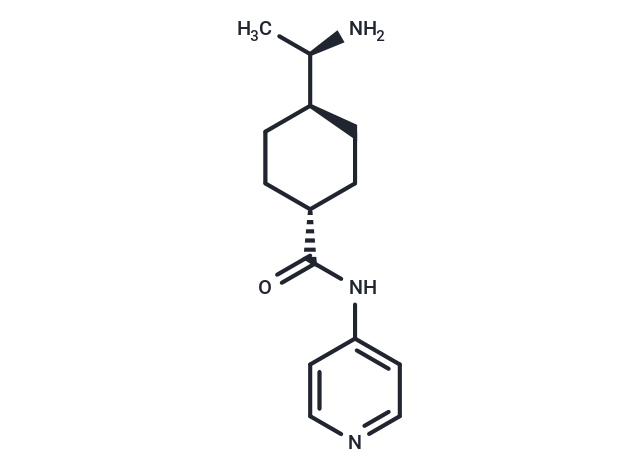
| Pack Size | Price | USA Stock | Global Stock | Quantity |
|---|---|---|---|---|
| 5 mg | $31 | In Stock | In Stock | |
| 10 mg | $44 | In Stock | In Stock | |
| 25 mg | $80 | In Stock | In Stock | |
| 50 mg | $140 | In Stock | In Stock | |
| 100 mg | $233 | In Stock | In Stock | |
| 200 mg | $366 | In Stock | In Stock | |
| 1 mL x 10 mM (in DMSO) | $35 | In Stock | In Stock |
| Description | Y-27632 is an orally potent, ATP-competitive inhibitor of ROCK-I and ROCK-II. Y-27632 also inhibits isolation-induced apoptosis in mouse prostate stem or progenitor cells. |
| Targets & IC50 | ROCK2:300 nM(Ki), Citron kinase:5.3 μM (Ki), PKCα:73 μM (Ki), PKN:3.1 μM (Ki), ROCK1:220 nM(Ki), PKA:25 μM (Ki), CITK:5.3 μM (Ki) |
| In vitro | METHODS: Human induced pluripotent stem cells, marmoset iPSC, were treated with Y-27632 (5-20 μM) for 7 days and clone formation was detected by AKP.
RESULTS: Y-27632 significantly improved the cloning efficiency of marmoset iPSC. [1] METHODS: Adult adipose tissue-derived stem cells ADSCs were treated with Y-27632 (5 μmol/L) for 1 h. The morphological changes of ADSCs were detected. RESULTS: Y-27632 dose-dependently induced neuronal differentiation in ADSCs. the percentage of neuron-like cells in ADSCs treated with 5 μmol/L Y-27632 for 1 h was (93.5±4.7)%. [2] METHODS: Crab monkey embryonic stem cells cyES were routinely passaged or treated with Y-27632 (1-10 μM) for 24 h. Live-dead staining was performed using the Flow Cytometry method, and BrdU was detected using a kit. RESULTS: Y-27632 promoted the increase of cyES surviving cells. Y-27632 did not promote cell proliferation, but protected the cells from cell death after single-cell digestion. [3] |
| In vivo | METHODS: To investigate the therapeutic potential of Y-27632 in motor neuron disease, Y-27632 (2 or 30 mg/kg in drinking water) was administered orally to SOD1G93A mice in the ALS model for 137 days.
RESULTS: Y-27632 2 mg/kg treatment was ineffective, Y-27632 30 mg/kg treatment improved motor function in male mice, and female mice showed only limited improvement. [4] METHODS: To investigate the effect of Y-27632 on liver fibrosis, Y-27632 (30 mg/kg) was administered orally to rats with dimethylnitrosamine (DMN)-induced liver fibrosis once a day for four weeks. RESULTS: Y-27632 treatment significantly reduced the incidence of DMN-induced hepatic fibrosis and lowered the levels of collagen and hydroxyproline as well as the expression of α-SMA in the liver. [5] |
| Kinase Assay | Recombinant ROCK-I, ROCK-II, PKN, or citron kinase is expressed in HeLa cells as Myc-tagged proteins by transfection using Lipofectamine, and is precipitated from the cell lysates by the use of 9E10 monoclonal anti-Myc antibody coupled to G protein-Sepharose. Recovered immunocomplexes are incubated with various concentrations of [32P]ATP and 10 mg of histone type 2 as substrates in the absence or presence of various concentrations of either Y-27632 or Y-30141 at 30°C for 30 min in a total volume of 30 μL of the kinase buffer containing 50 mM HEPES-NaOH, pH 7.4, 10 mM MgCl2, 5 mM MnCl2, 0.02% Briji 35, and 2 mM dithiothreitol. PKCa is incubated with 5 μM [32P]ATP and 200 μg/mL histone type 2 as substrates in the absence or presence of various concentrations of either Y-27632 or Y-30141 at 30°C for 10 min in a kinase buffer containing 50 mM Tris-HCl, pH 7.5, 0.5 mM CaCl2, 5 mM magnesium acetate, 25 μg/mL phosphatidyl serine, 50 ng/mL 12-O-tetradecanoylphorbol-13-acetate and 0.001% leupeptin in a total volume of 30 μL. Incubation is terminated by the addition of 10 μL of 43 Laemmli sample buffer. After boiling for 5 min, the mixture is subjected to SDS-polyacrylamide gel electrophoresis on a 16% gel. The gel is stained with Coomassie Brilliant Blue, and then dried. The bands corresponding to histone type 2 are excised, and the radioactivity is measured[1]. |
| Cell Research | Y-27632 is dissolved in water and stored[1]. HeLa cells are plated at a density of 3×10⁴ cells per 3.5-cm dish. The cells are cultured in DMEM containing 10% FBS in the presence of 10 mM Thymidine for 16 h. After the cells are washed with DMEM containing 10% FBS, they are cultured for an additional 8 h, and then 40 ng/mL of Nocodazole is added. After 11.5 h of the Nocodazole treatment, various concentrations of Y-27632 (0-300 μM), Y-30141, or vehicle is added and the cells are incubated for another 30 min[1]. |
| Molecular Weight | 247.34 |
| Formula | C14H21N3O |
| Cas No. | 146986-50-7 |
| Smiles | C[C@@H](N)[C@H]1CC[C@@H](CC1)C(=O)Nc1ccncc1 |
| Relative Density. | 1.136 g/cm3 |
| Storage | Keep away from direct sunlight Powder: -20°C for 3 years | In solvent: -80°C for 1 year Shipping with blue ice/Shipping at ambient temperature. | |||||||||||||||||||||||||||||||||||
| Solubility Information | H2O: insoluble  DMSO: 127.5 mg/mL (515.48 mM), Sonication is recommended. | |||||||||||||||||||||||||||||||||||
| In Vivo Formulation | 10% DMSO+90% Saline: 2.48 mg/mL (10.03 mM), Solution. Please add the solvents sequentially, clarifying the solution as much as possible before adding the next one. Dissolve by heating and/or sonication if necessary. Working solution is recommended to be prepared and used immediately. The formulation provided above is for reference purposes only. In vivo formulations may vary and should be modified based on specific experimental conditions. | |||||||||||||||||||||||||||||||||||
Solution Preparation Table | ||||||||||||||||||||||||||||||||||||
DMSO
Note : The dilution table applies only to solid products. For liquid products, please calculate the stock solution based on the stated concentration and/or density. | ||||||||||||||||||||||||||||||||||||
 For example, if the intended dosage is 10 mg/kg for animals weighing 20 g , with a dosing volume of 100 μL per animal, and a total of 10 animals are to be administered, using a formulation of
  10% DMSO+ 40% PEG300+ 5% Tween 80+ 45% Saline/PBS/ddH2O , the resulting working solution concentration would be 2 mg/mL.
Dissolve 2 mg of the compound in 100 μL DMSO to obtain a stock solution at a concentration of 20 mg/mL . If the required concentration exceeds the compound's known solubility, please contact us for technical support before proceeding.
1) Add 100 μL of the DMSO stock solution to 400 µL PEG300 and mix thoroughly until the solution becomes clear.
2) Add 50 µL Tween 80 and mix well until fully clarified.
3) Add 450 µL Saline,PBS or ddH2O and mix thoroughly until a homogeneous solution is obtained.
| Size | Quantity | Unit Price | Amount | Operation |
|---|
 Feedback
 Hello! How can I help you today?
Copyright © 2015-2026 TargetMol Chemicals Inc. All Rights Reserved.
