


Shopping Cart
Remove All Your shopping cart is currently empty

Synonyms: LY2228820 dimesylate
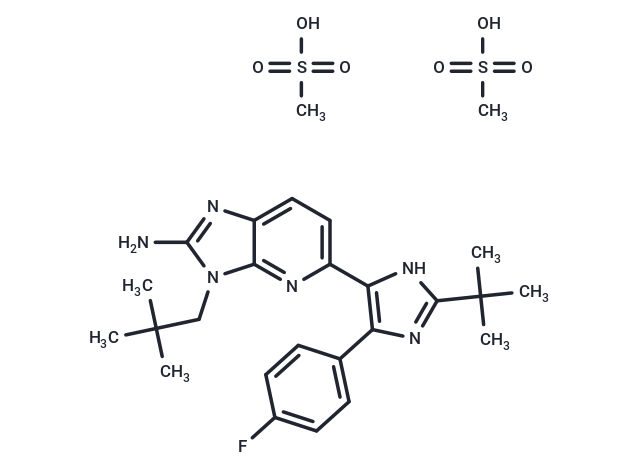
| Pack Size | Price | USA Stock | Global Stock | Quantity |
|---|---|---|---|---|
| 1 mg | $35 | In Stock | In Stock | |
| 5 mg | $77 | In Stock | In Stock | |
| 10 mg | $133 | In Stock | In Stock | |
| 25 mg | $253 | In Stock | In Stock | |
| 50 mg | $388 | - | In Stock | |
| 100 mg | $496 | - | In Stock | |
| 1 mL x 10 mM (in DMSO) | $101 | In Stock | In Stock |
| Description | Ralimetinib dimesylate (LY2228820 dimesylate) is the dimesylate salt form of LY2228820, a tri-substituted imidazole derivative and orally available p38 mitogen-activated protein kinase (MAPK) inhibitor with potential anti-inflammatory and antineoplastic activities. |
| Targets & IC50 | p38α:7 nM, p38β MAPK:3.2 nM |
| In vitro | Ralimetinib inhibits p38α, as well as the level of phosphoMAPKAPK-2 (pMK2) in RAW 264.7 cells, with IC50 values of 7 nM and 34.3 nM, respectively. Furthermore, Ralimetinib inhibits lipopolysaccharide (LPS)-induced TNFα formation in murine peritoneal macrophages, with IC50 of 5.2 nM. [1] In multiple myeloma (MM) cells, including INA6, RPMI-8226, U266, and RPMI-Dox40, Ralimetinib (200 nM–800 nM) significantly blocks p38MAPK signaling, as revealed by its inhibition on phosphorylation of HSP27, a downstream target of p38MAPK, without affecting the expression level of HSP27. Ralimetinib (200 nM–400 nM) enhances bortezomib-induced cytotoxicity and apoptosis, but Ralimetinib alone doesn't inhibit the growth of MM.1S cells. Ralimetinib (200 nM–800 nM) also inhibits secretion of IL-6 and MIP-1α in long-term BM stromal cells (LT-BMSCs), BM mononuclear cells (BMMNCs), peripheral blood (PB) CD138+, CD138 or PB CD14+ cells. Ralimetinib (400 nM–800 nM) also blocks osteoclastogenesis from CD14+ cells. [2] |
| In vivo | In LPS-induced mice, Ralimetinib effectively inhibits the formation of TNFα with a threshold minimum 50% effective dose (TMED50) less than 1 mg/kg. In a rat model of collagen-inducedarthritis (CIA), Ralimetinib displays potent effects on paw swelling, bone erosion, and cartilage destruction, with a threshold minimum 50% effective dose (TMED50)of 1.5 mg/kg. [1] |
| Synonyms | LY2228820 dimesylate |
| Kinase Assay | Inhibition of p38α: Inhibition of p38α is determined using recombinant human p38α in a standard filter binding protocol using ATP[γ-33P] and EGFR 21-mer peptide as substrate. Functional inhibition of TNFα in murine peritoneal macrophages is determined using LPS stimulation in the presence of LY2228820. To assess p38α activity in cells more directly, RAW 264.7 cells are treated with LY2228820 and then stimulated with anisomycin. The level of p38α activity is detected using a phosphoMAPKAPK-2 (pMK2) (Thr 334) antibody which reacts with a residue specifically phosphorylated by p38α. |
| Cell Research | MTT assays and APO 2.7 staining are performed to assess cellular proliferation and induction of apoptosis, respectively. Viability is expressed as percent viable cells. Apoptosis in cells is evaluated by APO 2.7 staining. For detection of mitochondrial membrane protein 7A6 expressed in apoptotic cells, cells are incubated with APO 2.7 reagent for 20 min. Expression of APO 2.7 is determined using an EPICS XL flow cytometer.(Only for Reference) |
| Molecular Weight | 612.74 |
| Formula | C24H29FN6·2CH4O3S |
| Cas No. | 862507-23-1 |
| Smiles | CS(O)(=O)=O.CS(O)(=O)=O.CC(C)(C)Cn1c(N)nc2ccc(nc12)-c1[nH]c(nc1-c1ccc(F)cc1)C(C)(C)C |
| Relative Density. | no data available |
| Storage | Powder: -20°C for 3 years | In solvent: -80°C for 1 year Shipping with blue ice/Shipping at ambient temperature. | |||||||||||||||||||||||||
| Solubility Information | DMSO: 27.5 mg/mL (44.88 mM), Sonication is recommended.  | |||||||||||||||||||||||||
| In Vivo Formulation | 10% DMSO+40% PEG300+5% Tween 80+45% Saline: 2 mg/mL (3.26 mM), Sonication is recommended. Please add the solvents sequentially, clarifying the solution as much as possible before adding the next one. Dissolve by heating and/or sonication if necessary. Working solution is recommended to be prepared and used immediately. The formulation provided above is for reference purposes only. In vivo formulations may vary and should be modified based on specific experimental conditions. | |||||||||||||||||||||||||
Solution Preparation Table | ||||||||||||||||||||||||||
DMSO
Note : The dilution table applies only to solid products. For liquid products, please calculate the stock solution based on the stated concentration and/or density. | ||||||||||||||||||||||||||
 For example, if the intended dosage is 10 mg/kg for animals weighing 20 g , with a dosing volume of 100 μL per animal, and a total of 10 animals are to be administered, using a formulation of
  10% DMSO+ 40% PEG300+ 5% Tween 80+ 45% Saline/PBS/ddH2O , the resulting working solution concentration would be 2 mg/mL.
Dissolve 2 mg of the compound in 100 μL DMSO to obtain a stock solution at a concentration of 20 mg/mL . If the required concentration exceeds the compound's known solubility, please contact us for technical support before proceeding.
1) Add 100 μL of the DMSO stock solution to 400 µL PEG300 and mix thoroughly until the solution becomes clear.
2) Add 50 µL Tween 80 and mix well until fully clarified.
3) Add 450 µL Saline,PBS or ddH2O and mix thoroughly until a homogeneous solution is obtained.
| Size | Quantity | Unit Price | Amount | Operation |
|---|
 Feedback
 Hello! How can I help you today?
Copyright © 2015-2026 TargetMol Chemicals Inc. All Rights Reserved.
