Shopping Cart
Remove All
  • TargetMol
    Your shopping cart is currently empty

Haloperidol

Copy Product Info
🥰Excellent
Catalog No. T0025Cas No. 52-86-8
Alias Serenace, Haldol, Aloperidin

Haloperidol is an effective dopamine D2 receptor antagonist that can be used to induce models of tardive dyskinesia and Parkinson’s disease.

Haloperidol

Haloperidol

Copy Product Info
🥰Excellent
Purity: 98.97%
Catalog No. T0025Alias Serenace, Haldol, AloperidinCas No. 52-86-8
Haloperidol is an effective dopamine D2 receptor antagonist that can be used to induce models of tardive dyskinesia and Parkinson’s disease.
Pack SizePriceUSA WarehouseGlobal WarehouseQuantity
25 mg$30In StockIn Stock
50 mg$40In StockIn Stock
100 mg$50In StockIn Stock
200 mg$65In StockIn Stock
1 mL x 10 mM (in DMSO)$50In StockIn Stock
Add to Cart
Add to Quotation
In Stock Estimated shipping dateUSA Warehouse[1-2 days] Global Warehouse[5-7 days]
All TargetMol products are for research purposes only and cannot be used for human consumption. We do not provide products or services to individuals. Please comply with the intended use and do not use TargetMol products for any other purpose.
Questions
TargetMol
View More

Batch Information

Select Batch
Purity:98.97%
Appearance:Solid
Color:White
Contact us for more batch information

Resource Download

Product Introduction

Haloperidol AI Summary
Haloperidol exhibits diverse bioactivities primarily related to its interactions with various neurotransmitter receptors, specifically dopamine, serotonin, and sigma receptors. It demonstrates high binding affinity for the Dopamine D2 receptor (Ki = 0.2 to 7.6 nM) and moderate affinity for dopamine receptors D3 (Ki = 3.0 to 5.8 nM) and D4 (Ki = 1.6 to 7.3 nM). It also interacts with serotonin receptors, particularly 5-hydroxytryptamine 2A (Ki = 19.95 nM) and 5-hydroxytryptamine 2 (Ki = 43.0 nM), but shows low affinity for the 5-hydroxytryptamine 1A receptor (Ki > 1000 nM). In addition, Haloperidol has significant affinities for sigma-1 (Ki = 2.2 to 6.3 nM) and sigma-2 receptors (Ki = 16.0 to 78.0 nM). In vivo, Haloperidol exhibits antipsychotic activity demonstrated by its ability to inhibit amphetamine and apomorphine-induced behaviors in rodent models. Effective doses (ED50) range from 0.12 to 1.95 mg/kg, depending on the specific behavioral assay. Additionally, the compound has been shown to induce catalepsy (ED50: 0.58 to 0.9 mg/kg), suggesting potential side effects related to motor functions. Pharmacokinetically, Haloperidol displays moderate lipophilicity with log P values around 3.5 to 3.98, moderate aqueous solubility, and high oral bioavailability (>60%). It shows a high volume of distribution (17.0 L/kg in humans) and is highly protein-bound in plasma (unbound fraction ~0.08). The compound also demonstrates moderate binding in brain tissues, indicating good penetration across the blood-brain barrier. Potential applications include antipsychotic treatments due to strong dopaminergic and serotonergic modulation as well as potential uses in neurodegenerative diseases through sigma receptor interactions. However, the compound also exhibits significant binding to the sigma receptors, which could suggest broader CNS implications, including potential for use in pain management or neuroprotection. Overall, Haloperidol’s pharmacological profile suggests that it is a promising candidate for further research in neuropsychiatric and possibly neuroprotective therapeutic applications..
Note: Summary generated by AI. Data source: ChEMBL
Bioactivity
Description
Haloperidol is an effective dopamine D2 receptor antagonist that can be used to induce models of tardive dyskinesia and Parkinson’s disease.
Disease Modeling Protocol
Tardive dyskinesia
  • Modeling Mechanism:

    Haloperidol, a typical antipsychotic drug, induces TD pathology through multiple mechanisms: ① Long-term blocking of dopamine D2 receptors leads to receptor hypersensitivity, enhances striatal dopamine metabolism, generates dopaquinones, triggers excessive production of reactive oxygen species (ROS), and induces oxidative stress; ② It damages mitochondrial function, activates apoptosis pathways (upregulation of Caspase-3/6/9), and damages striatal GABAergic neurons and dopaminergic neural projections; ③ It induces neuroinflammation (elevated IL-6), disrupts the balance of excitatory/inhibitory signals in the basal ganglia, and ultimately leads to involuntary movements and motor coordination disorders.

  • Related Products:

    Haloperidol (T0025)

  • Modeling Method:

    Experimental Subject:

    Rats: Wistar strain, male, body weight 250–300 g

    Dosage and Administration Route:

    ① Core modelling: Haloperidol (1 mg/kg) dissolved in physiological saline, administered intraperitoneally (i.p.);
    ② Control treatment: Equal volume saline solution, Administered via identical route;
    ③ Intervention verification (optional): Bacillus Calmette-Guérin (BCG vaccine, 2×10⁷ cfu) – dissolved in distilled water – intraperitoneal injection – administered once on day 1 of modelling (1 hour prior to modelling)

    Dosing Frequency and Duration Model:

    Once daily for 21 days

  • Validation:

    Behavioral indicators: Involuntary movements: Significantly increased vouching movements (VCMs), tongue protrusions (TPs), and facial jerks (FJs) appeared 14/21 days after modeling (P<0.01 vs control group); Motor function: Shortened fall latency in the rotarod test, prolonged beam crossing time and increased number of foot slips in the narrow beam walking test, and significantly reduced number of grids traversed, distance traveled, and activity time in the open field test (P<0.01); Biochemical indicators: Oxidative stress: Elevated striatal MDA and nitrite levels, and decreased GSH, SOD, and catalase activities (P<0.01); Apoptosis and inflammation: Significantly upregulated Caspase-3/6/9 and IL-6 protein levels (P<0.01); Neurochemistry: Decreased striatal dopamine (DA), norepinephrine (NE), and serotonin (5-HT) levels, and increased homovanillic acid (HVA) metabolite (P<0.01).

*Precautions: The victim was euthanized using cervical dislocation during the tissue collection process.

*References:Yedke NG,et,al. Bacillus Calmette-Guérin Vaccine Attenuates Haloperidol-Induced TD-like Behavioral and Neurochemical Alteration in Experimental Rats. Biomolecules. 2023 Nov 19;13(11):1667.

SynonymsSerenace, Haldol, Aloperidin
Chemical Properties
Molecular Weight375.86
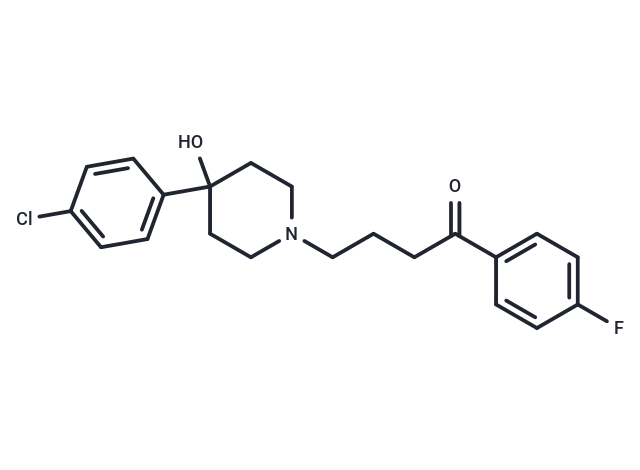
FormulaC21H23ClFNO2
Cas No.52-86-8
SmilesOC1(C2=CC=C(Cl)C=C2)CCN(CCCC(=O)C3=CC=C(F)C=C3)CC1
Relative Density.1.1820 g/cm3 (Estimated)
Storage & Solubility Information
StoragePowder: -20°C for 3 years | In solvent: -80°C for 1 year | Shipping with blue ice/Shipping at ambient temperature.
Solubility Information
Ethanol: 8 mg/mL (21.28 mM), Sonication is recommended.
H2O: < 1 mg/mL (insoluble or slightly soluble)
DMSO: 45.45 mg/mL (120.92 mM), Sonication is recommended.

In Vivo Formulation
10% DMSO+40% PEG300+5% Tween 80+45% Saline: 1 mg/mL (2.66 mM), Sonication is recommended.
Please add the solvents sequentially, clarifying the solution as much as possible before adding the next one. Dissolve by heating and/or sonication if necessary. Working solution is recommended to be prepared and used immediately. The formulation provided above is for reference purposes only. In vivo formulations may vary and should be modified based on specific experimental conditions.
Solution Preparation Table
Ethanol/DMSO
1mg5mg10mg50mg
1 mM2.6606 mL13.3028 mL26.6057 mL133.0283 mL
5 mM0.5321 mL2.6606 mL5.3211 mL26.6057 mL
10 mM0.2661 mL1.3303 mL2.6606 mL13.3028 mL
20 mM0.1330 mL0.6651 mL1.3303 mL6.6514 mL
DMSO
1mg5mg10mg50mg
50 mM0.0532 mL0.2661 mL0.5321 mL2.6606 mL
100 mM0.0266 mL0.1330 mL0.2661 mL1.3303 mL

Calculator

  • Molarity Calculator
  • Dilution Calculator
  • Reconstitution Calculator
  • Molecular Weight Calculator

In Vivo Formulation Calculator (Clear solution)

Please enter your animal experiment information in the following box and click Calculate to obtain the stock solution preparation method and in vivo formula preparation method:
TargetMol | Animal experiments For example, if the intended dosage is 10 mg/kg for animals weighing 20 g , with a dosing volume of 100 μL per animal, TargetMol | Animal experiments and a total of 10 animals are to be administered, using a formulation of TargetMol | reagent 10% DMSO+ 40% PEG300+ 5% Tween 80+ 45% Saline/PBS/ddH2O , the resulting working solution concentration would be 2 mg/mL.

Stock Solution Preparation:

Dissolve 2 mg of the compound in 100 μL DMSOTargetMol | reagent to obtain a stock solution at a concentration of 20 mg/mL . If the required concentration exceeds the compound's known solubility, please contact us for technical support before proceeding.

Preparation of the In Vivo Formulation:

1) Add 100 μL of the DMSOTargetMol | reagent stock solution to 400 μL PEG300TargetMol | reagent and mix thoroughly until the solution becomes clear.

2) Add 50 μL Tween 80 and mix well until fully clarified.

3) Add 450 μL Saline,PBS or ddH2OTargetMol | reagent and mix thoroughly until a homogeneous solution is obtained.

This example is provided solely to demonstrate the use of the In Vivo Formulation Calculator and does not constitute a recommended formulation for any specific compound. Please select an appropriate dissolution and formulation strategy based on your experimental model and route of administration.
All co-solvents required for this protocol, includingDMSO, PEG300/PEG400, Tween 80, SBE-β-CD, and Corn oil, are available for purchase on the TargetMol website.
1 Enter information below:
mg/kg
g
μL
2 Enter the in vivo formulation:
% DMSO
%
% Tween 80
% Saline/PBS/ddH2O

Dose Conversion

You can also refer to dose conversion for different animals. More Dose Conversion

Tech Support

Please see Inhibitor Handling Instructions for more frequently ask questions. Topics include: how to prepare stock solutions, how to store products, and cautions on cell-based assays & animal experiments, etc

Keywords

Related Tags: buy Haloperidol | purchase Haloperidol | Haloperidol cost | order Haloperidol | Haloperidol chemical structure | Haloperidol formula | Haloperidol molecular weight