


Shopping Cart
Remove All Your shopping cart is currently empty


Synonyms: NSC 241240, JM-8, CBDCA
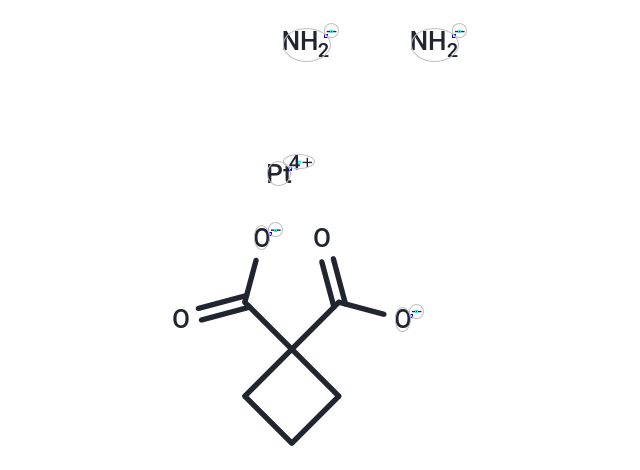
| Pack Size | Price | USA Stock | Global Stock | Quantity |
|---|---|---|---|---|
| 50 mg | $33 | In Stock | In Stock | |
| 100 mg | $46 | In Stock | In Stock | |
| 500 mg | $107 | In Stock | In Stock | |
| 1 g | $158 | In Stock | In Stock |
| Description | Carboplatin (JM-8) is a cisplatin derivative, a DNA synthesis inhibitor. Carboplatin binds to DNA, inhibits replication and transcription, and induces cell death. Carboplatin has antitumor activity. |
| Targets & IC50 | Brca1 cells:3.4 μM, IGROV1 cells:2.233 μM, HX62 cells:116.068 μM, SKOV3 cells:12.442 μM, Brca2 cells:1.9 μM, A2780 cells:6.177 μM |
| In vitro | METHODS: 5637 cells were treated with Carboplatin (0-10000 μM) for 4 h. Cell viability was determined by MTT. RESULTS: Carboplatin showed a dose-dependent cell killing effect with an IC50 value of 289.3±2.90 μM. [1] METHODS: Human RB tumor cells Y79 were treated with Carboplatin (20-80 μg/mL) for 2 days, and apoptosis was detected by Flow Cytometry. RESULTS: Carboplatin induced an increase in the rate of early apoptosis. [2] |
| In vivo | METHODS: To test the antitumor activity in vivo, Carboplatin (20 mg/kg) was injected intravenously into the tail of BALB/c (nu/nu) mice harboring human RB tumor Y79 every three days for one or two weeks. RESULTS: Carboplatin successfully inhibited the growth of human RB xenografts in vivo. [2] METHODS: To detect anti-tumor activity in vivo, Carboplatin (25-75 mg/kg) was injected intraperitoneally into immunodeficient mice bearing EOC xenograft tumors once a week for six weeks. RESULTS: OV1946 and OV4453 were sensitive to Carboplatin, OV90 and OV4485 showed moderate response, and TOV21G and TOV112D were resistant. [3] |
| Synonyms | NSC 241240, JM-8, CBDCA |
| Kinase Assay | Radioligand binding studies on human AT1 receptors: A radioligand binding assay is performed by using human AT1 receptor-coated microplates containing 4.4 to 6.2 fmol of receptors/well (10 μg of membrane protein/well). Membrane-coated wells are incubated with 45 μL of assay buffer (50 mM Tris-HCl, 5 mM MgCl2, 1 mM EDTA, and 0.005% CHAPS, pH 7.4) containing various concentrations of Azilsartan at room temperature. After 90 minutes, 5 μL of 125I-Sar1-Ile8-AII (final concentration 0.6 nM) dissolved in assay buffer is added to the wells, and the plate is incubated for 5 hours. In each step, the plate is briefly and gently shaken on a plate shaker. In washout experiments, the membranes are incubated with Azilsartan for 90 minutes, then immediately washed twice with 200 μL/well of assay buffer to remove unbound compounds, and further incubated for 5 hours with 125I-Sar1-Ile8-AII. Membrane-bound radioactivity is counted using a TopCount Microplate Scintillation and Luminescence Counter. In the experiments to estimate the dissociation rate of Azilsartan from AT1 receptors, membranes are incubated for 90 minutes with Azilsartan at a concentration of 30 nM for Azilsartan. Azilsartan inhibits the specific binding of 125I-Sar1-Ile8-AII to human AT1 by approximately 90%. The membranes are then immediately washed twice with 200 μL/well of assay buffer and further incubated with 125I-Sar1-Ile8-AII for 240 minutes. Membrane-bound radioactivity is counted using the TopCount Microplate Scintillation and Luminescence Counterat 30 minutes, 60 minutes, 90 minutes, 120 minutes, 150 minutes, 180 minutes, or 240 minutes. Nonspecific binding of 125I-Sar1-Ile8-AII is estimated in the presence of 10 μM unlabeled AII. Unlabeled AII is added again after washout for the washout experiment. Specific binding is defined as total binding minus nonspecific binding. |
| Cell Research | 3-(4,5-dimethylthiazol-2yl)-2,5-diphenyltetrazolium bromide (MTT) assays: Exponentially growing A2780, SKOV3, IGROV-1 and HX62 ovarian cancer cells are plated in 96 well plates. A range of drug concentrations are added and the plates are incubated for 72 hours to allow for 3–4 doubling times. Each experiment is carried out in triplicate. Sulforhodamine B (SRB) assays: Exponentially growing A2780 cells are plated in 96 well microtitre plates. For experiments studying concomitant exposure, cells are exposed to increasing concentrations of both drugs for 96 hours. For experiments studying the effect of sequence of exposure to 17-AAG or carboplatin cells are exposed to increasing concentrations of 17-AAG or carboplatin for 24 hours. A period of 24-hour exposure to the first agent is chosen so that the A2780 cells would be exposed to the first drug for at least one doubling time (18-24 hours). The cells are then washed with sterile phosphate buffered saline and the medium is replenished. Following this, the second drug (to which the cells are not exposed to in the first 24 hours) or medium is added for 96 hours. All experiments are carried out in triplicate. The results of combination studies are analyzed using the well-established principles of median effect analysis method. The effects of the combination are calculated using an in-house spreadsheet. (Only for Reference) |
| Molecular Weight | 371.25 |
| Formula | C6H12N2O4Pt |
| Cas No. | 41575-94-4 |
| Smiles | [NH2-].[NH2-].[Pt+4].[O-]C(=O)C1(CCC1)C([O-])=O |
| Relative Density. | no data available |
| Storage | Keep away from direct sunlight,The compound is unstable in solution. Please use soon Powder: -20°C for 3 years | In solvent: -80°C for 1 year Shipping with blue ice/Shipping at ambient temperature. | ||||||||||||||||||||||||||||||
| Solubility Information | DMF: 1 mg/mL (2.69 mM), Sonication is recommended. H2O: 12.5 mg/mL (33.67 mM), Sonication is recommended. (DMSO inactivates the activity of Carboplatin.)  DMSO: Slightly soluble, DMSO inactivates the activity of Carboplatin. | ||||||||||||||||||||||||||||||
Solution Preparation Table | |||||||||||||||||||||||||||||||
DMF/H2O
H2O
Note : The dilution table applies only to solid products. For liquid products, please calculate the stock solution based on the stated concentration and/or density. | |||||||||||||||||||||||||||||||
 For example, if the intended dosage is 10 mg/kg for animals weighing 20 g , with a dosing volume of 100 μL per animal, and a total of 10 animals are to be administered, using a formulation of
  10% DMSO+ 40% PEG300+ 5% Tween 80+ 45% Saline/PBS/ddH2O , the resulting working solution concentration would be 2 mg/mL.
Dissolve 2 mg of the compound in 100 μL DMSO to obtain a stock solution at a concentration of 20 mg/mL . If the required concentration exceeds the compound's known solubility, please contact us for technical support before proceeding.
1) Add 100 μL of the DMSO stock solution to 400 µL PEG300 and mix thoroughly until the solution becomes clear.
2) Add 50 µL Tween 80 and mix well until fully clarified.
3) Add 450 µL Saline,PBS or ddH2O and mix thoroughly until a homogeneous solution is obtained.
| Size | Quantity | Unit Price | Amount | Operation |
|---|
 Feedback
 Hello! How can I help you today?
Copyright © 2015-2026 TargetMol Chemicals Inc. All Rights Reserved.
