


Shopping Cart
Remove All Your shopping cart is currently empty

Synonyms: Resorufin ethyl ether

| Pack Size | Price | USA Stock | Global Stock | Quantity |
|---|---|---|---|---|
| 1 mg | $30 | In Stock | In Stock | |
| 2 mg | $38 | In Stock | In Stock | |
| 5 mg | $61 | In Stock | In Stock | |
| 10 mg | $101 | In Stock | In Stock | |
| 25 mg | $206 | In Stock | In Stock | |
| 50 mg | $369 | - | In Stock |
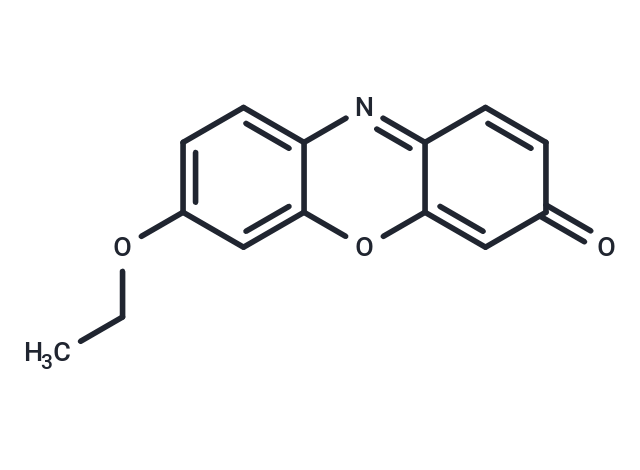
| Description | 7-Ethoxyresorufin (Resorufin ethyl ether) (7-ER) is a fluorometric substrate and competitive inhibitor of cytochrome P450, particularly CYP1A1. |
| In vivo | 7-ER inhibited responses to NO and nitrergic nerve stimulation through generation of superoxide radicals. A 7-ER sensitive P450 system may be involved in the bioactivation of GTN and SNP in rat aortic rings, but not in rabbit aorta or rat anococcygeus muscles. |
| Synonyms | Resorufin ethyl ether |
| Cell Research | Instructions I. Solution preparation 1. Stock solution preparation: 7-Ethoxyresorufin is dissolved in DMSO or ethanol and prepared to 1–10 mM (adjusted according to experimental needs). 2. Working concentration: Usually 0.5–5 µM. (Adjusted according to experimental needs) Notes: 1) Powder: Store dry and away from light at -20°C. 2) Stock solution: Store away from light at -20°C, and can be stored at 4°C for a short period of time to avoid repeated freezing and thawing. II. CYP1A1/CYP1A2 enzyme activity detection Operation steps 1. Sample preparation: Use liver microsomes or cultured cells as samples. Cells need to be pretreated to induce the expression of CYP1A1 or CYP1A2 (such as treatment with benzo[a]pyrene or 3-methylcholanthracene). 2. Reaction system: 1) Prepare reaction buffer (e.g. 50 mM Tris-HCl, pH 7.4). 2) Dilute the stock solution of 7-Ethoxyresorufin to a working concentration (e.g. 2 µM) and add to the buffer. 3) Add NADPH generating system (e.g. NADPH or NADPH regenerating system) to start the reaction. 3. Reaction conditions: 1) Incubate at 37°C for 10–30 minutes (the specific time is optimized according to the experiment). 2) Stop the reaction: The reaction can be terminated by adding an equal volume of cold ethanol or methanol. 3. Fluorescence detection: Resorufin (deethoxylated product) generated by the reaction emits strong green fluorescence: Excitation wavelength: ~530 nm Emission wavelength: ~585 nm Measure the fluorescence signal using a fluorescence spectrophotometer or microplate reader. The above information is based on published literature. Experimental procedures should be appropriately modified to meet specific research demands. |
| Molecular Weight | 241.24 |
| Formula | C14H11NO3 |
| Cas No. | 5725-91-7 |
| Smiles | CCOc1ccc2nc3ccc(=O)cc3oc2c1 |
| Relative Density. | 1.29 g/cm3 |
| Storage | Store at low temperature Powder: -20°C for 3 years | In solvent: -80°C for 1 year Shipping with blue ice/Shipping at ambient temperature. | |||||||||||||||
| Solubility Information | DMSO: < 1 mg/mL (insoluble or slightly soluble)  DMF: 1.92 mg/mL (7.96 mM), Sonication is recommended. | |||||||||||||||
Solution Preparation Table | ||||||||||||||||
DMF
Note : The dilution table applies only to solid products. For liquid products, please calculate the stock solution based on the stated concentration and/or density. | ||||||||||||||||
 For example, if the intended dosage is 10 mg/kg for animals weighing 20 g , with a dosing volume of 100 μL per animal, and a total of 10 animals are to be administered, using a formulation of
  10% DMSO+ 40% PEG300+ 5% Tween 80+ 45% Saline/PBS/ddH2O , the resulting working solution concentration would be 2 mg/mL.
Dissolve 2 mg of the compound in 100 μL DMSO to obtain a stock solution at a concentration of 20 mg/mL . If the required concentration exceeds the compound's known solubility, please contact us for technical support before proceeding.
1) Add 100 μL of the DMSO stock solution to 400 µL PEG300 and mix thoroughly until the solution becomes clear.
2) Add 50 µL Tween 80 and mix well until fully clarified.
3) Add 450 µL Saline,PBS or ddH2O and mix thoroughly until a homogeneous solution is obtained.
| Size | Quantity | Unit Price | Amount | Operation |
|---|
 Feedback
 Hello! How can I help you today?
Copyright © 2015-2026 TargetMol Chemicals Inc. All Rights Reserved.
