Shopping Cart
Remove All
  • TargetMol
    Your shopping cart is currently empty

Serum Amyloid P Protein, Human, Recombinant (His)

Catalog No. TMPY-03195 Copy Product Info
Serum Amyloid P Protein, Human, Recombinant (His) is expressed in HEK293 mammalian cells with His tag. The predicted molecular weight is 24.7 kDa and the accession number is P02743.

Serum Amyloid P Protein, Human, Recombinant (His)

Catalog No. TMPY-03195
Copy Product Info

Serum Amyloid P Protein, Human, Recombinant (His) is expressed in HEK293 mammalian cells with His tag. The predicted molecular weight is 24.7 kDa and the accession number is P02743.

Serum Amyloid P Protein, Human, Recombinant (His)
Pack SizePriceUSA StockGlobal StockQuantity
5 μg$48-In Stock
10 μg$75-In Stock
20 μg$118-In Stock
50 μg$229-In Stock
100 μg$386-In Stock
200 μg$6607-10 days7-10 days
500 μg$1,3307-10 days7-10 days
Add to Cart
Add to Quotation
For In stock only · Estimated delivery:USA Stock (1-2 days) Global Stock (5-7 days)
For research use only—not for human use. No sales to individuals. Use as intended only.
Questions
View More

Batch Information

Select Batch

Product Information

Biological Activity
Activity testing is in progress. It is theoretically active, but we cannot guarantee it. If you require protein activity, we recommend choosing the eukaryotic expression version first.
Description
Serum Amyloid P Protein, Human, Recombinant (His) is expressed in HEK293 mammalian cells with His tag. The predicted molecular weight is 24.7 kDa and the accession number is P02743.
Species
Human
Expression System
HEK293 Cells
TagC-His
Accession NumberP02743
Synonyms
SAP,PTX2,HEL-S-92n,amyloid P component, serum
Construction
A DNA sequence encoding the human APCS (P02743) (Met1-Val223) was expressed with a polyhistidine tag at the C-terminus. Predicted N terminal: His 20
Protein Purity
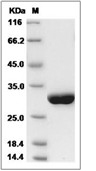
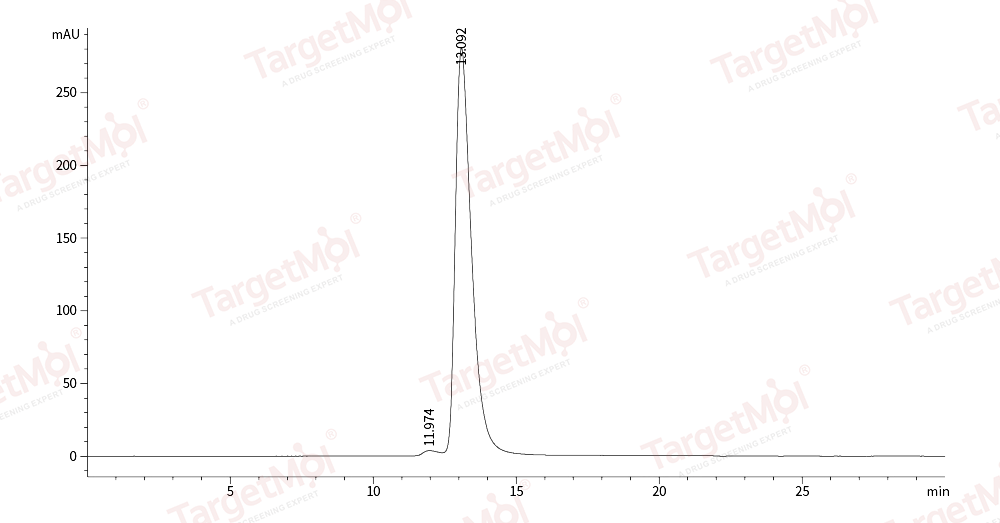
≥ 95 % as determined by SDS-PAGE. ≥ 90 % as determined by SEC-HPLC.
Serum Amyloid P Protein, Human, Recombinant (His)Serum Amyloid P Protein, Human, Recombinant (His)
Molecular Weight24.7 kDa (predicted); 31 kDa (reducing conditions)
Endotoxin< 1.0 EU/μg of the protein as determined by the LAL method.
FormulationLyophilized from a solution filtered through a 0.22 μm filter, containing 20 mM Tris, 100 mM Nacl, pH 8.0.Typically, a mixture containing 5% to 8% trehalose, mannitol, and 0.01% Tween 80 is incorporated as a protective agent before lyophilization.
Reconstitution
Reconstituted with sterile deionized water to 0.25 mg/mL. Reconstitution conditions may vary depending on the lot.
Stability & Storage
It is recommended to store recombinant proteins at -20°C to -80°C for future use. Lyophilized powders can be stably stored for over 12 months, while liquid products can be stored for 6-12 months at -80°C. For reconstituted protein solutions, the solution can be stored at -20°C to -80°C for at least 3 months. Please avoid multiple freeze-thaw cycles and store products in aliquots.
ShippingIn general, lyophilized powders are shipped with blue ice, while solutions are shipped with dry ice.
Research Background
Serum amyloid P component (SAP) is the identical serum form of amyloid P component (AP), a highly preserved plasma protein named for its ubiquitous presence in amyloid deposits. As a normal plasma protein first identified as the pentagonal constituent of in vivo pathological deposits called "amyloid". Serum amyloid P component represents another member of the pentraxin family, a highly conserved group of molecules that may play a role in innate immunity. SAP is a key negative regulator for innate immune responses to DNA and may be partly responsible for the insufficient immune responses after DNA vaccinations in humans. SAP suppression may be a novel strategy for improving efficacy of human DNA vaccines and requires further clinical investigations.

Dose Conversion

You can also refer to dose conversion for different animals. More

Calculator

  • Reconstitution Calculator
  • Recombinant Protein Dilution Calculator
  • Specific Activity Calculator

Tech Support

Please read the User Guide of Recombinant Proteins for more specific information.

Keywords