


Shopping Cart
Remove All Your shopping cart is currently empty

Synonyms: ZD4054
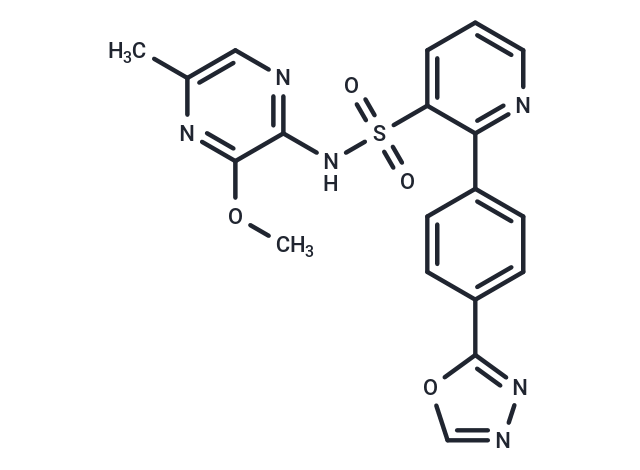

| Pack Size | Price | USA Stock | Global Stock | Quantity |
|---|---|---|---|---|
| 1 mg | $36 | - | In Stock | |
| 2 mg | $52 | - | In Stock | |
| 5 mg | $84 | - | In Stock | |
| 10 mg | $147 | - | In Stock | |
| 25 mg | $297 | - | In Stock | |
| 50 mg | Preferential | - | In Stock | |
| 1 mL x 10 mM (in DMSO) | $94 | - | In Stock |
| Description | Zibotentan (ZD4054) (ZD4054) is a specific Endothelin (ET)A antagonist with IC50 of 21 nM, exhibiting no activity at ETB. Phase 3. |
| Targets & IC50 | ETA:21 nM |
| In vitro | As Zibotentan specifically inhibits ETA-mediated antiapoptotic effects, but not ETB-mediated proapoptotic effects in human and rat smooth muscle cells, Zibotentan binds to endothelin A receptor (ETA) with high affinity with Ki of 13 nM, and has no affinity for endothelin B receptor (ETB) with IC50 of >10 μM. [1] Zibotentan treatment at 1 μM inhibits ET-1 induced mitogenic activity in ovarian carcinoma cell lines HEY and OVCA 433 secreting ET-1 and expressing ETA and ETB mRNA. [2] ZD4054 (1 μM) inhibits ET-1 induced EGFR transactivation in HEY and OVCA 433 cells. Zibotentan (1 μM) reverts ET-1 mediated epithelial-mesenchymal transition (EMT), by enhancing E-cadherin expression and promoter activity, and inhibiting vascular endothelial growth factor (VEGF) secretion and invasiveness in HEY and OVCA 433 cells. [3] Zibotentan also potently inhibits the basal and ET-1 induced cell proliferation in SKOV-3 and A-2780 cells, associated with the inhibition of AKT and p42/44MAPK phosphorylation, and with increased apoptosis through the inhibition of bcl-2 and activation of caspase-3 and poly(ADP-ribose) polymerase proteins. [4] |
| In vivo | Administration of Zibotentan at 10 mg/kg/day for 21 days potently inhibits the growth of HEY ovarian carcinoma xenografts in mice by 69% with no associated toxicity, which is in association with the blocking of cell proliferation evaluated by 37% inhibition of the Ki-67 expression, and the 62% inhibition of tumor-induced vascularization. Consistently, Zibotentan treatment significantly inhibits the expression of matrix metalloproteinase-2 (MMP-2) and VEGF, as well as the activation of p42/44 MAPK and EGFR, and potently enhances the expression of E-cadherin. [3] |
| Synonyms | ZD4054 |
| Kinase Assay | Receptor-binding assays: The inhibition by Zibotentan (varying concentrations) of 125iodine-ET-1 binding to cloned human ETA is assessed using standard radioligand-binding techniques. Human recombinant ETA is expressed in mouse erythroleukaemic cells, and cell membranes prepared for competitive binding studies using 125iodine-ET-1 as the radioligand. Incubations are carried out in triplicate in the presence of Zibotentan, 100 pM to 100 μM in half-log increments, and inhibition of ET-1 binding is expressed as the geometric mean pIC50 value (concentration to inhibit 50% of binding) with a 95% confidence interval (CI). The affinity of Zibotentan for cloned human ETA is also assessed using the equation of Cheng and Prusoff to determine the equilibrium dissociation constant (Ki) in a further receptor-binding screen utilizing a greater number of concentration-response curves determined in three separate studies. |
| Cell Research | Cells are serum starved by incubation for 24 hours in serum-free DMEM before exposed to Zibotentan for 48 hours. After the treatment, cells are lysed and the supernatant is recovered and assayed for histone-associated DNA fragments, at 405 nm by the use of a microplate reader. For detection of early apoptotic events, floating and adherent cells are collected. Cells are double stained with FITC-conjugated Annexin V and propidium iodide using the Vybrant Apoptosis Kit and are immediately analyzed by cytofluorometric analysis.(Only for Reference) |
| Molecular Weight | 424.43 |
| Formula | C19H16N6O4S |
| Cas No. | 186497-07-4 |
| Smiles | COc1nc(C)cnc1NS(=O)(=O)c1cccnc1-c1ccc(cc1)-c1nnco1 |
| Relative Density. | 1.422 g/cm3 |
| Storage | Powder: -20°C for 3 years | In solvent: -80°C for 1 year Shipping with blue ice/Shipping at ambient temperature. | ||||||||||||||||||||||||||||||
| Solubility Information | DMSO: 23 mg/mL (54.19 mM), Sonication is recommended. Ethanol: < 1 mg/mL (insoluble or slightly soluble) H2O: < 1 mg/mL (insoluble or slightly soluble) | ||||||||||||||||||||||||||||||
| In Vivo Formulation | 10% DMSO+90% Corn Oil: 2 mg/mL (4.71 mM), Sonication is recommended. Please add the solvents sequentially, clarifying the solution as much as possible before adding the next one. Dissolve by heating and/or sonication if necessary. Working solution is recommended to be prepared and used immediately. The formulation provided above is for reference purposes only. In vivo formulations may vary and should be modified based on specific experimental conditions. | ||||||||||||||||||||||||||||||
Solution Preparation Table | |||||||||||||||||||||||||||||||
DMSO
Note : The dilution table applies only to solid products. For liquid products, please calculate the stock solution based on the stated concentration and/or density. | |||||||||||||||||||||||||||||||
 For example, if the intended dosage is 10 mg/kg for animals weighing 20 g , with a dosing volume of 100 μL per animal, and a total of 10 animals are to be administered, using a formulation of
  10% DMSO+ 40% PEG300+ 5% Tween 80+ 45% Saline/PBS/ddH2O , the resulting working solution concentration would be 2 mg/mL.
Dissolve 2 mg of the compound in 100 μL DMSO to obtain a stock solution at a concentration of 20 mg/mL . If the required concentration exceeds the compound's known solubility, please contact us for technical support before proceeding.
1) Add 100 μL of the DMSO stock solution to 400 µL PEG300 and mix thoroughly until the solution becomes clear.
2) Add 50 µL Tween 80 and mix well until fully clarified.
3) Add 450 µL Saline,PBS or ddH2O and mix thoroughly until a homogeneous solution is obtained.
| Size | Quantity | Unit Price | Amount | Operation |
|---|
 Feedback
 Hello! How can I help you today?
Copyright © 2015-2026 TargetMol Chemicals Inc. All Rights Reserved.
