


Shopping Cart
Remove All Your shopping cart is currently empty


Synonyms: CEB-4520, BIIB-014

| Pack Size | Price | USA Stock | Global Stock | Quantity |
|---|---|---|---|---|
| 2 mg | $30 | In Stock | In Stock | |
| 5 mg | $47 | In Stock | In Stock | |
| 10 mg | $73 | In Stock | In Stock | |
| 25 mg | $133 | In Stock | In Stock | |
| 50 mg | $221 | In Stock | In Stock | |
| 100 mg | $329 | In Stock | In Stock | |
| 200 mg | $469 | In Stock | In Stock | |
| 1 mL x 10 mM (in DMSO) | $66 | In Stock | In Stock |
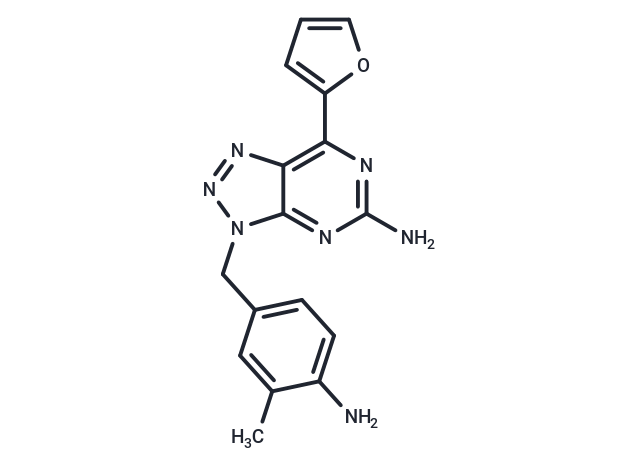
| Description | Vipadenant (CEB-4520)(BIIB-014) is an adenosine A2a antagonist with Ki of 1.3 nM; less potent for A1(Ki=69 nM). |
| Targets & IC50 | A1:69 nM(Ki), A2A:1.3 nM(Ki) |
| In vivo | Vipadenant, administered at doses ranging from 0.3 to 30 mg/kg, effectively reduces catalepsy in a dose-dependent manner without inducing statistically significant dyskinetic episodes in 6-OHDA-lesioned rats at a dosage of 10 mg/kg through a 19-day treatment protocol. Moreover, in models of haloperidol-induced hypolocomotion in mice and rats, the minimum effective doses of vipadenant are 0.1 mg/kg and 1 mg/kg, respectively. Additionally, oral administration of vipadenant at 3 and 10 mg/kg is shown to increase contralateral rotations in 6-OHDA lesioned rats, indicating its potential in modulating motor functions. |
| Synonyms | CEB-4520, BIIB-014 |
| Kinase Assay | Peptide substrate phosphorylation assays with GST-Abl kinase domains: The effect of AP24534 (0-320 nM) on GST-Abl kinase activity is assessed by using a synthetic peptide substrate (Abltide: EAIYAAPFAKKK). Assays are carried out at 30 °C for 15 min in 25 μL reaction mixture: 8 mM MOPS (pH 7), 0.2 mM EDTA, 50 μM Abltide, 30 mM MgCl2, 10 mM β-glycerol phosphate, 1 mM EGTA, 0.002% Brij-35, 0.4 mM DTT, 0.2 mg/mL BSA, 0.4 mM sodium orthovanadate, 10 nM WT or mutant GST-Abl kinase, and 100 μM ATP/γ-32[P]ATP (5000 cpm/pmol). Reactions are terminated by transferring a portion of the reaction mixture onto a p81 phosphocellulose filter and immersing in 0.75% phosphoric acid. Filters are washed 3 times in 0.75% phosphoric acid, rinsed in acetone, and air dried; phosphate incorporation is determined by scintillation counting. All results are corrected for background binding to the filters, as determined by omitting peptide substrate from the kinase reaction. Time course experiments to establish the linear range of enzymatic activity precedes kinase assays. |
| Molecular Weight | 321.34 |
| Formula | C16H15N7O |
| Cas No. | 442908-10-3 |
| Smiles | Cc1cc(Cn2nnc3c(nc(N)nc23)-c2ccco2)ccc1N |
| Relative Density. | 1.56 g/cm3 (Predicted) |
| Storage | Powder: -20°C for 3 years | In solvent: -80°C for 1 year Shipping with blue ice/Shipping at ambient temperature. | |||||||||||||||||||||||||||||||||||
| Solubility Information | DMSO: 55 mg/mL (171.16 mM), Sonication is recommended.  | |||||||||||||||||||||||||||||||||||
Solution Preparation Table | ||||||||||||||||||||||||||||||||||||
DMSO
Note : The dilution table applies only to solid products. For liquid products, please calculate the stock solution based on the stated concentration and/or density. | ||||||||||||||||||||||||||||||||||||
 For example, if the intended dosage is 10 mg/kg for animals weighing 20 g , with a dosing volume of 100 μL per animal, and a total of 10 animals are to be administered, using a formulation of
  10% DMSO+ 40% PEG300+ 5% Tween 80+ 45% Saline/PBS/ddH2O , the resulting working solution concentration would be 2 mg/mL.
Dissolve 2 mg of the compound in 100 μL DMSO to obtain a stock solution at a concentration of 20 mg/mL . If the required concentration exceeds the compound's known solubility, please contact us for technical support before proceeding.
1) Add 100 μL of the DMSO stock solution to 400 µL PEG300 and mix thoroughly until the solution becomes clear.
2) Add 50 µL Tween 80 and mix well until fully clarified.
3) Add 450 µL Saline,PBS or ddH2O and mix thoroughly until a homogeneous solution is obtained.
| Size | Quantity | Unit Price | Amount | Operation |
|---|
 Feedback
 Hello! How can I help you today?
Copyright © 2015-2026 TargetMol Chemicals Inc. All Rights Reserved.
