


Shopping Cart
Remove All Your shopping cart is currently empty


Synonyms:
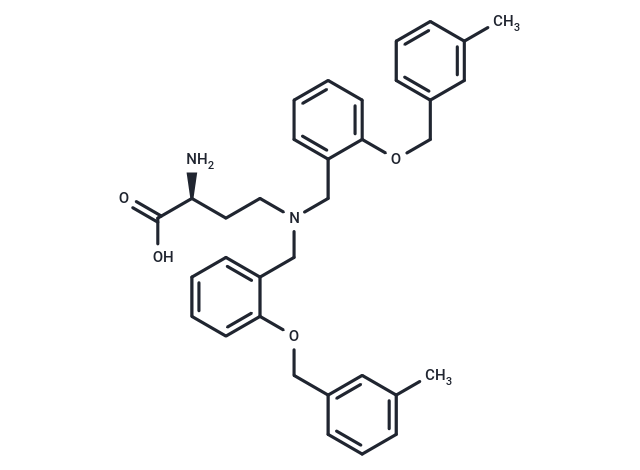
| Pack Size | Price | USA Stock | Global Stock | Quantity |
|---|---|---|---|---|
| 2 mg | $35 | In Stock | In Stock | |
| 5 mg | $56 | In Stock | In Stock | |
| 10 mg | $81 | In Stock | In Stock | |
| 25 mg | $147 | In Stock | In Stock | |
| 50 mg | $230 | In Stock | In Stock | |
| 100 mg | $370 | In Stock | In Stock | |
| 1 mL x 10 mM (in DMSO) | $67 | In Stock | In Stock |
| Description | V-9302 is a competitive antagonist of transmembrane glutamine flux. V-9302 selectively targets the amino acid transporter ASCT2 (SLC1A5) without affecting ASCT1. V-9302 inhibits ASCT2-mediated glutamine uptake in HEK-293 cells (IC50=9.6 μM). V-9302 can be used for research on tumor and amino acid transport |
| Targets & IC50 | ASCT2:9.6 μM (in HEK-293 cells) |
| In vitro | Methods: Human pancreatic cancer cells (BxPC-3 and HPAC) were treated with V-9302 alone at concentrations ranging from 0 to 20 μM (arranged in a dose matrix) for 48 hours, and cell viability was assessed using the MTT assay. Results: V-9302 increased caspase-7 cleavage, PARP cleavage, and PUMA expression, suggesting the induction of apoptosis. [1] Methods: The MTT assay and colony formation assay were used to assess the effects of 0.1, 1, 5, and 10 μM V-9302 monotherapy on the viability and colony formation of BxPC-3 and HPAC pancreatic cancer cells. Results: V-9302 inhibited the proliferation of pancreatic cancer cells. [2] Methods: Normal human lung fibroblasts (NHLF), idiopathic pulmonary fibrosis (IPF) fibroblasts, and mouse AKR-2B fibroblasts were pretreated with 10 μM V-9302 for 1 hour, followed by co-treatment with 5 ng/ml TGF-β for 48 hours. SLC1A5 and fibrosis markers were detected using qPCR and Western blot. Results: V-9302 significantly inhibited glutamine uptake and blocked the TGF-β-induced expression of pro-fibrotic proteins such as Col1, FN, CTGF, and ACTA2.[3] |
| In vivo | Methods: A model was established by tracheal injection of bleomycin (3.5 U/kg) into C57BL/6 mice. Starting on day 11, V-9302 (37.5 mg/kg) was administered intraperitoneally once daily for 13 consecutive days. Results: V-9302 significantly improved lung compliance, increased blood oxygen saturation, reduced lung weight and collagen deposition, alleviated inflammatory infiltration and fibrosis in lung tissue, downregulated pro-fibrotic genes such as Col1a1, Fn, and CTGF, and inhibited the activation of mTOR, HIF1/2α, and c-Myc in lung tissue. No significant hepatotoxicity, nephrotoxicity, or weight loss was observed. [3] |
| Cell Research | Live-cell amino acid uptake assays using HEK293 cells were carried out in 96-well plates. 96-well plates were coated with poly-D-lysine prior to the assay. Cells were plated at a density of 35,000 cells per well 24 h prior to carrying out the assay. Each set of conditions was replicated at least three times, technically and biologically. Cells were washed three times with 100 μL of assay buffer (containing 137 mM NaCl, 5.1 mM KCl, 0.77 mM KH2PO4, 0.71 mM MgSO4.7H2O, 1.1 mM CaCl2, 10 mM D-glucose, and 10 mM HEPES) to remove cell media. 3H-amino acid (500 nM) in the same buffer was added concomitantly with V-9302 and allowed to incubate for 15 min at 37 oC. For ASCT2-mediated 3H-glutamine uptake assays, 5 mM of the system-L inhibitor 2-amino-2-norbornanecarboxylic acid (BCH) was added and the assay buffer was adjusted to pH 6.0. For selectivity studies, no BCH was added and the assay was conducted at pH 7.4. Following the incubation period, the 3H-glutamine/inhibitor was removed and the cells were washed three times with assay buffer. The cells were then lysed by the addition of 50 μL of 1 M NaOH. For reading, 150 μL of scintillation fluid was added and the plates were counted on a scintillation counter. IC50 was calculated using GraphPad Prism. |
| Animal Research | Animal handling methods for PET imaging studies were conducted as reported. Prior to imaging, animals were allowed to acclimate to facility environment for at least 1 h in a warmed chamber at 31.5 °C. Animals were administered 10.4–11.8 MBq 4-[18F]fluoroglutamine via intravenous injection and imaged using a scanner. During imaging, animals were maintained under 2% isoflurane anesthesia in oxygen at 2 L/min and kept warm for the duration of the PET scan. PET images in xenograft-bearing mice were acquired as 60-minute dynamic data sets. Imaging was initiated three hours post-treatment following vehicle or V-9302 (75 mg/kg) administration. PET data were reconstructed using a three-dimensional (3D) ordered subset expectation maximization/maximum a posteriori (OSEM3D/MAP) algorithm. The resulting three-dimensional reconstructions had an x-y voxel size of 0.474 mm and inter-slice distance of 0.796 mm. ASIPro software was used to manually draw 3D regions of interest (ROIs) surrounding the entire tumor volume. 4-[18F]fluoroglutamine uptake was quantified as the percentage of the injected dose per gram of tissue (%ID/g). Significance was calculated using a t-test in Graphpad Prism. Error is reported as standard deviation (SD). |
| Molecular Weight | 538.68 |
| Formula | C34H38N2O4 |
| Cas No. | 1855871-76-9 |
| Smiles | Cc1cccc(COc2ccccc2CN(CC[C@H](N)C(O)=O)Cc2ccccc2OCc2cccc(C)c2)c1 |
| Relative Density. | 1.179 g/cm3 (Predicted) |
| Storage | Store at low temperature,Keep away from moisture Powder: -20°C for 3 years | In solvent: -80°C for 1 year Shipping with blue ice/Shipping at ambient temperature. | |||||||||||||||||||||||||
| Solubility Information | H2O: Insoluble DMSO: 11 mg/mL (20.42 mM), Sonication is recommended.  | |||||||||||||||||||||||||
| In Vivo Formulation | 10% DMSO+40% PEG300+5% Tween 80+45% Saline: 10 mg/mL (18.56 mM), Solution. Please add the solvents sequentially, clarifying the solution as much as possible before adding the next one. Dissolve by heating and/or sonication if necessary. Working solution is recommended to be prepared and used immediately. The formulation provided above is for reference purposes only. In vivo formulations may vary and should be modified based on specific experimental conditions. | |||||||||||||||||||||||||
Solution Preparation Table | ||||||||||||||||||||||||||
DMSO
Note : The dilution table applies only to solid products. For liquid products, please calculate the stock solution based on the stated concentration and/or density. | ||||||||||||||||||||||||||
 For example, if the intended dosage is 10 mg/kg for animals weighing 20 g , with a dosing volume of 100 μL per animal, and a total of 10 animals are to be administered, using a formulation of
  10% DMSO+ 40% PEG300+ 5% Tween 80+ 45% Saline/PBS/ddH2O , the resulting working solution concentration would be 2 mg/mL.
Dissolve 2 mg of the compound in 100 μL DMSO to obtain a stock solution at a concentration of 20 mg/mL . If the required concentration exceeds the compound's known solubility, please contact us for technical support before proceeding.
1) Add 100 μL of the DMSO stock solution to 400 µL PEG300 and mix thoroughly until the solution becomes clear.
2) Add 50 µL Tween 80 and mix well until fully clarified.
3) Add 450 µL Saline,PBS or ddH2O and mix thoroughly until a homogeneous solution is obtained.
| Size | Quantity | Unit Price | Amount | Operation |
|---|
 Feedback
 Hello! How can I help you today?
Copyright © 2015-2026 TargetMol Chemicals Inc. All Rights Reserved.
