


Shopping Cart
Remove All Your shopping cart is currently empty


Synonyms: ABT-494
| Pack Size | Price | USA Stock | Global Stock | Quantity |
|---|---|---|---|---|
| 2 mg | $53 | In Stock | In Stock | |
| 5 mg | $86 | In Stock | In Stock | |
| 10 mg | $125 | In Stock | In Stock | |
| 25 mg | $220 | In Stock | In Stock | |
| 50 mg | $307 | In Stock | In Stock | |
| 100 mg | $433 | In Stock | In Stock | |
| 200 mg | $662 | In Stock | In Stock | |
| 1 mL x 10 mM (in DMSO) | $39 | In Stock | In Stock |
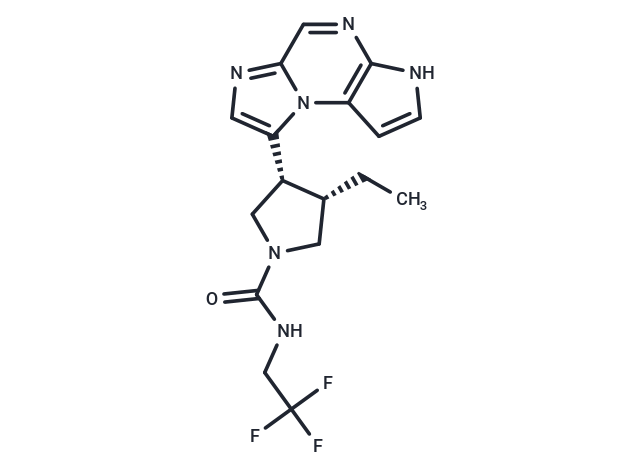
| Description | Upadacitinib (ABT-494) is a highly potent, selective, and orally active JAK1 inhibitor with an IC₅₀ of 43 nM; its selectivity for JAK1 is approximately 74 times that for JAK2. Upadacitinib is being investigated for the treatment of autoimmune diseases such as rheumatoid arthritis and ankylosing spondylitis. |
| Targets & IC50 | JAK3:2.3 μM, Tyk2:4.7 μM, JAK1:43 nM, JAK2:200 nM |
| In vitro | Methods: RAW264.7 mouse macrophages were treated with a concentration gradient (3, 6, 9 μg/mL) of upadacitinib for 24 hours, followed by cell viability assessment using the CCK-8 assay. Results: No cytotoxicity was observed at the concentrations of upadacitinib used. [1] Methods: Human whole blood was stimulated with IL-6 and treated with a concentration gradient of upadacitinib for 10 minutes. pSTAT3 expression in CD14+ monocytes and CD3+ T cells was detected by flow cytometry. Results: Upadacitinib inhibited IL-6 signaling in whole blood, with IC50 values of 78 nM (monocytes) and 207 nM (T cells).[2] |
| In vivo | Methods: Mice were randomly assigned to groups and administered daily oral gavage Upadacitinib (3 mg/kg and 6 mg/kg), once daily. Positive control: dexamethasone 4 mg/kg) for 5 consecutive days. CLP surgery was performed 4 hours after the final dose. Samples were collected 6 hours post-surgery, and 7-day survival rates were observed. Results: Upadacitinib (6 mg/kg) significantly improved the 7-day survival rate in CLP mice, reduced intestinal histopathological damage, and decreased bacterial counts in peritoneal lavage fluid. [1] Methods: Female Lewis rats developed arthritis via intra-articular injection of Mycobacterium tuberculosis emulsion into the right hind paw pad. Upadacitinib (1, 3, 10 mg/kg) was administered orally twice daily from days 7–17 post-onset. Paw swelling was measured; μCT assessed bone volume and density; histopathology was evaluated. Results: Upadacitinib exhibited dose-dependent reduction in paw swelling and bone destruction. [2] Methods: Healthy volunteers received single oral doses of upa-tibin (1, 3, 12, 24, 36, 48 mg) or tofacitinib (5 mg). Blood samples were collected at 1, 6, and 12 hours post-dose. Whole blood was stimulated ex vivo to measure inhibition of STAT phosphorylation. Results: Upa-tibin 3 mg inhibited IL-6-induced pSTAT3 by approximately 50%. [2] |
| Synonyms | ABT-494 |
| Molecular Weight | 380.37 |
| Formula | C17H19F3N6O |
| Cas No. | 1310726-60-3 |
| Smiles | CC[C@@H]1CN(C[C@@H]1c1cnc2cnc3[nH]ccc3n12)C(=O)NCC(F)(F)F |
| Relative Density. | 1.56 g/cm3 (Predicted) |
| Storage | Store at low temperature Powder: -20°C for 3 years | In solvent: -80°C for 1 year Shipping with blue ice/Shipping at ambient temperature. | |||||||||||||||||||||||||||||||||||
| Solubility Information | DMSO: 55 mg/mL (144.6 mM), Sonication is recommended.  | |||||||||||||||||||||||||||||||||||
| In Vivo Formulation | 10% DMSO+40% PEG300+5% Tween 80+45% Saline: 1 mg/mL (2.63 mM), Sonication is recommended. Please add the solvents sequentially, clarifying the solution as much as possible before adding the next one. Dissolve by heating and/or sonication if necessary. Working solution is recommended to be prepared and used immediately. The formulation provided above is for reference purposes only. In vivo formulations may vary and should be modified based on specific experimental conditions. | |||||||||||||||||||||||||||||||||||
Solution Preparation Table | ||||||||||||||||||||||||||||||||||||
DMSO
Note : The dilution table applies only to solid products. For liquid products, please calculate the stock solution based on the stated concentration and/or density. | ||||||||||||||||||||||||||||||||||||
 For example, if the intended dosage is 10 mg/kg for animals weighing 20 g , with a dosing volume of 100 μL per animal, and a total of 10 animals are to be administered, using a formulation of
  10% DMSO+ 40% PEG300+ 5% Tween 80+ 45% Saline/PBS/ddH2O , the resulting working solution concentration would be 2 mg/mL.
Dissolve 2 mg of the compound in 100 μL DMSO to obtain a stock solution at a concentration of 20 mg/mL . If the required concentration exceeds the compound's known solubility, please contact us for technical support before proceeding.
1) Add 100 μL of the DMSO stock solution to 400 µL PEG300 and mix thoroughly until the solution becomes clear.
2) Add 50 µL Tween 80 and mix well until fully clarified.
3) Add 450 µL Saline,PBS or ddH2O and mix thoroughly until a homogeneous solution is obtained.
| Size | Quantity | Unit Price | Amount | Operation |
|---|
 Feedback
 Hello! How can I help you today?
Copyright © 2015-2026 TargetMol Chemicals Inc. All Rights Reserved.
