


Shopping Cart
Remove All Your shopping cart is currently empty

Synonyms:

| Pack Size | Price | USA Stock | Global Stock | Quantity |
|---|---|---|---|---|
| 5 mg | $41 | In Stock | In Stock | |
| 10 mg | $66 | In Stock | In Stock | |
| 25 mg | $121 | In Stock | In Stock | |
| 50 mg | $197 | In Stock | In Stock | |
| 100 mg | $316 | - | In Stock | |
| 1 mL x 10 mM (in DMSO) | $45 | In Stock | In Stock |
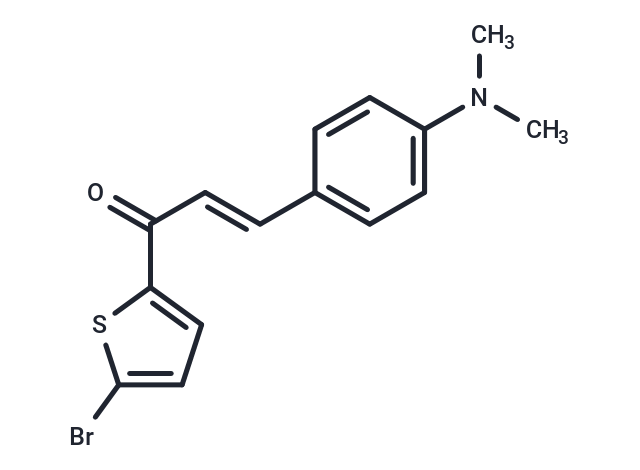
| Description | TB5 is a potent, selective, and reversible inhibitor of hMAO-B. |
| Targets & IC50 | MAO-B (human):0.11±0.01 μM. (Ki) |
| In vitro | TB5 and TB8 interact competitively with the catalytic sites of hMAO-B and hMAO-A. TB5 shows the highest inhibitory activity and selectivity toward hMAO-B, with Ki and SI values of 0.11±0.01 μM and 13.18, respectively. Inhibition by TB5 (hMAO-B) and TB8 (hMAO-A) is fully reversible after 24 hours of dialysis. Cytotoxicity studies reveal TB5 is non-toxic at 5 and 25 μM, with cell viabilities of 95.75% and 84.59%, respectively [1]. |
| In vivo | Compounds are initially dissolved in DMSO (5 mg/mL), then further diluted with a PBS/EtOH mixture (70:30). To elucidate the critical interactions dictating selectivity and potency, kinetic analyses of TB5 and TB8 are conducted. Lineweaver–Burk plots, a total of five, are created to compare the catalytic rates of MAO-B and MAO-A at various substrate concentrations (0.1-1 μM) in both the absence and presence of TB5 and TB8 at differing concentrations. The initial plot reveals the baseline enzyme activity without inhibitors, while the subsequent four plots show the impact of varying concentrations of TB5 and TB8[1]. |
| Kinase Assay | Compounds are dissolved in DMSO (5 mg/mL) and diluted with PBS/EtOH (70:30).Kinetic analyses are carried out for TB5 and TB8. A set of Lineweaver–Burk plots are constructed in the absence and presence of various concentrations of compounds TB5 and TC8. The set consists of five graphs, each constructed by measuring MAO-B and MAO-A catalytic rates at different substrate concentrations (0.1-1 μM). The first Lineweaver–Burk plot is constructed in the absence of inhibitor, while the remaining four graphs are constructed in the presence of different concentrations of TB5 and TB8[1]. |
| Cell Research | In vitro cytotoxicity of brominated thiophene chalcones and standard MAO inhibitors are tested in human HepG2 hepatic cancer cells at three different concentrations (1, 5 and 25 μM)[1]. |
| Molecular Weight | 336.25 |
| Formula | C15H14BrNOS |
| Cas No. | 948841-07-4 |
| Smiles | CN(C)c1ccc(\C=C\C(=O)c2ccc(Br)s2)cc1 |
| Relative Density. | 1.440 g/cm3 (Predicted) |
| Storage | Powder: -20°C for 3 years | In solvent: -80°C for 1 year Shipping with blue ice/Shipping at ambient temperature. | |||||||||||||||||||||||||||||||||||
| Solubility Information | DMSO: 55 mg/mL (163.57 mM), Sonication is recommended.  | |||||||||||||||||||||||||||||||||||
Solution Preparation Table | ||||||||||||||||||||||||||||||||||||
DMSO
Note : The dilution table applies only to solid products. For liquid products, please calculate the stock solution based on the stated concentration and/or density. | ||||||||||||||||||||||||||||||||||||
 For example, if the intended dosage is 10 mg/kg for animals weighing 20 g , with a dosing volume of 100 μL per animal, and a total of 10 animals are to be administered, using a formulation of
  10% DMSO+ 40% PEG300+ 5% Tween 80+ 45% Saline/PBS/ddH2O , the resulting working solution concentration would be 2 mg/mL.
Dissolve 2 mg of the compound in 100 μL DMSO to obtain a stock solution at a concentration of 20 mg/mL . If the required concentration exceeds the compound's known solubility, please contact us for technical support before proceeding.
1) Add 100 μL of the DMSO stock solution to 400 µL PEG300 and mix thoroughly until the solution becomes clear.
2) Add 50 µL Tween 80 and mix well until fully clarified.
3) Add 450 µL Saline,PBS or ddH2O and mix thoroughly until a homogeneous solution is obtained.
| Size | Quantity | Unit Price | Amount | Operation |
|---|
 Feedback
 Hello! How can I help you today?
Copyright © 2015-2026 TargetMol Chemicals Inc. All Rights Reserved.
