


Shopping Cart
Remove All Your shopping cart is currently empty

Synonyms: LY573636
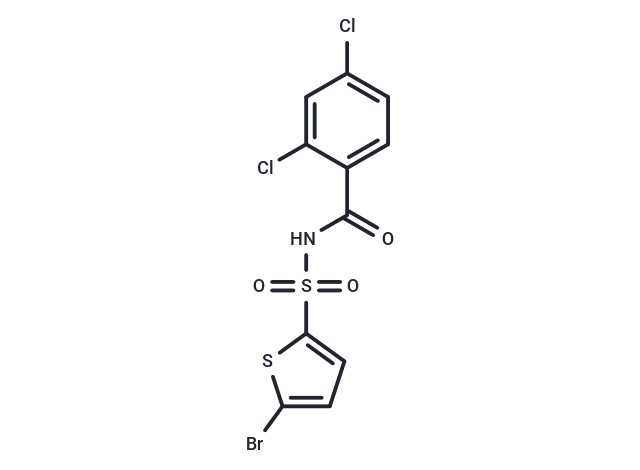
| Pack Size | Price | USA Stock | Global Stock | Quantity |
|---|---|---|---|---|
| 5 mg | $35 | In Stock | In Stock | |
| 10 mg | $56 | In Stock | In Stock | |
| 25 mg | $126 | In Stock | In Stock | |
| 50 mg | $215 | In Stock | In Stock | |
| 100 mg | $322 | In Stock | In Stock | |
| 200 mg | $483 | In Stock | In Stock | |
| 500 mg | $789 | - | In Stock | |
| 1 mL x 10 mM (in DMSO) | $40 | In Stock | In Stock |
| Description | Tasisulam (LY573636) is an apoptosis inducer and an antitumor agent via the intrinsic pathway. |
| In vitro | Tasisulam inhibits growth of various human leukemia and lymphoma cell lines with ED50 ranging from 7 to 40 μM. LY573636 also induces apoptosis in HL60, Reh, and MD901 cells, mainly by loss of mitochondrial membrane potential and induction of reactive oxygen species. [1] In addition, Tasisulam also produce antiproliferative activities in more than 70% of the 120 cell lines tested with EC50 of less than 50 μM. Tasisulam induces G2–M accumulation and subsequent apoptosis in Calu-6 and A-375 cells. In vitro, Tasisulam also inhibits VEGF-, FGF- and EGF-induced endothelial cord formation with EC50 of 47, 103, and 34 nM, respectively. [2] |
| In vivo | Tasisulam induces morphologic features of vascular normalization, including increased pericyte coverage and decreased hypoxia in vivo. Tasisulam (25 or 50 mg/kg, i.v.) displays dose-dependent antitumor activity, induces apoptosis, and normalizes tumor-associated vasculature in the Calu-6 non–small cell lung xenograft model. Besides, Tasisulam displays potent antitumor activity across a range of in vivo xenografts, including colorectal (HCT-116), melanoma (A-375), gastric (NUGC-3), leukemia (MV-4-11), and pancreatic (QGP-1). [2] |
| Synonyms | LY573636 |
| Kinase Assay | Electrophysiology: The human IKCa1 is cloned and expressed in COS-7 cells. Cells are studied in the whole-cell configuration of the patch-clamp technique. The holding potential is 280 mV. The internal pipette solution contains: 145 mM K+ aspartate, 2 mM MgCl2, 10 mM Hepes, 10 mM K2EGTA, and 8.5 mM CaCl2 (1 μM free Ca2+), pH 7.2, 290-310 mOsm. To reduce currents from the native chloride channels in COS-7 cells, Na+ aspartate Ringer is used as an external solution: 160 mM Na+ aspartatey/4.5 mM KCl/2 mM CaCl2/1 mM MgCl2/5 mM Hepes, pH 7.4/290-310 mOsm. IKCa currents in COS-7 cells are elicited by 200-ms voltage ramps from -120 mV to 40 mV applied every 10 seconds and the reduction of slope conductance at -80 mV by TRAM-34 taken as a measure of channel block. |
| Cell Research | Cells are treated with various concentrations of LY573636. 3-(4,5-Dimethylthiazol-2-yl)-2,5-diphenyltetrazolium bromide (MTT) assay is performed. Briefly, MTT is dissolved in phosphate-buffered saline (PBS) at 5 mg/mL. Approximately 1,000 cells per well are incubated in culture medium for 96 hours in 96-well plates; and then, 10 μL of the MTT solution is added. After a 4-hour incubation, 100 μL of solubilization solution (20 % sodium dodecyl sulfate [SDS]) is added, and the mixture was incubated at 37 °C for 16 hours. In this assay, MTT is cleaved to an orange formazan dye by metabolically active cells; and the absorbance of the formazan product is measured with an enzyme-linked immunoabsorbent assay (ELISA) reader at 540 nm. (Only for Reference) |
| Molecular Weight | 415.11 |
| Formula | C11H6BrCl2NO3S2 |
| Cas No. | 519055-62-0 |
| Smiles | Clc1ccc(C(=O)NS(=O)(=O)c2ccc(Br)s2)c(Cl)c1 |
| Relative Density. | 1.812 |
| Storage | Powder: -20°C for 3 years | In solvent: -80°C for 1 year Shipping with blue ice/Shipping at ambient temperature. | |||||||||||||||||||||||||||||||||||
| Solubility Information | Ethanol: 77 mg/mL (185.49 mM), Sonication is recommended. DMSO: 245 mg/mL (590.21 mM), Sonication is recommended.  H2O: < 1 mg/mL (insoluble or slightly soluble) | |||||||||||||||||||||||||||||||||||
| In Vivo Formulation | 10% DMSO+90% Saline: < 10 mg/mL (24.09 mM), Lower concentrations may be soluble, but exact solubility limit is unknown. 10% DMSO+40% PEG300+5% Tween 80+45% Saline: 10 mg/mL (24.09 mM), Solution. Please add the solvents sequentially, clarifying the solution as much as possible before adding the next one. Dissolve by heating and/or sonication if necessary. Working solution is recommended to be prepared and used immediately. The formulation provided above is for reference purposes only. In vivo formulations may vary and should be modified based on specific experimental conditions. | |||||||||||||||||||||||||||||||||||
Solution Preparation Table | ||||||||||||||||||||||||||||||||||||
Ethanol/DMSO
Note : The dilution table applies only to solid products. For liquid products, please calculate the stock solution based on the stated concentration and/or density. | ||||||||||||||||||||||||||||||||||||
 For example, if the intended dosage is 10 mg/kg for animals weighing 20 g , with a dosing volume of 100 μL per animal, and a total of 10 animals are to be administered, using a formulation of
  10% DMSO+ 40% PEG300+ 5% Tween 80+ 45% Saline/PBS/ddH2O , the resulting working solution concentration would be 2 mg/mL.
Dissolve 2 mg of the compound in 100 μL DMSO to obtain a stock solution at a concentration of 20 mg/mL . If the required concentration exceeds the compound's known solubility, please contact us for technical support before proceeding.
1) Add 100 μL of the DMSO stock solution to 400 µL PEG300 and mix thoroughly until the solution becomes clear.
2) Add 50 µL Tween 80 and mix well until fully clarified.
3) Add 450 µL Saline,PBS or ddH2O and mix thoroughly until a homogeneous solution is obtained.
| Size | Quantity | Unit Price | Amount | Operation |
|---|
 Feedback
 Hello! How can I help you today?
Copyright © 2015-2026 TargetMol Chemicals Inc. All Rights Reserved.
