


Shopping Cart
Remove All Your shopping cart is currently empty


Synonyms:

| Pack Size | Price | USA Stock | Global Stock | Quantity |
|---|---|---|---|---|
| 1 mg | $41 | In Stock | In Stock | |
| 5 mg | $97 | In Stock | In Stock | |
| 10 mg | $147 | In Stock | In Stock | |
| 25 mg | $267 | In Stock | In Stock | |
| 50 mg | $447 | In Stock | In Stock | |
| 100 mg | $659 | In Stock | In Stock | |
| 200 mg | $1,050 | In Stock | In Stock | |
| 1 mL x 10 mM (in DMSO) | $109 | In Stock | In Stock |
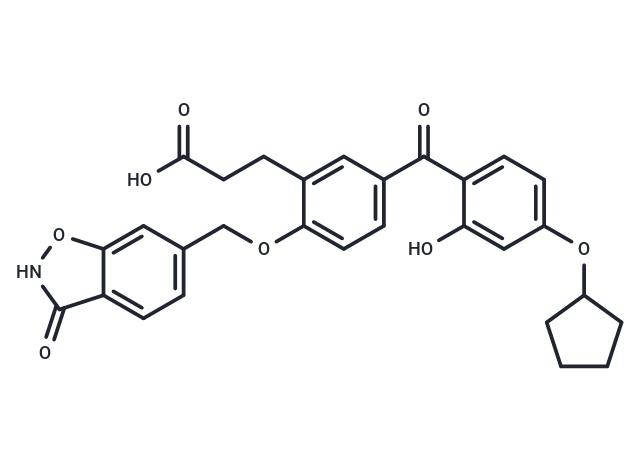
| Description | T-5224 is a selective inhibitor of the transcription factor c-Fos/activator protein (AP)-1 with anti-inflammatory effects. T-5224 specifically suppresses the DNA-binding activity of c-Fos/c-Jun, thereby inhibiting IL-1β-induced transcriptional upregulation of Mmp-3, Mmp-13, and Adamts-5, without affecting the binding activity of other transcription factors. T-5224 can be used in research on rheumatoid arthritis, osteoarthritis, and cartilage degeneration. |
| Targets & IC50 | AP-1 (NIH3T3 cells):10 μM, MMP1 (SW982 cells):10 μM, β-hexosaminidase (RBL-2H3 cells):18.30 ± 1.48 µM |
| In vitro | Methods: Human epidermal keratinocytes (NHEKs) were treated with T-5224 at concentrations ranging from 0.1 to 1 μM for 24 hours, followed by MTT assay to assess cell viability. Results: Within this concentration range, T-5224 exhibited no cytotoxicity and did not affect cell proliferation. [1] Methods: Add T-5224 at gradient concentrations (0, 20, 40, 80 μM) to HSC-3-M3 and OSC-19 cells. Measure cell migration area 24 hours after wounding. Results: T-5224 exhibited dose-dependent inhibition of migration in both cell types, with migration nearly completely suppressed at 80 μM. [2] |
| In vivo | Methods: Female BALB/c mice aged 8–10 weeks were used to establish a DNFB model. Following successful model establishment, topical application of 1% T-5224, 1% baricitinib, or 1% T-5224 + 1% baricitinib ointment was administered at 25 mg per ear, once daily for 8 days. Results: T-5224 significantly suppressed inflammation and restored Flg expression. T-5224 restored Elovl6 expression. T-5224 specifically suppressed Il17a/Il17f. [1] Methods: BALB/c nude mice were established with an orthotopic tumor model by injecting HSC-3-M3 cells (1×10⁵) into the tongue. T-5224 (150 mg/kg/day) was administered orally via gavage starting on day 1 post-tumor implantation, once daily for 4 consecutive weeks. Results: No significant difference in primary tumor volume was observed between groups, and T-5224 had no apparent effect on body weight. Cervical lymph node metastasis rates were 74.1% (20/27) in the control group and 40.0% (12/30) in the T-5224-treated group, representing a significant difference.[2] |
| Kinase Assay | The DNA binding activity of transcription factors was measured using the TransAM kits. Nuclear extracts containing factors such as c-Fos/AP-1, c-Jun/AP-1, ATF-2, C/EBPa, MyoD, Sp-1 or NF-kB/p65 and various concentrations of T-5224 were added in the multi-well plates precoated with respective consensus double-stranded (ds)DNA oligomers. After incubation for 1 h, the transcription factor bound to its respective consensus dsDNA sequences was detected by using antibodies reactive against the respective transcription factors according to the manufacturer's protocol [1]. |
| Cell Research | NIH/3T3 cells were transiently transfected with the luciferase reporter plasmids pAP-1-Luc (× 7 TGACTAA), pNF-kB-Luc (× 5 TGGGGACTTTCCGC) or control phRL-TK, and cultured overnight. Cells were incubated in 0.5% FBS/DMEM containing T-5224 for 1 h, and then stimulated with PMA (10 ng/ml) or TNFa (10 ng/ml), and then cultured for 3 h, followed by measurement of lysate by using dual-luciferase reporter assay system [1]. |
| Animal Research | Mice were housed in an SPF (specific pathogen-free) grade environment and provided food and water ad libitum with a 12 h:12 h light/dark cycle. Male 8-week-old DBA/1J mice were immunized with bovine type II collagen emulsified in Freund's complete adjuvant on days 0 and 21. T-5224, MTX and LEF were orally administered once per day. Arthritis was assessed in a blind fashion for four paws per mouse using the following score: 0, uninvolved; 1, swelling of ≤2 toes or slight swelling in ankles and wrists; 2, swelling of ≥3 toes or moderate swelling in ankles and wrists; 3, extensive swelling of total paw. X-ray films of four paws taken using Softex were assessed for joint destruction in 2nd to 5th proximal interphalangeal joints and five metatarsophalangeal joints of four paws, the carpal joints of the forepaws, and the tarsal and calcaneal joints of the hind paws. Score was: 0, no change; 1, partial erosion; 2, complete erosion for joints; and 0, negative; 0.5, positive for osteoporosis. IL-1β (500 ng per unilateral hind paw) was administered into the footpads. The mice with ≥1 arthritis score were treated with either anti-TNFα antibody at 50 or 250 μg/mouse, intraperitoneally (i.p.) twice a week and/or with 3 mg/kg T-5224, orally once daily [1]. |
| Molecular Weight | 517.53 |
| Formula | C29H27NO8 |
| Cas No. | 530141-72-1 |
| Smiles | OC(=O)CCc1cc(ccc1OCc1ccc2c(c1)o[nH]c2=O)C(=O)c1ccc(OC2CCCC2)cc1O |
| Relative Density. | 1.376 g/cm3 (Predicted) |
| Storage | Store at low temperature Powder: -20°C for 3 years | In solvent: -80°C for 1 year Shipping with blue ice/Shipping at ambient temperature. | |||||||||||||||||||||||||||||||||||
| Solubility Information | H2O: Insoluble DMSO: 240 mg/mL (463.74 mM), Sonication is recommended.  | |||||||||||||||||||||||||||||||||||
| In Vivo Formulation | 10% DMSO+40% PEG300+5% Tween 80+45% Saline: 5 mg/mL (9.66 mM), Suspension. Please add the solvents sequentially, clarifying the solution as much as possible before adding the next one. Dissolve by heating and/or sonication if necessary. Working solution is recommended to be prepared and used immediately. The formulation provided above is for reference purposes only. In vivo formulations may vary and should be modified based on specific experimental conditions. | |||||||||||||||||||||||||||||||||||
Solution Preparation Table | ||||||||||||||||||||||||||||||||||||
DMSO
Note : The dilution table applies only to solid products. For liquid products, please calculate the stock solution based on the stated concentration and/or density. | ||||||||||||||||||||||||||||||||||||
 For example, if the intended dosage is 10 mg/kg for animals weighing 20 g , with a dosing volume of 100 μL per animal, and a total of 10 animals are to be administered, using a formulation of
  10% DMSO+ 40% PEG300+ 5% Tween 80+ 45% Saline/PBS/ddH2O , the resulting working solution concentration would be 2 mg/mL.
Dissolve 2 mg of the compound in 100 μL DMSO to obtain a stock solution at a concentration of 20 mg/mL . If the required concentration exceeds the compound's known solubility, please contact us for technical support before proceeding.
1) Add 100 μL of the DMSO stock solution to 400 µL PEG300 and mix thoroughly until the solution becomes clear.
2) Add 50 µL Tween 80 and mix well until fully clarified.
3) Add 450 µL Saline,PBS or ddH2O and mix thoroughly until a homogeneous solution is obtained.
| Size | Quantity | Unit Price | Amount | Operation |
|---|
 Feedback
 Hello! How can I help you today?
Copyright © 2015-2026 TargetMol Chemicals Inc. All Rights Reserved.
