


Shopping Cart
Remove All Your shopping cart is currently empty


Synonyms:
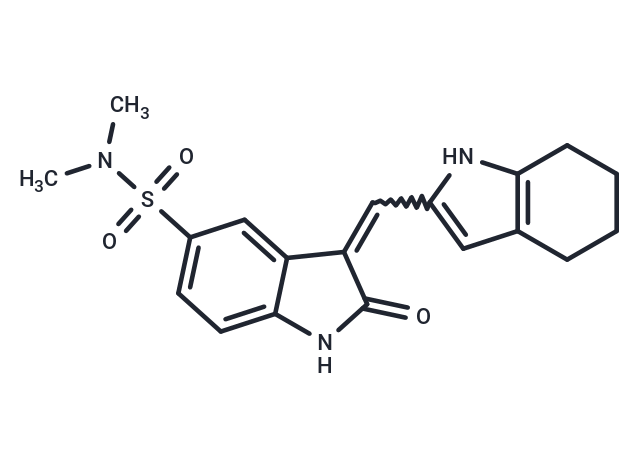

| Pack Size | Price | USA Stock | Global Stock | Quantity |
|---|---|---|---|---|
| 1 mg | $32 | In Stock | In Stock | |
| 5 mg | $73 | In Stock | In Stock | |
| 10 mg | $130 | In Stock | In Stock | |
| 25 mg | $263 | In Stock | In Stock | |
| 50 mg | $395 | In Stock | In Stock | |
| 100 mg | $593 | In Stock | In Stock | |
| 1 mL x 10 mM (in DMSO) | $77 | In Stock | In Stock |
| Description | SU 6656 is a selective inhibitor of Src family kinases, with IC50 of 280 nM, 20 nM, 130 nM, and 170 nM for Src, Yes, Lyn, and Fyn, respectively. |
| Targets & IC50 | Src:280 nM, Fyn:170 nM, Lyn:130 nM, YES:20 nM |
| In vitro | In NIH 3T3 cells, SU 6656 inhibits the PDGF-stimulated S-phase induction with IC50 of 0.3-0.4 μM. SU 6656 also inhibits PDGF- and serum-mediated NIH 3T3 cell proliferation, as well as epidermal growth factor and colony-stimulating factor 1-stimulated DNA synthesis in normal and colony-stimulating factor 1 receptor transfected NIH 3T3 cells. SU6656 inhibits PDGF-stimulated c-Myc induction and ERK2 activation.[1] Pretreating Jurkat T-cells with SU 6656 leads to increased VSV-G luciferase activity.[2] SU 6656 impairs TGF-β-mediated upregulation of CTGF mRNA and protein in proximal epithelial HKC-8 cells, and also reduces CTGF expression in cells exposed to autocrine growth factors. SU 6656 interferes with Aurora kinase activity resulting in inhibition of cell division and formation multilobular nuclei.[3] |
| In vivo | SU 6656 markedly and dose-dependently attenuates mecamylamine-induced experimental nicotine withdrawal syndrome in mice measured in terms of WSS and anxiety score.[4] Once-daily administration of SU 6656 (1.5, 3, and 6 mg/kg, i.p.) markedly and dose-dependently attenuates the naloxone-induced morphine withdrawal syndrome.[5] |
| Kinase Assay | Biochemical kinase assays for IC50 determination and kinetic studies: IC50 measurements are made using poly-Glu–Tyr (4:1), or, in the case of Lck, poly-Lys–Tyr (4:1) as a peptide substrate. The divalent cation is 20 mM MgCl2 (in the case of Src, Fyn, Yes, Lyn, Csk, Frk, or Abl) or 10 mM MnCl2 (in the case of FGFR1, IGF1R, Lck, or Met). The ?nal ATP concentrations are as follows: Src, 10 μM; Fyn, 6 μM; Yes, 100 μM; Lyn, 2 μM; Csk, 10 μM; Frk, 10 μM; Abl, 4 μM; FGFR1, 10 μM; IGF1R, 2 μM; Lck, 2 μM; Met, 5 μM; PDGFR, 6 μM. IC50 measurements of PDGFRb autophosphorylation are determined on immunoprecipitated PDGFRb. Km values are calculated using the Eadie-Hofstee method. |
| Cell Research | HKC-8 cells are seeded at different cells densities (10,000 cells/cm2 and 50,000 cells/cm2) and cultured in the presence or absence of SU 6656 for 24 and 48 h. Bright ?eld pictures of cells are recorded by Olympus CK40 microscope using Leica DC Viewer software.(Only for Reference) |
| Molecular Weight | 371.45 |
| Formula | C19H21N3O3S |
| Cas No. | 330161-87-0 |
| Smiles | C(=C1C=2C(NC1=O)=CC=C(S(N(C)C)(=O)=O)C2)C3=CC4=C(N3)CCCC4 |
| Relative Density. | 1.378g/cm3 |
| Storage | Powder: -20°C for 3 years | In solvent: -80°C for 1 year Shipping with blue ice/Shipping at ambient temperature. | |||||||||||||||||||||||||||||||||||
| Solubility Information | DMSO: 83.33 mg/mL (224.34 mM), Sonication is recommended.  H2O: < 1 mg/mL (insoluble or slightly soluble) Ethanol: < 1 mg/mL (insoluble or slightly soluble) | |||||||||||||||||||||||||||||||||||
| In Vivo Formulation | 10% DMSO+90% Saline: < 8.33 mg/mL (22.43 mM), Lower concentrations may be soluble, but exact solubility limit is unknown. 10% DMSO+90% Corn oil: < 8.33 mg/mL (22.43 mM), Lower concentrations may be soluble, but exact solubility limit is unknown. 10% DMSO+90% (20% SBE-β-CD in Saline): < 8.33 mg/mL (22.43 mM), Lower concentrations may be soluble, but exact solubility limit is unknown. 10% DMSO+40% PEG300+5% Tween 80+45% Saline: < 8.33 mg/mL (22.43 mM), Lower concentrations may be soluble, but exact solubility limit is unknown. Please add the solvents sequentially, clarifying the solution as much as possible before adding the next one. Dissolve by heating and/or sonication if necessary. Working solution is recommended to be prepared and used immediately. The formulation provided above is for reference purposes only. In vivo formulations may vary and should be modified based on specific experimental conditions. | |||||||||||||||||||||||||||||||||||
Solution Preparation Table | ||||||||||||||||||||||||||||||||||||
DMSO
Note : The dilution table applies only to solid products. For liquid products, please calculate the stock solution based on the stated concentration and/or density. | ||||||||||||||||||||||||||||||||||||
 For example, if the intended dosage is 10 mg/kg for animals weighing 20 g , with a dosing volume of 100 μL per animal, and a total of 10 animals are to be administered, using a formulation of
  10% DMSO+ 40% PEG300+ 5% Tween 80+ 45% Saline/PBS/ddH2O , the resulting working solution concentration would be 2 mg/mL.
Dissolve 2 mg of the compound in 100 μL DMSO to obtain a stock solution at a concentration of 20 mg/mL . If the required concentration exceeds the compound's known solubility, please contact us for technical support before proceeding.
1) Add 100 μL of the DMSO stock solution to 400 µL PEG300 and mix thoroughly until the solution becomes clear.
2) Add 50 µL Tween 80 and mix well until fully clarified.
3) Add 450 µL Saline,PBS or ddH2O and mix thoroughly until a homogeneous solution is obtained.
| Size | Quantity | Unit Price | Amount | Operation |
|---|
 Feedback
 Hello! How can I help you today?
Copyright © 2015-2026 TargetMol Chemicals Inc. All Rights Reserved.
