


Shopping Cart
Remove All Your shopping cart is currently empty


Synonyms: BLZ945
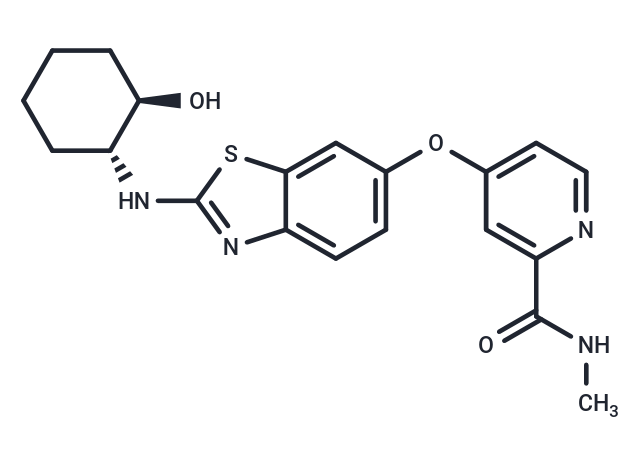
| Pack Size | Price | USA Stock | Global Stock | Quantity |
|---|---|---|---|---|
| 1 mg | $31 | In Stock | In Stock | |
| 5 mg | $72 | In Stock | In Stock | |
| 10 mg | $113 | In Stock | In Stock | |
| 25 mg | $175 | In Stock | In Stock | |
| 50 mg | $228 | In Stock | In Stock | |
| 100 mg | $397 | In Stock | In Stock | |
| 500 mg | $913 | In Stock | In Stock | |
| 1 mL x 10 mM (in DMSO) | $79 | In Stock | In Stock |
| Description | Sotuletinib (BLZ945) is a CSF-1R inhibitor, a highly selective, brain-penetrant CSF-1R inhibitor (IC50 = 1 nM, with 1000-fold selectivity over other kinases), with oral activity, used for microglia depletion and tumor and neurological disease research. |
| Targets & IC50 | CSF1R:1 nM, c-Kit:3.2 μM, PDGFRβ:4.8 μM, FLT3:9.1 μM, CSF1R:67 nM (EC50) |
| In vitro | Methods: TGCT cell lines (Si-TGCT-1, -2, -3, -4) and control cells Bewo and MDA-MB-231 were incubated with 0–1000 μM Sotuletinib for 96 hours, and cell viability was detected by MTS assay. Results: Sotuletinib inhibited TGCT cell proliferation, induced apoptosis, and increased the BAX/BCL-2 ratio, with IC₅₀ values varying with CSF1R expression levels. [1] |
| In vivo | Methods: In a male NSG mouse ccRCC model, Sotuletinib was administered orally by gavage daily at a dose of 200 mg/kg, dissolved in 20% DMSO, for three consecutive weeks.[2] Results: Compared to the control group, the Sotuletinib group showed significantly reduced tumor volume, decreased Ki67 expression in tumor tissue, and reduced proportion of M2 macrophages (CD68+CD163+). Methods: In a 4T1 tumor-bearing mouse model, Sotuletinib (BLZ-945) was administered by tail vein injection at a dose of 1.75 mg/kg every 3 days, with PBS as the vehicle, combined with 660 nm laser irradiation. Results:Tumor growth was significantly suppressed in this treatment group, with the proportion of M2 tumor-associated macrophages in tumor tissue reduced to approximately 19.86%, and the proportion of cytotoxic T lymphocytes in spleen reaching approximately 39.36%.[3] Methods: In male Wistar Han rats, Sotuletinib was administered orally by gavage daily at a dose of 150 mg/kg/day, with sodium acetate-methylcellulose solution as the vehicle, continuously for 16 days followed by drug discontinuation. Results: ALT elevation occurred during the administration period, which rapidly returned to control levels after drug discontinuation, without accompanying liver injury or miR-122 elevation.[4] |
| Synonyms | BLZ945 |
| Kinase Assay | Inhibition of biochemical TrkA, TrkB and TrkC: TrkA and TrkC biochemical assays are carried out by HTRF method. The reaction mixtures contains 1 μM peptide substrate, 1 μM ATP, and either 1.8 nM TrkA or 34 nM TrkC in the reaction buffer (50 mM HEPES pH 7.1, 10 mM MgCl2, 2 mM MnCl2, 0.01% BSA, 2.5 mM DTT and 0.1 mM Na3VO4) at a final volume of 10 μL. All reactions are carried out at room temperature in white ProxiPlate? 384-well Plus plates and are quenched with 5 μL of 0.2 mM EDTA at 60 min. Five μL of the detection reagents (2.5 ng PT66K and 0.05 μg SAXL per well) are added, the plates are incubated at room temperature for 1 h and then read in EnVision reader. Compounds are diluted into assay mixture (final DMSO 0.5%), and IC50 values are determined by 12-point (from 50 to 0.000282 μΜ) inhibition curves in duplicate under the assay conditions. TrkB biochemical assay is carried out by caliper microfluidic method. The reaction mixtures contained 1 μM peptide substrate, 10 μM ATP, and 2 nM TrkB in a reaction buffer containing 100 mM HEPES, pH 7.5, 5 mM MgCl2, 0.01% Triton X-100, 0.1% BSA, 1 mM DTT, 10 μΜNa3VO4, and 10 μΜBeta-Glycerophosphate. The reactions are carried out at room temperature for 3 hrs, and the products are determined by Caliper EZ-reader. Compounds are diluted into assay mixture (final DMSO 1%), and IC50 values are determined by 12-point (from 50 to 0.000282 μΜ) inhibition curves in duplicate under the assay conditions. |
| Cell Research | Cell growth rate is determined using the MTT cell proliferation kit. Briefly, cells are plated in triplicate in 96-well plates: 1,000 cells per well for glioma cell lines, 5 x 1,000 cells per well for BMDM and CRL-2467, and 2.5 x 1,000 cells per well for HUVEC and HBMEC cell lines. For all experiments, media is changed every 48 h. Cells are grown in the presence or absence of 6.7–6,700 nM of BLZ945, or 8 μg/mL of CSF-1R neutralizing antibody. BMDM and CRL-2467 cells were supplemented with 10 ng/mL and 30 ng/ mL recombinant mouse CSF-1, respectively. Reduction of the MTT substrate is detected by colorimetric analysis using a plate reader as per the manufacturer's protocol, and measured at 595 nm and 750 nm on a spectraMax 340pc plate reader.(Only for Reference) |
| Molecular Weight | 398.48 |
| Formula | C20H22N4O3S |
| Cas No. | 953769-46-5 |
| Smiles | CNC(=O)c1cc(Oc2ccc3nc(N[C@@H]4CCCC[C@H]4O)sc3c2)ccn1 |
| Relative Density. | 1.377 g/cm3 (Predicted) |
| Storage | Keep away from direct sunlight,Keep away from moisture,Store at low temperature Powder: -20°C for 3 years | In solvent: -80°C for 1 year Shipping with blue ice/Shipping at ambient temperature. | ||||||||||||||||||||||||||||||||||||||||
| Solubility Information | DMSO: 257 mg/mL (644.95 mM), Sonication is recommended.  Ethanol: 3 mg/mL (7.53 mM), Heating is recommended. H2O: < 1 mg/mL (insoluble or slightly soluble) | ||||||||||||||||||||||||||||||||||||||||
| In Vivo Formulation | 10% DMSO+40% PEG300+5% Tween 80+45% Saline: 5 mg/mL (12.55 mM), Sonication is recommended. Please add the solvents sequentially, clarifying the solution as much as possible before adding the next one. Dissolve by heating and/or sonication if necessary. Working solution is recommended to be prepared and used immediately. The formulation provided above is for reference purposes only. In vivo formulations may vary and should be modified based on specific experimental conditions. | ||||||||||||||||||||||||||||||||||||||||
Solution Preparation Table | |||||||||||||||||||||||||||||||||||||||||
Ethanol/DMSO
DMSO
Note : The dilution table applies only to solid products. For liquid products, please calculate the stock solution based on the stated concentration and/or density. | |||||||||||||||||||||||||||||||||||||||||
 For example, if the intended dosage is 10 mg/kg for animals weighing 20 g , with a dosing volume of 100 μL per animal, and a total of 10 animals are to be administered, using a formulation of
  10% DMSO+ 40% PEG300+ 5% Tween 80+ 45% Saline/PBS/ddH2O , the resulting working solution concentration would be 2 mg/mL.
Dissolve 2 mg of the compound in 100 μL DMSO to obtain a stock solution at a concentration of 20 mg/mL . If the required concentration exceeds the compound's known solubility, please contact us for technical support before proceeding.
1) Add 100 μL of the DMSO stock solution to 400 µL PEG300 and mix thoroughly until the solution becomes clear.
2) Add 50 µL Tween 80 and mix well until fully clarified.
3) Add 450 µL Saline,PBS or ddH2O and mix thoroughly until a homogeneous solution is obtained.
| Size | Quantity | Unit Price | Amount | Operation |
|---|
 Feedback
 Hello! How can I help you today?
Copyright © 2015-2026 TargetMol Chemicals Inc. All Rights Reserved.
