


Shopping Cart
Remove All Your shopping cart is currently empty


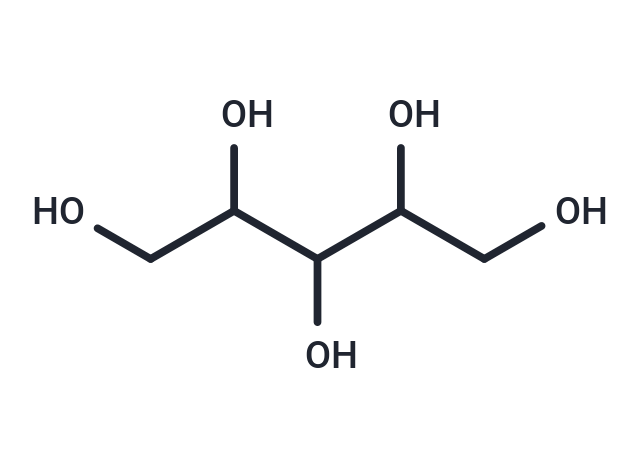
Synonyms: Adonitol, Adonite
| Pack Size | Price | USA Stock | Global Stock | Quantity |
|---|---|---|---|---|
| 1 g | $29 | In Stock | In Stock |
| Description | Ribitol is a pentitol that can be formed by ribose reduction. Enhancement of the D-glucose to pentose phosphate pathway in Saccharomyces cerevisiae can be used to produce ribitol and D-ribose. |
| In vitro | Ribitol is a crystalline pentose alcohol. [1] Ribitol is characterized from the plant Adonis vernalis. [2] Ribitol in 10% NFSM suspending medium exerts 1.45 to 2.18 times the protective effect exerted by glycerol at equal concentration. The cryoprotective action of Ribitol reaches its highest level at 0.75 M. For 11 of the 13 organisms tested including S. lactis T164, the degree of protection conferred by Ribitol is >80%. Ribitol has a strong protective effect on lactic acid bacteria during freeze-drying. [3] |
| Synonyms | Adonitol, Adonite |
| Kinase Assay | The high-performance liquid chromatography (HPLC) analyses are carried out using a Fast Acid Column (100×7.8 mm) and a HPX-87H Ion Exclusion Column (300 mm×7.8 mm) in series with 2.5 mM H2SO4 in water as the mobile phase at a flow rate of 0.3 mL/min, at 55°C. This method enabled quantification of D-glucose, ethanol, glycerol, D-xylulose, Ribitol, and xylitol. D-ribose, D-ribulose, and D-arabitol coeluted on the Aminex HPX-87H column. The CarboPac MA-1 column of Dionex ICS-3000 is used to analyze representative culture supernatant samples for the presence of arabitol and xylitol. Samples are run at column temperature of 30°C with 480 mM NaOH at flow rate 0.4 mL/min. The CarboPac MA-1 column separated D-arabitol from D-ribose and D-ribulose, but the alkaline conditions degraded D-ribulose interfering with the quantification of D-ribose.Yeast cells are disrupted with glass beads in 100 mM sodium phosphate buffer pH 7.0 containing phenylmethylsulfonyl fluoride and pepstatin A in final concentrations of 0.17 mg/mL and 0.01 mg/mL, respectively.The activity of NAD+-dependent Gdh2p is measured in a reaction buffer of 0.5 M triethanol amine pH 7.7 and 2 mM NADH. After addition of the cell lysate, the reaction is started by adding a mixture of α-ketoglutarate (100 mM) and NH4Cl (200 mM) to a final concentration of 2.4 mM and 4.9 mM, respectively. The GapB activity is measured. Shortly, the reaction mixture is 500 mM triethanol amine pH 7.8, 1 mM ATP, 2 mM MgCl2, 200 μM NADPH, and 10 μg/mL of phosphoglycerate kinase. 3-phosphoglycerate is added to a final concentration of 5 mM to start the reaction. Activity measurements are performed with a Cobas Mira Plus automated analyzer[2]. |
| Molecular Weight | 152.15 |
| Formula | C5H12O5 |
| Cas No. | 488-81-3 |
| Smiles | C(C(CO)O)(C(CO)O)O |
| Relative Density. | 1.1497 g/cm3 (Estimated) |
| Storage | Powder: -20°C for 3 years | In solvent: -80°C for 1 year Shipping with blue ice/Shipping at ambient temperature. | |||||||||||||||||||||||||||||||||||
| Solubility Information | H2O: 262.5 mg/mL (1725.27 mM), Sonication is recommended.  | |||||||||||||||||||||||||||||||||||
Solution Preparation Table | ||||||||||||||||||||||||||||||||||||
H2O
Note : The dilution table applies only to solid products. For liquid products, please calculate the stock solution based on the stated concentration and/or density. | ||||||||||||||||||||||||||||||||||||
 For example, if the intended dosage is 10 mg/kg for animals weighing 20 g , with a dosing volume of 100 μL per animal, and a total of 10 animals are to be administered, using a formulation of
  10% DMSO+ 40% PEG300+ 5% Tween 80+ 45% Saline/PBS/ddH2O , the resulting working solution concentration would be 2 mg/mL.
Dissolve 2 mg of the compound in 100 μL DMSO to obtain a stock solution at a concentration of 20 mg/mL . If the required concentration exceeds the compound's known solubility, please contact us for technical support before proceeding.
1) Add 100 μL of the DMSO stock solution to 400 µL PEG300 and mix thoroughly until the solution becomes clear.
2) Add 50 µL Tween 80 and mix well until fully clarified.
3) Add 450 µL Saline,PBS or ddH2O and mix thoroughly until a homogeneous solution is obtained.
| Size | Quantity | Unit Price | Amount | Operation |
|---|
 Feedback
 Hello! How can I help you today?
Copyright © 2015-2026 TargetMol Chemicals Inc. All Rights Reserved.
