


Shopping Cart
Remove All Your shopping cart is currently empty

Synonyms:
| Pack Size | Price | USA Stock | Global Stock | Quantity |
|---|---|---|---|---|
| 25 mg | $2,140 | 6-8 weeks | 6-8 weeks | |
| 50 mg | $2,785 | 6-8 weeks | 6-8 weeks | |
| 100 mg | $3,520 | 6-8 weeks | 6-8 weeks |
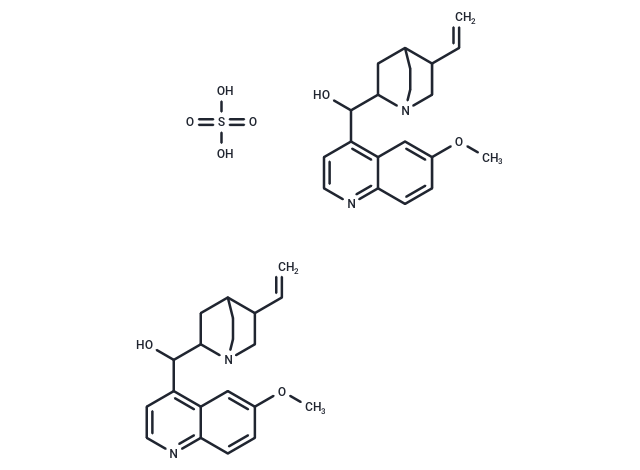
| Description | Quinidine Monosulfate is an antiarrhythmic agent and a potent, orally active, selective cytochrome P450db inhibitor. Additionally, it functions as a K+ channel blocker with an IC50 of 19.9 μM, and can be used for malaria research [1] [2] [3]. |
| In vitro | Quinidine is an anti-arrythmic drug which affects ionic currents in heart muscle and which has also been shown to be a potent blocker of several classes of K + channel in a variety of cell types [1]. Bath application of quinidine causes a dose-dependent reduction of the peak amplitude of I k. The K d for blockade of I k at 0 mV is estimated to be 41 μM [1]. Quinidine elicits a dose-dependent increase of the rate of the decay of I k and this effect is enhanced by membrane depolarization. Quinidine also causes a 5 mV hyperpolarizing shift of the steady-state inactivation curve and increases the half-time for recovery from inactivation. Quinidine does not affect the onset of inactivation measured at -30 mV [1]. |
| In vivo | Quinidine sulfate is rapidly absorbed, with peak plasma concentrations 60-90 min after an oral dose. Other salts (gluconate, polygalacturonate) are more slowly absorbed, with lower peak concentrations [2]. Quinidine is approximately 70-90 % bound to plasma proteins. It undergoes hepatic oxidative metabolism to form an N-oxide, a 3-hydroxy form, an O-demethyl form and 2'-quinidinone. Over one-half of patients starting quinidine stop within the first year of therapy because of side effects. These include, commonly, diarrhea, nausea, and vomiting which are not necessarily related to high plasma concentrations [2]. Quinidine inhibits metabolism of amphetamine in rats. Quinidine pretreatment results in a significant decrease in the excretion of p-hydroxyamphetamine at 24 and 48 h to 7.2 and 24.1% of the vehicle-control levels, respectively, accompanied by a significant increase in amphetamine excretion between 24 and 48 h to 542% of the control [3]. |
| Molecular Weight | 746.92 |
| Formula | C40H50N4O8S |
| Cas No. | 50-54-4 |
| Smiles | OS(O)(=O)=O.COc1ccc2nccc(C(O)C3CC4CCN3CC4C=C)c2c1.COc1ccc2nccc(C(O)C3CC4CCN3CC4C=C)c2c1 |
| Storage | Powder: -20°C for 3 years | In solvent: -80°C for 1 year Shipping with blue ice/Shipping at ambient temperature. |
 For example, if the intended dosage is 10 mg/kg for animals weighing 20 g , with a dosing volume of 100 μL per animal, and a total of 10 animals are to be administered, using a formulation of
  10% DMSO+ 40% PEG300+ 5% Tween 80+ 45% Saline/PBS/ddH2O , the resulting working solution concentration would be 2 mg/mL.
Dissolve 2 mg of the compound in 100 μL DMSO to obtain a stock solution at a concentration of 20 mg/mL . If the required concentration exceeds the compound's known solubility, please contact us for technical support before proceeding.
1) Add 100 μL of the DMSO stock solution to 400 µL PEG300 and mix thoroughly until the solution becomes clear.
2) Add 50 µL Tween 80 and mix well until fully clarified.
3) Add 450 µL Saline,PBS or ddH2O and mix thoroughly until a homogeneous solution is obtained.
| Size | Quantity | Unit Price | Amount | Operation |
|---|
 Feedback
 Hello! How can I help you today?
Copyright © 2015-2026 TargetMol Chemicals Inc. All Rights Reserved.
