


Shopping Cart
Remove All Your shopping cart is currently empty


Synonyms: ACP-103
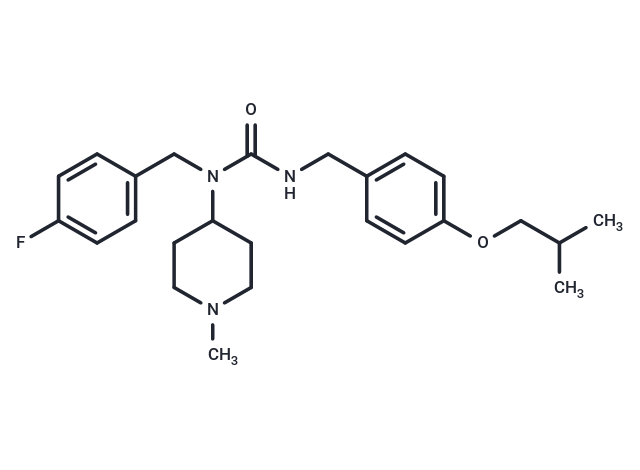
| Pack Size | Price | USA Stock | Global Stock | Quantity |
|---|---|---|---|---|
| 25 mg | $44 | In Stock | In Stock | |
| 50 mg | $68 | In Stock | In Stock | |
| 100 mg | $108 | In Stock | In Stock | |
| 1 mL x 10 mM (in DMSO) | $29 | In Stock | In Stock |
| Description | Pimavanserin (ACP-103)(ACP-103) is an effective and specific 5-HT2A receptor inverse agonist (mean pIC50: 8.7, in the cell-based functional assay). Pimavanserin is an atypical antipsychotic used in the treatment of hallucinations and psychosis in patients with Parkinson disease. |
| Targets & IC50 | 5-HT2A:8.7(pIC50) |
| In vitro | Pimavanserin (ACP-103) competitively antagonizes the binding of [3H]ketanserin to human 5-HT2A receptors, with mean pKi values of 9.3 in membranes and 9.70 in whole cells. It shows lesser affinity (mean pKi of 8.80 in membranes and 8.00 in whole cells) and potency as an inverse agonist (mean pIC50 7.1 in R-SAT) at 5-HT2C receptors, and lacks affinity and functional activity at 5-HT2B receptors, dopamine D2 receptors, and other human monoaminergic receptors[1]. Pimavanserin (ACP-103) is highly selective for 5-HT2A receptors, displaying affinity predominantly for 5-HT2C receptors and maintaining approximately 30-fold selectivity for 5-HT2A over 5-HT2C receptors, depending on the assay[2]. |
| In vivo | Pimavanserin (ACP-103) is a potent and effective orally active 5-HT2A receptor inverse agonist, with a pharmacological profile indicating its potential as an antipsychotic. It mitigates head-twitch behavior (3 mg/kg p.o.) and prepulse inhibition deficits (1-10 mg/kg s.c.) induced by the 5-HT2A receptor agonist (±)-2,5-dimethoxy-4-iodoamphetamine hydrochloride in rats and reduces hyperactivity in mice caused by N-methyl-D-aspartate receptor antagonism via 5H-dibenzo[a,d]cyclohepten-5,10-imine (MK-801) at dosages of 0.1 and 0.3 mg/kg s.c. and 3 mg/kg p.o., corroborating its in vivo mechanism of action through the 5-HT2A receptor and demonstrating antipsychotic-like effectiveness. Pimavanserin also exhibits oral bioavailability exceeding 42.6% in rats[1]. |
| Synonyms | ACP-103 |
| Kinase Assay | For the membrane binding, NIH-3T3 cells are grown to 70% confluence in 15 cm2 dishes and transfected with 10 μg of receptor plasmid DNA using Polyfect transfection reagent. Two days after transfection, cells expressing the desired serotonin receptor are homogenized in 20 mM HEPES/10 mM EDTA and spun down at 11,000 g at 4°C for 30 min. The supernatant is discarded, and the pellet is resuspended in 20 mM HEPES/1 mM EDTA and spun down at the same setting. The pellet is then resuspended in 20 mM HEPES/0.5 mM EDTA, and membranes are used for binding assays. Bradford analysis is used to determine total membrane protein. Kd and Bmax values are derived from 12-point concentration experiments using 1 nM [3H]ketanserin for the 5-HT2A receptor and 3 nM [3H]mesulergine for the 5-HT2B and 5-HT2C receptors. Membranes are incubated at room temperature for 3 h with various concentrations of test ligand in the presence of a fixed concentration of radioligand. The suspension is filtered as explained below for whole-cell binding, washed with ice-cold buffer, and dried, and radioactivity is determined using TopCount[1]. |
| Cell Research | Pimavanserin (ACP-103) is dissolved in DMSO and stored, and then diluted with appropriate media before use[1]. For the whole-cell binding, 6 million human embryonic kidney 293T cells are plated in 10-cm dishes and transfected with 5 μg of plasmid DNA using Polyfect. Two days after transfection, cells are harvested with 10 mM EDTA, washed, and resuspended in binding buffer (1× DMEM with 0.1% bovine serum albumin). Then, 60,000 cells transfected with the 5-HT2A receptor or 20,000 cells transfected with the 5-HT2C-INI receptor are incubated at 37°C for 3 h in the presence of 5 nM radioligand ([3H]ketanserin for 5-HT2A receptors and [3H]mesulergine for 5-HT2C-INI receptors) and varying concentrations of ligands (total volume 100 μL in a 96-well plate). Cells are filtered onto a 96-well GF/B filter plate and washed with 300 mL of wash buffer (25 mM HEPES, 1 mM CaCl2, 5 mM MgCl2, and 0.25 M NaCl) using a Filtermate 196 harvester. The filter plates are dried under a heat lamp before addition of 50 μL of scintillation fluid to each well. Plates are counted on a TopCount. Separately, the hydrochloride salt form of Pimavanserin (10 μM) is evaluated at MDS Pharma Services for activity in a broad screen of radioligand binding assays at 65 different receptors[1]. |
| Molecular Weight | 427.55 |
| Formula | C25H34FN3O2 |
| Cas No. | 706779-91-1 |
| Smiles | N(CC1=CC=C(F)C=C1)(C(NCC2=CC=C(OCC(C)C)C=C2)=O)C3CCN(C)CC3 |
| Relative Density. | 1.15±0.1 g/cm3 (calc.) |
| Storage | Keep away from moisture,Keep away from direct sunlight Powder: -20°C for 3 years | In solvent: -80°C for 1 year Shipping with blue ice/Shipping at ambient temperature. | |||||||||||||||||||||||||||||||||||
| Solubility Information | DMSO: 85.83 mg/mL (200.75 mM), Sonication is recommended.  | |||||||||||||||||||||||||||||||||||
| In Vivo Formulation | 10% DMSO+40% PEG300+5% Tween 80+45% Saline: 2 mg/mL (4.68 mM), Sonication is recommended. Please add the solvents sequentially, clarifying the solution as much as possible before adding the next one. Dissolve by heating and/or sonication if necessary. Working solution is recommended to be prepared and used immediately. The formulation provided above is for reference purposes only. In vivo formulations may vary and should be modified based on specific experimental conditions. | |||||||||||||||||||||||||||||||||||
Solution Preparation Table | ||||||||||||||||||||||||||||||||||||
DMSO
Note : The dilution table applies only to solid products. For liquid products, please calculate the stock solution based on the stated concentration and/or density. | ||||||||||||||||||||||||||||||||||||
 For example, if the intended dosage is 10 mg/kg for animals weighing 20 g , with a dosing volume of 100 μL per animal, and a total of 10 animals are to be administered, using a formulation of
  10% DMSO+ 40% PEG300+ 5% Tween 80+ 45% Saline/PBS/ddH2O , the resulting working solution concentration would be 2 mg/mL.
Dissolve 2 mg of the compound in 100 μL DMSO to obtain a stock solution at a concentration of 20 mg/mL . If the required concentration exceeds the compound's known solubility, please contact us for technical support before proceeding.
1) Add 100 μL of the DMSO stock solution to 400 µL PEG300 and mix thoroughly until the solution becomes clear.
2) Add 50 µL Tween 80 and mix well until fully clarified.
3) Add 450 µL Saline,PBS or ddH2O and mix thoroughly until a homogeneous solution is obtained.
| Size | Quantity | Unit Price | Amount | Operation |
|---|
 Feedback
 Hello! How can I help you today?
Copyright © 2015-2026 TargetMol Chemicals Inc. All Rights Reserved.
