


Shopping Cart
Remove All Your shopping cart is currently empty


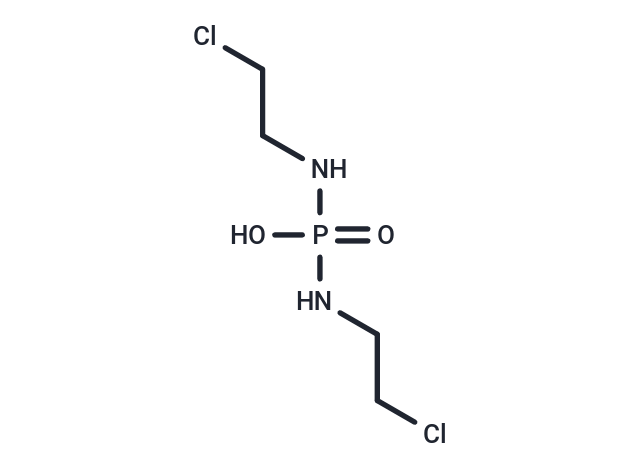
Synonyms: ZIO-201, Isophosphoramide mustard, Isophosphamide mustard
| Pack Size | Price | USA Stock | Global Stock | Quantity |
|---|---|---|---|---|
| 1 mg | $70 | In Stock | In Stock | |
| 2 mg | $98 | In Stock | In Stock | |
| 5 mg | $172 | In Stock | In Stock | |
| 10 mg | $289 | In Stock | In Stock | |
| 25 mg | $452 | In Stock | In Stock | |
| 50 mg | $596 | In Stock | In Stock | |
| 100 mg | $863 | In Stock | In Stock |
| Description | Palifosfamide (Isophosphamide mustard) lysine (ZIO-201) is a stable form of palifosfamide. Palifosfamide lysine has broad activity in sarcoma lines in vitro. The IC50 ranges from 2.25 to 6.75 μM for most cell lines except OS222 (IC50=31.5 μM). |
| Targets & IC50 | OS222:31.5 μM |
| In vitro | Differential gene expression of ALDH3A1 but not ALDH1A1 is noted in the OS31 xenograft. Stabilized palifosfamide administered to mice suppresses MX-1 tumor growth by greater than 80% with 17% complete antitumor responses. Oral bioavailability in rats is 48-73% of parenteral administration, and antitumor activity in mice is equivalent by both routes. Treatment with palifosfamide-tris combined with docetaxelor doxorubicin at optimal regimens results in complete tumor regression in 62-75% of mice. |
| Synonyms | ZIO-201, Isophosphoramide mustard, Isophosphamide mustard |
| Cell Research | Palifosfamide is dissolved in phosphate buffered saline (PBS). Cells are plated in 96-well microtiter plates with approximately 500 cells per well in 100 μL of media. After 24 h of incubation at 37°C, cells are treated with increasing concentrations of palifosfamide lysine in separate plates either as a single-day treatment or three consecutive days of treatment, with fresh drug being added each day. The plates are incubated for 72 h at 37°C with 5% CO2. After 72 h, 250 μg of MTT is added to each well and incubated at 37°C for 6 h. MTT is converted to formazine crystals by mitochondria of viable cells, which are then dissolved in 100 μL of dimethyl sulfoxide. Optical density is measured at 595 nm. |
| Animal Research | Mouse: CB17 female SCID mice are used in the study. Once the tumors reached 50–150 mm3, mice are randomized into control and treatment groups (5-8 mice/group) for each tumor line. Cyclophosphamide is administered at the dose of 150 mg/kg intraperitoneally once a week for 6 weeks. Palifosfamide lysine is administered intravenously at the maximum tolerated dose of 100 mg/kg for three consecutive days as a one-time treatment and serial tumor volumes are determined over the next 6 weeks. Mice are sacrificed at the end of the experiment. |
| Molecular Weight | 221.02 |
| Formula | C4H11Cl2N2O2P |
| Cas No. | 31645-39-3 |
| Smiles | P(NCCCl)(NCCCl)(=O)O |
| Relative Density. | 1.411 |
| Storage | Pure form: -20°C for 3 years | In solvent: -80°C for 1 year Shipping with blue ice/Shipping at ambient temperature. |
| Solubility Information | DMSO: < 1 mg/mL (insoluble or slightly soluble)  |
 For example, if the intended dosage is 10 mg/kg for animals weighing 20 g , with a dosing volume of 100 μL per animal, and a total of 10 animals are to be administered, using a formulation of
  10% DMSO+ 40% PEG300+ 5% Tween 80+ 45% Saline/PBS/ddH2O , the resulting working solution concentration would be 2 mg/mL.
Dissolve 2 mg of the compound in 100 μL DMSO to obtain a stock solution at a concentration of 20 mg/mL . If the required concentration exceeds the compound's known solubility, please contact us for technical support before proceeding.
1) Add 100 μL of the DMSO stock solution to 400 µL PEG300 and mix thoroughly until the solution becomes clear.
2) Add 50 µL Tween 80 and mix well until fully clarified.
3) Add 450 µL Saline,PBS or ddH2O and mix thoroughly until a homogeneous solution is obtained.
| Size | Quantity | Unit Price | Amount | Operation |
|---|
 Feedback
 Hello! How can I help you today?
Copyright © 2015-2026 TargetMol Chemicals Inc. All Rights Reserved.
