


Shopping Cart
Remove All Your shopping cart is currently empty

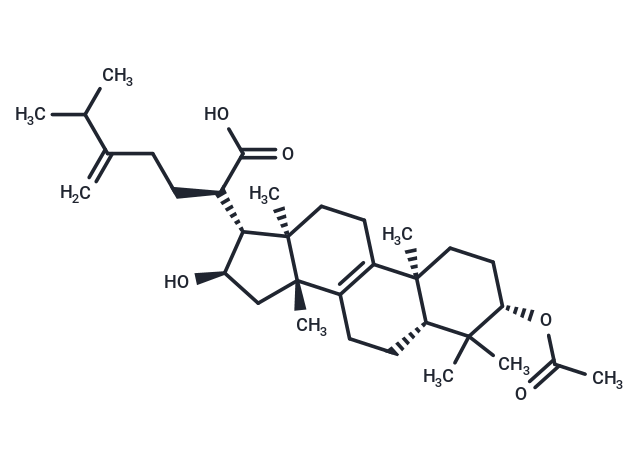
Synonyms: 3-O-Acetyltumulosic acid
| Pack Size | Price | USA Stock | Global Stock | Quantity |
|---|---|---|---|---|
| 1 mg | $31 | In Stock | In Stock | |
| 2 mg | $48 | In Stock | In Stock | |
| 5 mg | $93 | In Stock | In Stock | |
| 10 mg | $156 | In Stock | In Stock | |
| 25 mg | $289 | In Stock | In Stock | |
| 50 mg | $469 | In Stock | In Stock | |
| 100 mg | $676 | - | In Stock | |
| 200 mg | $943 | - | In Stock |
| Description | Pachymic acid (3-O-Acetyltumulosic acid) is a natural product, and inhibits Akt and ERK signaling pathways. |
| In vitro | Porinic acid (PA) exerted antitumor effects on NCI-H23 and NCI-H460 lung cancer cells in vitro, while inducing cellular G2/M phase arrest and apoptosis. Our data showed that PA induced reactive oxygen species (ROS) production, leading to activation of c-Jun N-terminal kinase (JNK) and endoplasmic reticulum (ER) stress apoptotic pathways in lung cancer cells. Furthermore, blocking ROS production reversed PA-induced JNK and ER stress activation. Finally, PA inhibited the growth of NCI-H23 xenograft tumors without causing any toxicity to the host, and suppressed cell proliferation and induced apoptosis in tumor xenograft tissues [1]. At the same time, PA induced cell cycle arrest at G0 phase.PA also significantly inhibited cancer cell migration and invasion in a dose-dependent manner. Interestingly, PA inhibited the adhesion ability of cancer cells in a dose-dependent manner, which may contribute to the inhibition of cell invasion. Finally, it was shown that PA inhibited AKT and ERK signaling pathways. And tumor proteins such as PCNA, ICAM-1 and RhoA, which are involved in tumorigenesis, were also down-regulated by PA [1]. |
| Synonyms | 3-O-Acetyltumulosic acid |
| Cell Research | The anti-proliferative ability of PA on lung cancer cells was assessed by MTT, colony formation and EdU proliferation assays; cell cycle changes were detected by flow cytometry; apoptosis was detected by annexin V/PI double staining and DNA laddering; and the expression of apoptosis-related proteins was analyzed by Western blotting [1]. |
| Molecular Weight | 528.76 |
| Formula | C33H52O5 |
| Cas No. | 29070-92-6 |
| Smiles | CC(C)C(=C)CC[C@H]([C@H]1[C@H](O)C[C@@]2(C)C3=C(CC[C@]12C)[C@@]1(C)CC[C@H](OC(C)=O)C(C)(C)[C@@H]1CC3)C(O)=O |
| Relative Density. | 1.10 g/cm3 (Predicted) |
| Storage | Keep away from direct sunlight,Store at low temperature Powder: -20°C for 3 years | In solvent: -80°C for 1 year Shipping with blue ice/Shipping at ambient temperature. | ||||||||||||||||||||
| Solubility Information | DMSO: 9.52 mg/mL (18 mM), Sonication is recommended.  | ||||||||||||||||||||
Solution Preparation Table | |||||||||||||||||||||
DMSO
Note : The dilution table applies only to solid products. For liquid products, please calculate the stock solution based on the stated concentration and/or density. | |||||||||||||||||||||
 For example, if the intended dosage is 10 mg/kg for animals weighing 20 g , with a dosing volume of 100 μL per animal, and a total of 10 animals are to be administered, using a formulation of
  10% DMSO+ 40% PEG300+ 5% Tween 80+ 45% Saline/PBS/ddH2O , the resulting working solution concentration would be 2 mg/mL.
Dissolve 2 mg of the compound in 100 μL DMSO to obtain a stock solution at a concentration of 20 mg/mL . If the required concentration exceeds the compound's known solubility, please contact us for technical support before proceeding.
1) Add 100 μL of the DMSO stock solution to 400 µL PEG300 and mix thoroughly until the solution becomes clear.
2) Add 50 µL Tween 80 and mix well until fully clarified.
3) Add 450 µL Saline,PBS or ddH2O and mix thoroughly until a homogeneous solution is obtained.
| Size | Quantity | Unit Price | Amount | Operation |
|---|
 Feedback
 Hello! How can I help you today?
Copyright © 2015-2026 TargetMol Chemicals Inc. All Rights Reserved.
